Many UK adults Google "do I need to use the UK government to change my name" - and the short answer is no, you don't. You can legally change your name in England, Wales, Scotland, or Northern Ireland without involving the government, gov.uk, or any court. This 2026 guide explains exactly why, what the government does (and does not) provide, and when - if ever - you'd want to use the official enrolment route over a private deed poll service.
The Short Answer: No, You Don't Need the UK Government
Under English common law (which also applies in Wales and Northern Ireland; Scotland has its own parallel rules with the same effect), your name changes the moment you sign a properly executed deed poll. You do not need to:
- Apply to any government department
- Pay a government fee
- Wait for government approval
- Register the change anywhere
- Notify Parliament, the courts, or any official body
This has been true for centuries. The UK government does not "approve" name changes - it simply recognises them once you've executed the deed poll. The signing is the legal act; everything else is just paperwork to update records that mention your old name.
What the UK Government Actually Provides
The government, via gov.uk, offers two name-change-related services. Both are optional:
1. The Optional Enrolment Service (£53.05)
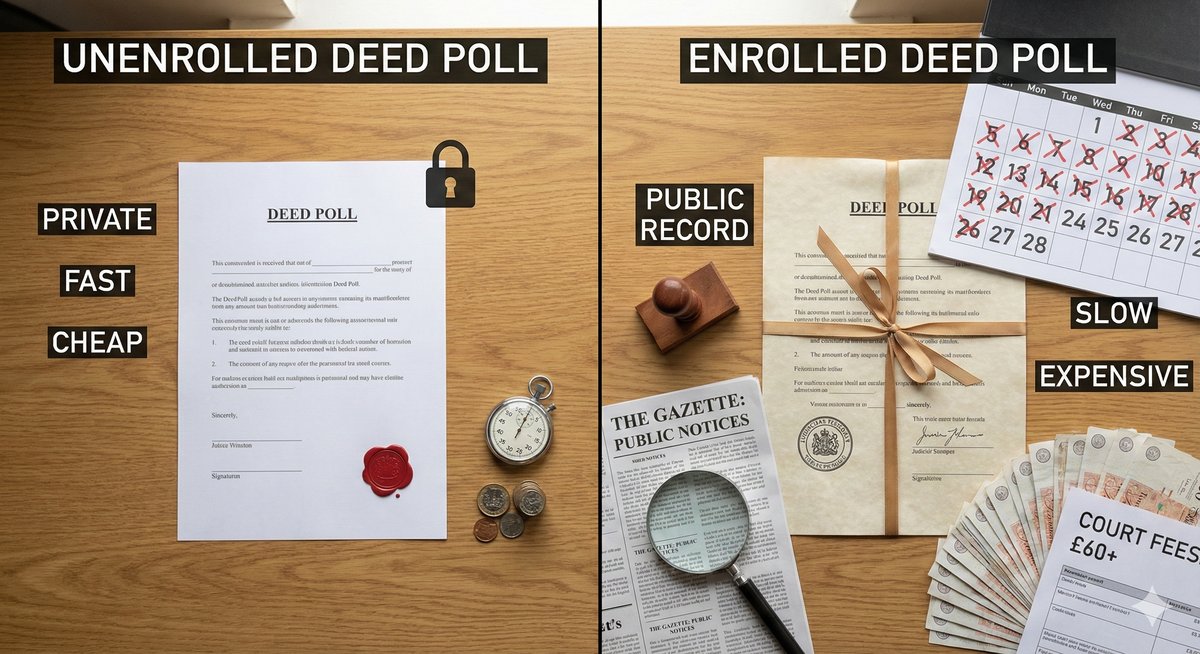
You can pay the Royal Courts of Justice £53.05 to register your name change in the public record. Your name change is then published in the London Gazette and stored on a central register. Processing takes 2-3 weeks. This is the only thing gov.uk "issues" related to deed polls.
Importantly: enrolment does not make your name change "more legal." An unenrolled deed poll has identical legal effect. Enrolment just adds a public record that the change happened.
2. A Free DIY Template (LOC020)
Gov.uk publishes a free downloadable template called LOC020 (also known as Form LOC020 06.23 in its current revision). You can download it, fill in your old and new names, print it, sign in front of two witnesses, and the result is a legally valid unenrolled deed poll.
That's everything the government provides. They do not have an "official deed poll database." They do not "register" individual unenrolled deed polls. They do not approve specific name changes.
Why So Many People Get Confused
The confusion comes from how gov.uk presents the information. Their "Change your name by deed poll" page is the top Google result for many name-change queries, and the page prominently mentions the official enrolment service and the LOC020 form. Naturally, people reading it assume "if it's on gov.uk, I must need to go through them."
The page does mention that you can use a private deed poll service - but it's less visible. The result: thousands of UK adults pay either £53.05 in court fees for unnecessary enrolment, or struggle through the DIY route, when neither is required.
The Two Routes That Actually Work
Route 1: Unenrolled Deed Poll (98%+ of UK name changes)
A deed poll signed by you and witnessed by two independent adults (not a relative, partner, or anyone living at the same address). No government involvement at any stage. Cost: free if you use the LOC020 template yourself, or about £14.49 if you use a private service like UK Name Change that prints and posts a professional document.
Accepted by every major UK organisation, including:
- HM Passport Office (HMPO) - confirmed in their official guidance
- DVLA (driving licences are updated free of charge)
- HMRC and your National Insurance record
- All UK banks (Barclays, HSBC, Lloyds, NatWest, Nationwide, Monzo, Starling, and others)
- The NHS - for medical records, GP, dentist
- Schools, colleges, universities
- DWP and Universal Credit
- Employers and HR systems
- Insurance companies, mortgage providers, utility companies
Route 2: Enrolled Deed Poll (under 2% of UK name changes)
Identical legal effect to an unenrolled deed poll, plus the additional step of registering with the Royal Courts of Justice and publication in the London Gazette. Cost: £53.05 court fee plus the cost of preparing the deed poll itself. Processing: 2-3 weeks for the enrolment registration to complete.
When Would You Actually Want Government Enrolment?
For 95%+ of people changing their name, enrolment offers no practical benefit. The narrow situations where it genuinely helps:
- You expect future disputes about your name change. A public register entry is harder to challenge years later than a single original document.
- You need the change recognised in foreign jurisdictions that don't accept unenrolled deed polls (rare - most countries accept either type, sometimes with apostille certification).
- You're a public figure or hold a regulated profession where a published name change record provides clarity for the public or regulators.
If none of these apply to you, you don't need enrolment, and you don't need gov.uk.
What HMPO, DVLA, and Banks Actually Accept
The persistent myth that "official" name changes need government approval is contradicted by every major UK organisation's own published policies:
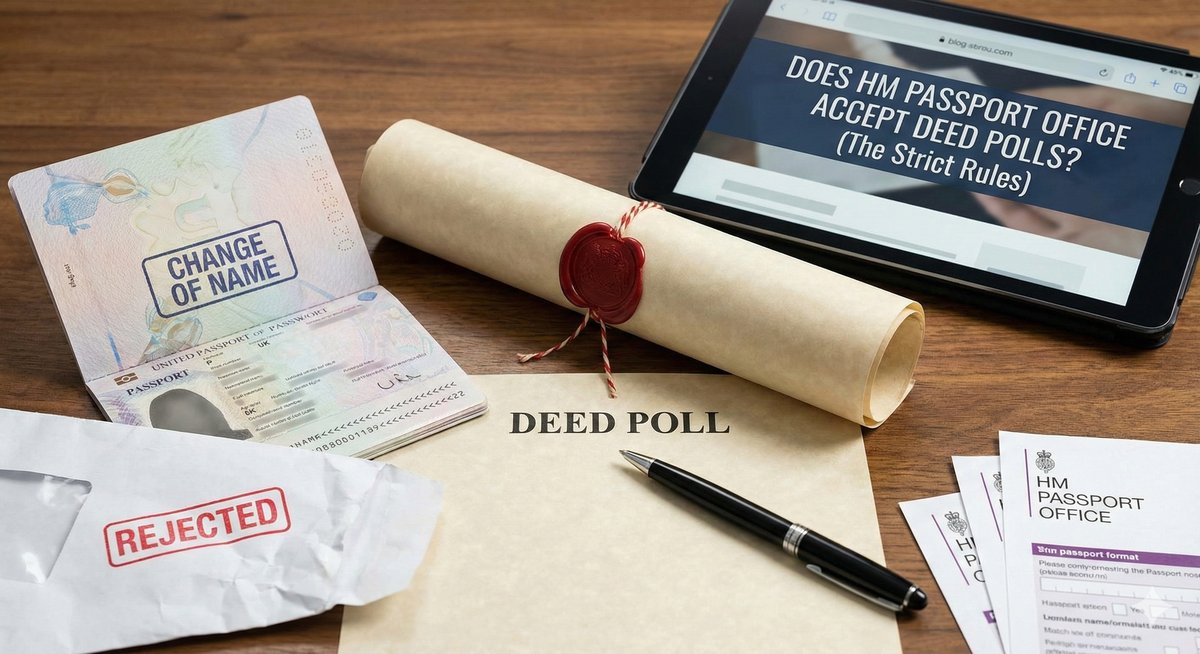
- HM Passport Office: Their published guidance confirms that unenrolled deed polls are accepted for passport renewals. No enrolment, no government registration required.
- DVLA: Accepts unenrolled deed polls for driving licence name updates. The update itself is free; you just pay if you also want a new photo.
- HMRC: Accepts unenrolled deed polls for personal tax records, PAYE, and National Insurance. You can update online via your Personal Tax Account.
- All major UK banks: Every high-street bank's official policy is to accept the original wet-ink signed unenrolled deed poll. Some require you to present it at a branch; others let you post it to head office.
- NHS: Your GP can update your medical records with an unenrolled deed poll. There's no separate "NHS name change" process.
Comparison: Gov.uk DIY vs Private Deed Poll Service
Both routes produce legally identical documents. The differences are practical, not legal:
- Cost: Gov.uk DIY (LOC020) is free to download; private service is around £14.49.
- Time to receive: DIY = whenever you print it; private service = same-day dispatch with next-day Royal Mail Tracked delivery.
- Print quality: DIY depends on your printer; private services use premium paper professionally bound.
- Format: DIY produces plain A4 sheets; private services use certificate-style formatting that banks and HMPO recognise immediately.
- Signing instructions: DIY gives you generic notes; private services include detailed step-by-step guidance.
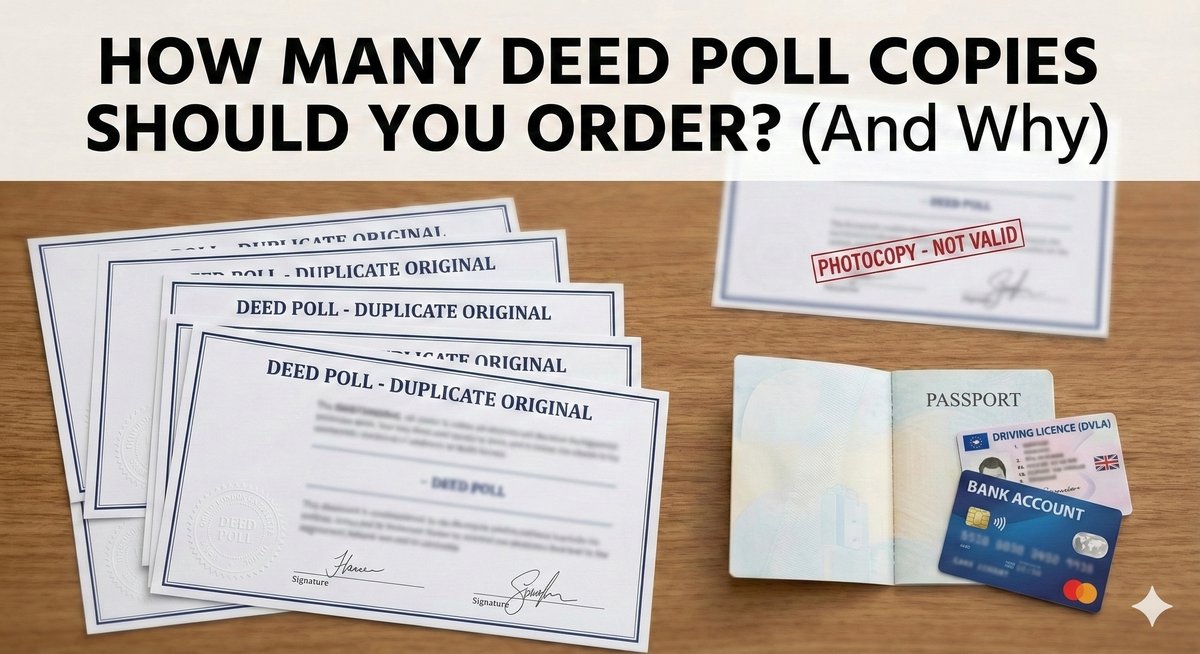
- Extra copies: DIY = print as many as you want (each costs ink and paper); private services let you order additional originals at once.
- Support: DIY = no support; private services usually answer questions by email.
- Legal validity: Identical. Both produce legally valid documents.
The legal effect of both is exactly the same. The difference is whether you want to handle the printing, formatting, and presentation yourself.
Common Mistakes When Going the DIY Route
The free LOC020 template works, but the most common reasons people switch to a paid service after attempting DIY are:
- The printed document looks unprofessional and some bank branches query it
- Missing a required field on the form (it's not always obvious where signatures go)
- Signing without a properly independent witness (using a family member or partner invalidates it)
- Using a typed or electronic signature instead of wet ink (always rejected by HMPO and banks)
- Printing only one copy and discovering they need multiple originals for simultaneous record updates
- Getting confused by the formal legal language and dating conventions
None of these are problems with the DIY route in principle - they're just easy mistakes when you're doing it for the first time without guidance.
Frequently Asked Questions
Do I need to use the UK government to change my name?
No. There is no UK government application, approval or register for changing your name. Under common law your name changes the moment you sign a correctly worded deed poll in front of two independent adult witnesses. Government bodies — HM Passport Office, the DVLA, HMRC — are users of your deed poll, not issuers of it. The only optional government service is enrolling the deed at the Royal Courts of Justice (£53.05), which about 98% of people skip because it adds no legal validity.
Is there an official UK deed poll office?
No single official ‘deed poll office’ exists — websites using that name are private companies, not government bodies. The closest thing is the Royal Courts of Justice in London, which offers the optional £53.05 enrolment service. You do not need any office’s permission: a correctly drafted, signed and witnessed deed poll is legally complete on its own and accepted by every UK organisation.
Is a private deed poll service legitimate?
Yes. Private deed poll services prepare the exact same legal document the government's LOC020 template provides. The deed poll itself is the legally operative document - not who printed it. Provided the document is signed and witnessed correctly, its legal effect is identical regardless of who produced it.
Does the UK government keep a record of name changes?
Only for enrolled deed polls (the Royal Courts of Justice register, published in the London Gazette). Unenrolled deed polls - which are the vast majority of UK name changes - are not registered anywhere centrally. Your deed poll itself is the legal record.
Can the government refuse my name change?
For an unenrolled deed poll, there is no government approval process at all - so there is nothing to refuse. You change your name; organisations recognise it. The only legal restrictions are general (you cannot impersonate someone, commit fraud, or use a name designed to mislead) - and these apply regardless of which route you use.
What if a bank or organisation says they "need a government-issued name change"?
This is a common misunderstanding by frontline staff. No "government-issued name change certificate" exists for unenrolled deed polls in the UK. Every major UK bank's official policy is to accept an unenrolled deed poll. If a branch refuses, escalate to head office - they will confirm the policy and complete the update.
Is gov.uk's LOC020 actually free?
Yes, the form itself is free to download. You will still need to print it on paper, sign in front of two independent witnesses, and produce extra copies yourself if you need them - so the real cost is the printer ink, paper, and your time. Many people who attempt DIY end up spending £5-£10 in printing costs and several hours formatting, only to switch to a paid service for additional copies.
How quickly can I change my name without using gov.uk?
Using a private service: place the order online in around 4 minutes, receive the printed deed poll the next working day via Royal Mail Tracked (same-day dispatch if ordered before 3 PM). Sign it in front of two independent witnesses when it arrives, and you are legally renamed the moment you sign. Total elapsed time can be under 48 hours.
Why doesn't gov.uk just say all of this clearly?
Gov.uk's role is to publish what's available through government channels. Its name change page mentions private services briefly but focuses on what the government itself provides (the enrolment service and the LOC020 template). This is consistent with how gov.uk handles every consumer service - it explains the official options, not the full private market.
Ready to Change Your Name?
If you don't need gov.uk's enrolment service (and most people don't), a professionally printed UK deed poll from UK Name Change costs £14.49 with same-day dispatch and FREE Royal Mail Tracked delivery. The document is legally identical to anything produced via gov.uk's LOC020 template, but formatted in a way that banks and HMPO recognise instantly - saving you the extra phone calls and branch visits that DIY documents sometimes require.
If you have decided to use the government’s free template specifically, our step-by-step LOC020 form guide walks through completing and signing it correctly so it is legally valid.