Enrolled vs. Unenrolled Deed Poll: Which Do You Really Need?
If you are looking to change your name, you have likely hit a fork in the road. One path says "Enrolled Deed Poll" and the other says "Unenrolled Deed Poll."
The terminology is confusing. "Enrolled" sounds more official, safe, and legal. "Unenrolled" sounds unofficial—perhaps even risky.
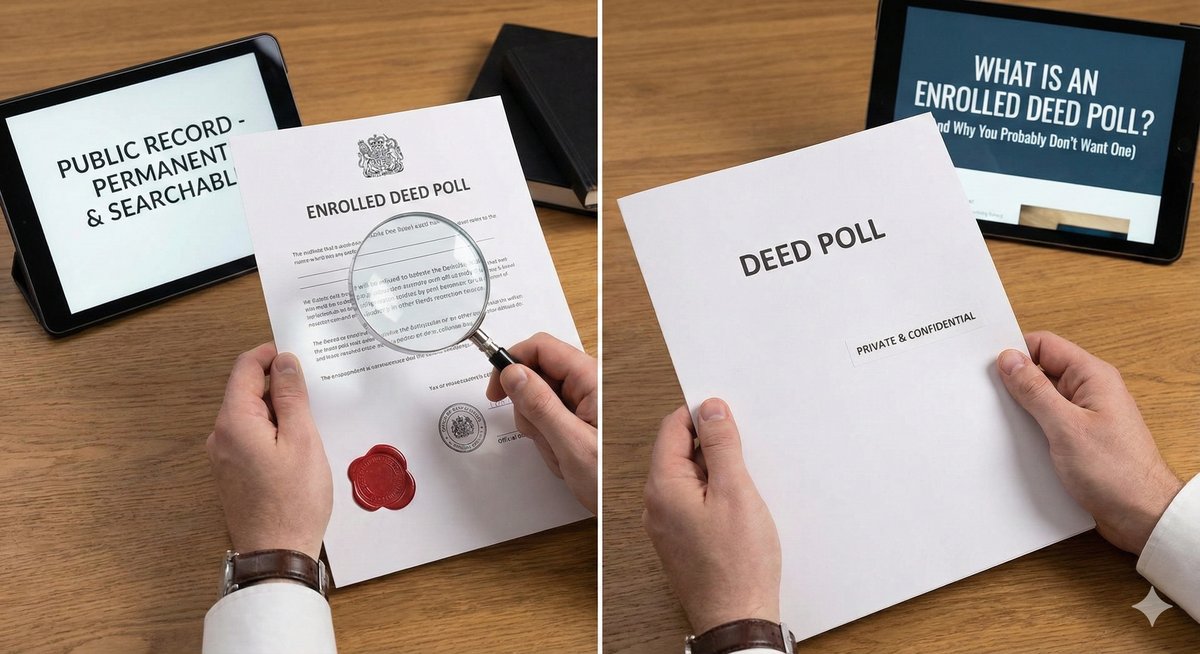
The reality is the exact opposite. For 99% of people, an Enrolled Deed Poll is an expensive, slow privacy nightmare that you should avoid.
Here is the side-by-side comparison to help you choose the right one.
At a Glance: The Comparison
Before we dive into the details, here is the quick difference:
| Feature | Unenrolled (Standard) | Enrolled (Court Registered) |
|---|---|---|
| Legal Validity | ✅ 100% Legal | ✅ 100% Legal |
| Acceptance | ✅ Accepted by Passport Office, DVLA, Banks | ✅ Accepted by everyone |
| Privacy | 🔒 Private (No public record) | 📢 Public (Address published online) |
| Cost | 💰 Cheap (~£19) | 💸 Expensive (£60+ Court Fees) |
| Speed | 🚀 Fast (24-48 Hours) | 🐢 Slow (Weeks/Months) |
Option 1: The Unenrolled Deed Poll (The Smart Choice)
What is it?
An Unenrolled Deed Poll is a legal contract that you sign in the presence of a witness (like a friend or colleague). It serves as legal proof that you have changed your name.
Why choose it?
- Privacy: Your name change remains private between you and the companies you tell. Your address is never published on the internet.
- Speed: You can have the document in your hand tomorrow.
- Simplicity: No solicitors required. Just sign and go.
Who is it for?
Almost everyone. If you are an adult changing your name for any reason (marriage, divorce, gender transition, or just personal preference), this is the document you need.
Option 2: The Enrolled Deed Poll (The "Public" Choice)
What is it?
An Enrolled Deed Poll is a name change that is formally registered with the Royal Courts of Justice in London. It becomes a matter of public record.
The Hidden Danger:
When you enroll a deed, the law requires a notice to be placed in The London Gazette. This notice publishes your old name, new name, and full home address. This information is then permanently searchable on Google.
Why choose it?
You should usually only choose this if you have no other choice. It is typically reserved for:
- Complex Child Cases: Where a court order requires it.
- Strict Professional Bodies: If you are a high-level medical or legal professional whose regulatory body demands it.
The Verdict: Which Do You Need?
Unless you have been specifically told by a Judge or a professional regulator that you must enroll your deed, do not do it.
You do not need to expose your home address to the internet just to get a new passport. Stick to the Unenrolled Deed Poll—it is cheaper, safer, and faster.