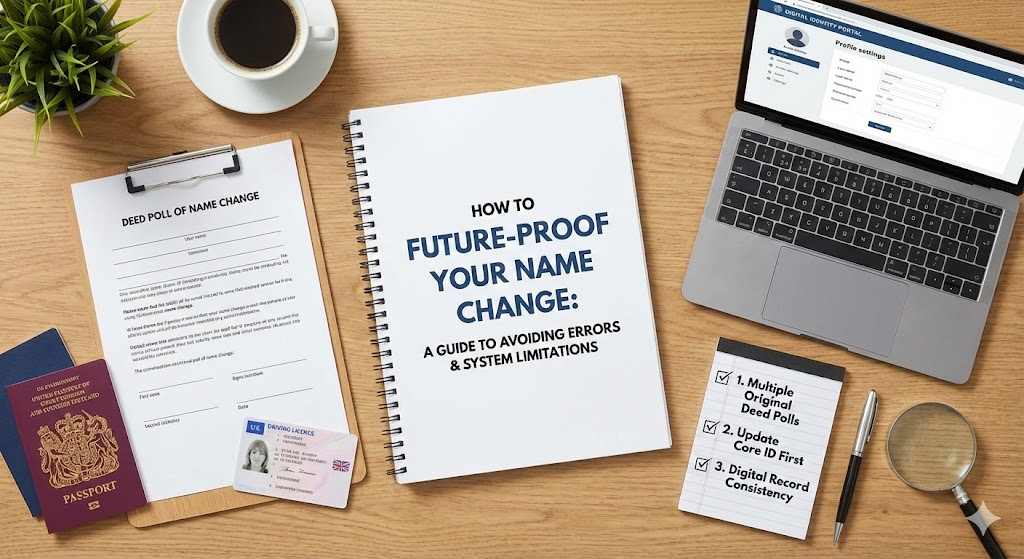
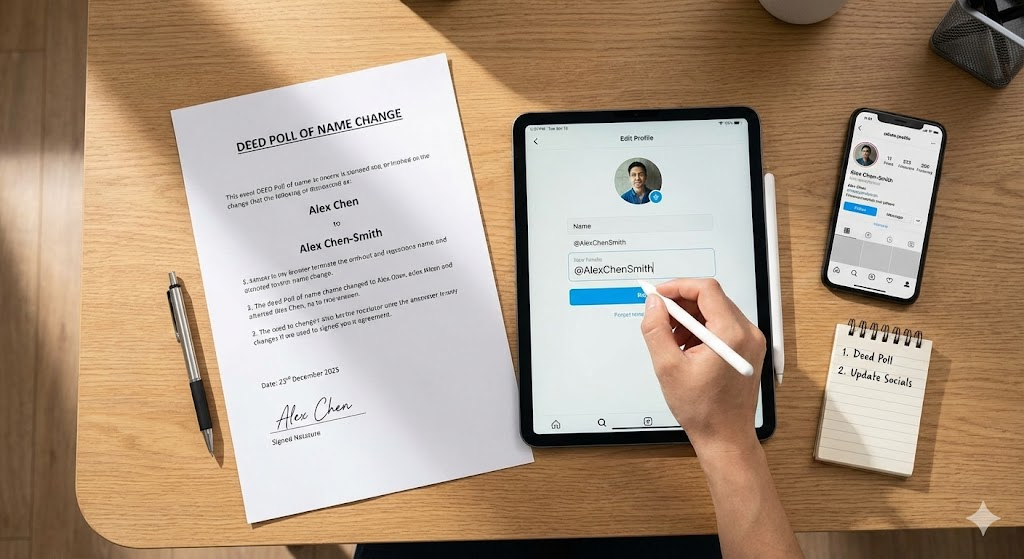
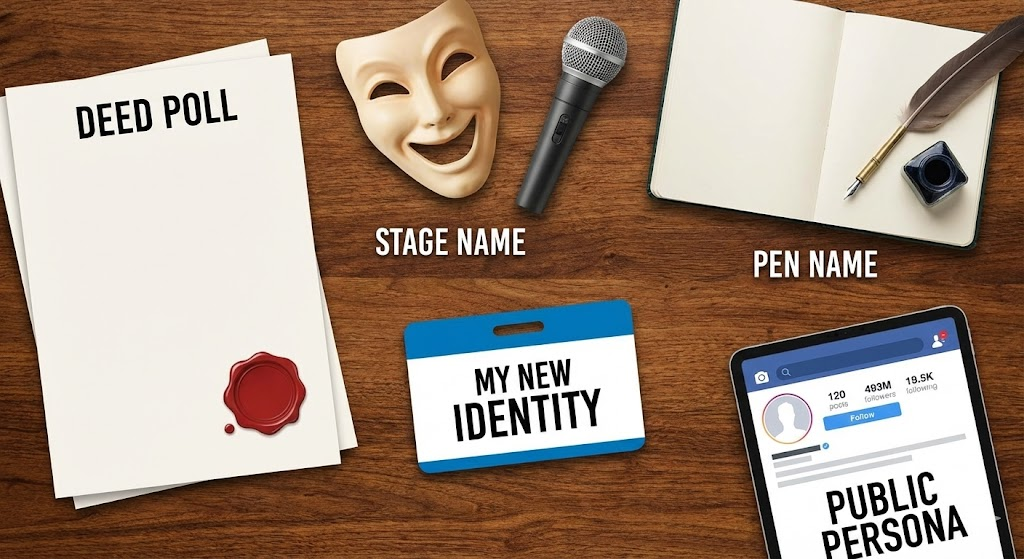
If the name you go by at work is different from the name on your passport, payslip or right-to-work documents, the cleanest fix in the UK is a deed poll: a single unenrolled deed poll legally changes your name everywhere, so your professional identity and your legal identity finally match across HR, payroll, HMRC, your bank and your passport. It costs from £14.49, takes minutes to sign, and is accepted by every employer and government department. You do not have to live with two names, and you do not need a solicitor to put it right.
What “professional name” actually means - and why mismatches happen
Your professional name is simply the name you are known by at work: on your email signature, your LinkedIn profile, your business cards, your contract of employment and the salary that lands in your bank account. Your legal name is the name on your passport, driving licence, HMRC records and bank accounts. For most people these are identical and never cause a moment’s thought. The friction starts when they drift apart.
This usually happens in one of a few ways. You married or formed a civil partnership and started using a new surname at work before (or instead of) changing it legally. You divorced and reverted to your former name socially but never updated your records. You shortened or anglicised a name that colleagues struggled with, and it quietly became “your name” at the office. Or you simply prefer a different forename to the one your parents chose, and everyone at work knows you by it.
None of these is a problem in itself - using any name you like at work is perfectly lawful, as long as there’s no intent to deceive. The problem is the gap between the two, because UK employers and institutions increasingly cross-check the name you use against the name on your official documents.
Why a name mismatch causes real friction at work
A mismatch rarely matters until it suddenly does - and it tends to surface at the worst moments: onboarding a new job, a promotion, a payroll audit or a background check. Here is where it bites.
Right-to-work and onboarding checks
Every UK employer must verify your right to work, which means matching your passport, share code or biometric residence details to the name they put on your contract. If your passport says “Elizabeth” but you’ve introduced yourself as “Beth Carter” and your previous employer’s reference is in yet another surname, HR has to pause and reconcile it before you can start.
Payroll, pensions and HMRC
Your salary is paid to a bank account in your legal name, and your tax record sits under that name with HMRC. If payroll runs you under a professional name that doesn’t match your bank or your National Insurance record, you risk delayed pay, mismatched tax codes and pension contributions filed against the wrong identity.
Background screening and regulated roles
DBS checks, financial-services vetting and security clearances all trace your history through your legal name. A professional name that has no paper trail to your legal identity can flag a check as “unverified” - not because you’ve done anything wrong, but because the names don’t line up.
Travel for work and expenses
Flights and hotels must be booked in the name on your passport. If colleagues know you as one name and your travel documents show another, business trips get complicated - airlines will not let you board on a ticket that doesn’t match your passport.
When to align the names - and when it’s fine to keep them different
Aligning your names is the right call when the name you use at work is the name you intend to be known by for good - especially after marriage, divorce, or simply settling on a forename you prefer. Making it legal removes every future friction point in one step.
Keeping them deliberately different can also be a valid choice. Plenty of people maintain a distinct working identity on purpose - a performer, author or consultant who trades under a different name, for example. If that’s you, a deed poll is usually not the tool you need; the working name is a brand sitting on top of your legal name. We cover that in detail in our guides to building a personal brand around a new name and using stage names and pen names with a deed poll. The key question is simple: do you want this to be your real name, recognised by your bank, your passport office and HMRC? If yes, you change it legally. If you just want a trading or creative identity, you don’t.
One small but common point: a title (Mr, Mrs, Ms, Mx or Dr) is not legally part of your name. You can ask your employer or bank to update your title without any deed poll at all - that’s purely a matter of preference.
How a deed poll aligns your professional and legal name
A deed poll is a formal legal document that records your decision to abandon your old name and use a new one for all purposes. Once signed and witnessed, it’s the proof every organisation needs to update its records to your chosen name - turning the name you already use at work into your name everywhere.
The vast majority of UK name changes - around 98% - use an unenrolled deed poll. An unenrolled deed poll is fully legally valid and accepted by HM Passport Office, the DVLA, HMRC, the NHS, banks, employers and schools. There’s an optional route to enrol your deed poll at the Royal Courts of Justice for £53.05, which publishes your new name in the London Gazette and takes 2-3 weeks - but it adds no extra legal validity and almost nobody needs it for a standard work-related name change.
Our professionally printed adult deed poll service costs from £14.49, with same-day dispatch on orders placed before 3pm and free Royal Mail Tracked delivery - compared with the £150-£300+ a solicitor would charge for the identical document. Anyone aged 16 or over can change their own name and sign their own deed poll.
Signing it correctly so HR and your bank accept it
Two details matter. First, your deed poll must be signed in wet ink and witnessed by two independent adults aged 18 or over - not a relative, partner or anyone living at your address. Second, HM Passport Office, the DVLA and banks all require the original signed deed poll, not a photocopy, so keep the original safe and let them scan or return it.
The order to update everyone - a work-first checklist
Once your deed poll is signed, work through your records in a sensible order. There’s no charge to update the ones that matter most for work:
- Employer / HR and payroll - free; this updates your contract, payslips and pension records.
- HMRC - free; keeps your tax code and National Insurance record correct.
- Your bank - free; so your salary lands in an account matching your new name.
- DVLA driving licence - free to update.
- Passport - £102 online or £115.50 by post (Fast Track is £192 for one week; Premium £239.50 for one day) - essential before any work travel.
- NHS, professional bodies, utilities - free.
Update your employer, HMRC and bank first so your pay, tax and right-to-work records line up, then move on to your passport and licence.
Building a name, not just changing one? See changing your name for your personal brand and balancing cultural identity with personal branding.
Academic Publications: How to Update Name Attribution After a Change
Changing your name when you have a published research record feels daunting, but the situation is far better than it used to be. You can update your name across your future academic output immediately, and you can retroactively change the author name on most past journal articles - quietly and without a public correction notice - by requesting a name change directly from each publisher. ORCID ties your entire body of work to a single permanent identifier, so your citations and authorship credit follow you regardless of which name appears on the page. The key is to update your identity in the right order: ORCID first, then publishers, then the indexing databases that mirror them.
Before you contact a single journal, get the paperwork right. Most UK publishers, your university HR department and your funder will accept a professionally drafted unenrolled deed poll as proof of your name change. An unenrolled deed poll is legally valid, costs from £14.49, and is accepted by HM Passport Office, DVLA, HMRC, banks, the NHS and employers - around 98% of UK name changes are unenrolled. You do not need the £53.05 Royal Courts of Justice enrolment, and you certainly do not need a solicitor charging £150-£300 for the same document.
Frequently Asked Questions
Can I change my name on already-published papers?
Yes, in most cases. The major academic publishers now operate confidential author name-change processes that update the version of record - PDF, HTML and metadata - without a public correction notice. You email the publisher’s author-services team, list the DOIs, and supply proof such as a deed poll. Printed back-issues cannot be recalled, but the authoritative online version can be corrected.
Do I need to enrol my deed poll to change my academic name?
No. An unenrolled deed poll from £14.49 is legally valid and accepted by publishers, universities and funders. The £53.05 Royal Courts of Justice enrolment is optional, adds no legal validity and publishes your change in the London Gazette - the opposite of what most academics changing their name want. An unenrolled adult deed poll is the right tool here.
How do publishers handle name changes for trans authors?
Most major publishers have adopted trans-inclusive policies developed with COPE. These allow silent, retroactive name changes with minimal documentation and no public erratum, specifically to avoid outing the author. If a publisher initially offers only a public correction, you can request the confidential route and reference COPE’s author name-change guidance.
Will I lose my citations if I change my name?
No. Your citation credit is tied to your ORCID iD and to each article’s DOI, not to the displayed author name. Once your works are linked to your ORCID record, your h-index and citation counts follow you. Update ORCID first, then the publishers and indexing databases, and your metrics stay intact.
Do I legally have to change my name to use it at work?
No. You can use any name socially or at work as long as there’s no intent to deceive. But a deed poll is the only way to make that name your legal name - so it appears consistently on your contract, passport, bank and HMRC records and passes right-to-work and background checks without friction.
Will an unenrolled deed poll be accepted by my employer?
Yes. An unenrolled deed poll is legally valid and accepted by employers, HM Passport Office, the DVLA, HMRC, banks, the NHS and schools. It’s the route around 98% of UK name changes use. You don’t need to pay the £53.05 to enrol it at the Royal Courts of Justice for it to work.
Can I keep my professional name on my passport as a note?
HM Passport Office can add an “observation” in limited circumstances, but it won’t maintain two interchangeable names for everyday professional use. If you want the name you use at work to be your official name, the clean solution is to change your legal name by deed poll so the passport simply shows that one name.
I changed my surname when I married - do I still need a deed poll?
For your married surname, your marriage certificate is usually enough to update most records. You only need a deed poll if you want a combination the certificate doesn’t cover - for example double-barrelling both surnames, taking a partner’s name without marrying, or changing your forename at the same time.
How long until everything is in my new name?
The deed poll itself dispatches the same day if you order before 3pm. After that, the timeline depends on each organisation: employers and banks often update within days, while a new passport takes around three weeks on the standard service (faster on Fast Track or Premium).
Put your whole working life in one name
If your colleagues, your contract and your passport disagree about who you are, you’re only ever one background check away from a headache. A deed poll closes the gap for good - one name across HR, payroll, HMRC, your bank and your passport. Start your adult deed poll from £14.49 with same-day dispatch and free tracked delivery, and make the name you’re already known by official.