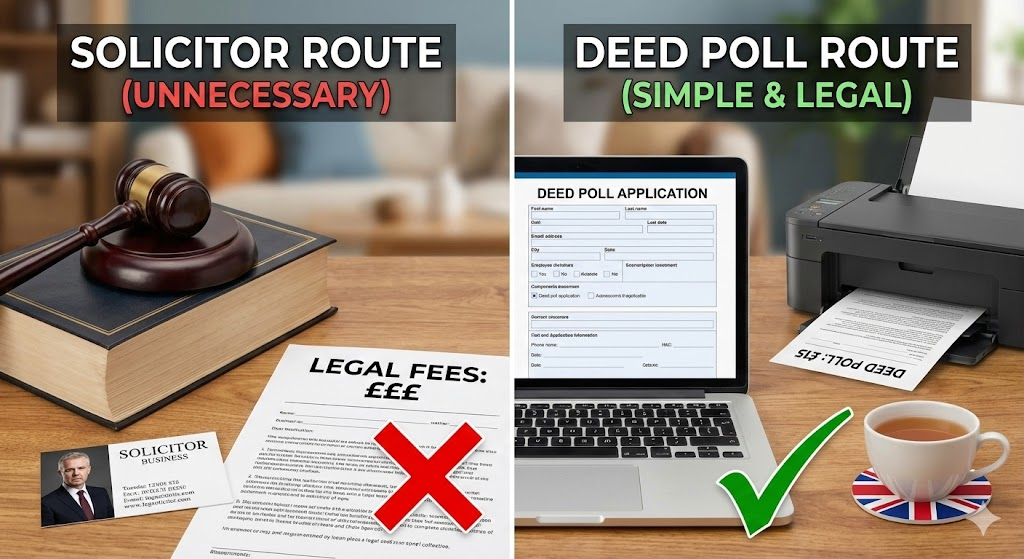
In the UK, changing your name is surprisingly flexible under common law. However, once you execute a deed poll, you have signed a legally binding document that contains three specific declarations: you are abandoning your old name, adopting a new one for all purposes, and requiring others to address you only by that new name. This creates a clear set of legal and administrative responsibilities to ensure your identity remains consistent across the board.
At UK Name Change, we help our clients understand that a name change isn't just a signature—it's a transition of your legal and financial status. In this 2026 guide, we break down your mandatory and practical responsibilities for notifying the UK government and your banks.
1. Government Notifications: The "Big Three"
While there is no central "Name Change Office" in the UK, failing to update these three specific government bodies can lead to legal friction, tax errors, or travel issues.
HM Revenue & Customs (HMRC)
Your primary responsibility is to notify HMRC. They manage your National Insurance (NI) and tax records. Keeping these accurate ensures your employer pays into the right pension pot and that your tax codes remain correct.
- The Process: You can usually tell HMRC about a name change online through your Personal Tax Account. Once updated, they will notify the Department for Work and Pensions (DWP) for you.
The Driver and Vehicle Licensing Agency (DVLA)
Under the Road Traffic Act 1988, you are legally required to keep your driving licence up to date. This includes your name and address.
- The Process: You must apply by post to update your licence. While there is no fee for changing your name, failing to do so can result in a fine of up to £1,000 if you are stopped by the police.
HM Passport Office (HMPO)
Technically, you are not legally forced to update your passport until it expires. However, having an "identity mismatch" (e.g., a bank in your new name but a passport in your old one) can trigger anti-fraud alerts. Most travellers find it responsible to update their passport as soon as they have "proof of use" from a bank or utility provider.
2. Banking and Financial Responsibilities
Your relationship with your bank is governed by "Know Your Customer" (KYC) regulations and the Data Protection Act 2018. You have a responsibility to provide your bank with accurate information so they can protect your assets.
The "Wet Ink" Original
Most UK banks (such as Barclays, HSBC, and NatWest) will not accept photocopies or digital scans of a deed poll. You have a responsibility to present the original physical document with a "wet ink" signature. Many banks will require you to visit a branch in person so they can verify the document and your identity simultaneously.
Credit Reference Agencies
You don't usually need to contact Experian or Equifax directly. Once you update your bank and the electoral roll (at your local council), the credit agencies will typically update their records automatically. However, it is your responsibility to check your credit report 3–4 months after the change to ensure the "Identity Chain" has linked your old and new names correctly.
3. Mandatory Legal Notifications (High-Risk Categories)
For some individuals, notification is not just a responsibility—it is a criminal requirement. You must notify the police within 3 days of a name change if:
- You are on the Sex Offenders Register or ViSOR.
- There are active criminal proceedings against you.
- You are currently on probation (notify your Offender Manager).
Additionally, if you are an undischarged bankrupt, you must notify the Official Receiver. If you trade in your new name, you are legally required to tell everyone you do business with the name in which you were made bankrupt.
Notification Priority Table
| Priority | Organisation | Reason |
|---|---|---|
| High | HMRC / Employer | Taxes, Payroll & Pension accuracy. |
| High | Banks & Lenders | Fraud prevention & credit stability. |
| Medium | DVLA | Legal duty to keep licence current. |
| Medium | NHS / GP | Correct medical records & prescriptions. |
Why Accuracy is Your Best Defence
Keeping your records accurate isn't just about following rules; it’s about your Right to Rectification under UK GDPR. Organisations have a legal duty to update your records when you provide evidence. If a bank refuses to update your details, you can remind them that they are in breach of the Data Protection Act by holding inaccurate data about you.
At UK Name Change, we provide the solicitor-approved deed polls that give you the authority to demand these updates. Our Complete Package includes a dedicated dashboard that tracks your responsibilities, providing pre-written letters for banks and government departments so you can meet your obligations with zero stress.
Conclusion
Executing a deed poll is the start of a serious legal commitment. By taking responsibility for notifying the government and your financial providers early, you protect your credit score, your legal standing, and your new identity. Consistency is the key to a successful name change in 2026.
Ready to meet your legal responsibilities with a professional document set? Start your application today and let our interactive dashboard guide you through every notification. If you have a complex background and need advice on mandatory notifications, contact our expert support team for a confidential consultation.