Changing your name when you have a published research record feels daunting, but the situation is far better than it used to be. You can update your name across your future academic output immediately, and you can retroactively change the author name on most past journal articles - quietly and without a public correction notice - by requesting a name change directly from each publisher. ORCID ties your entire body of work to a single permanent identifier, so your citations and authorship credit follow you regardless of which name appears on the page. The key is to update your identity in the right order: ORCID first, then publishers, then the indexing databases that mirror them.
Start with the legal document
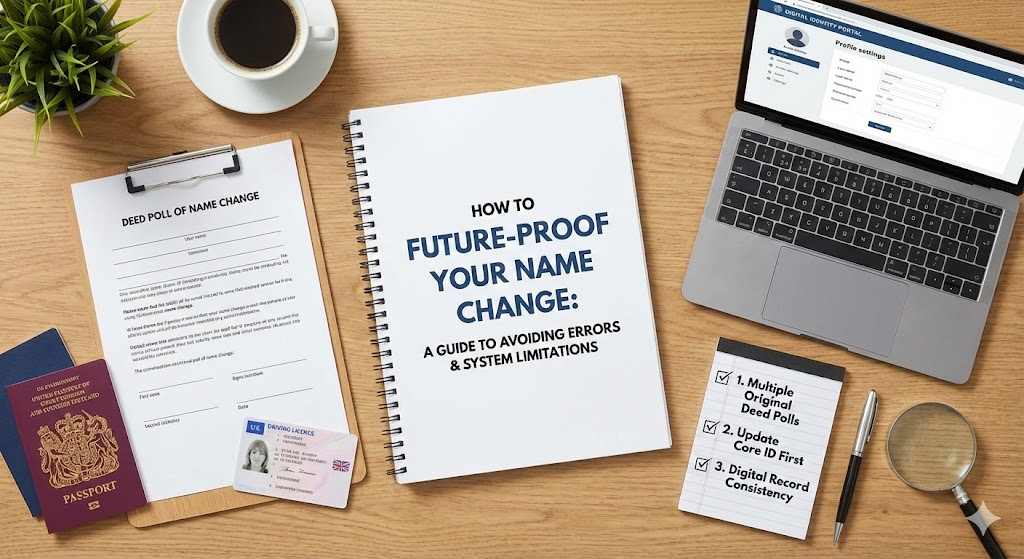
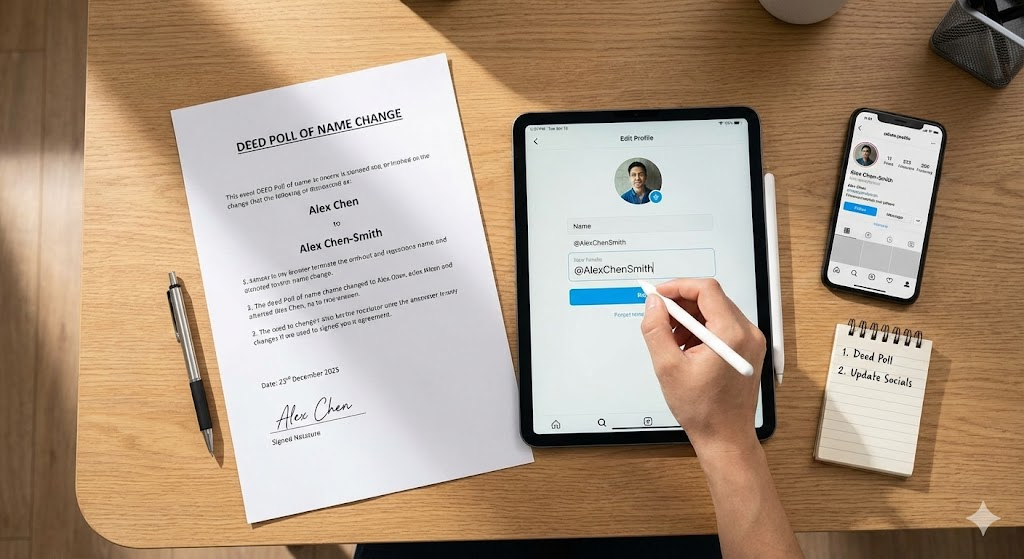
Before you contact a single journal, get the paperwork right. Most UK publishers, your university HR department and your funder will accept a professionally drafted unenrolled deed poll as proof of your name change. An unenrolled deed poll is legally valid, costs from £14.49, and is accepted by HM Passport Office, DVLA, HMRC, banks, the NHS and employers - around 98% of UK name changes are unenrolled. You do not need the £53.05 Royal Courts of Justice enrolment, and you certainly do not need a solicitor charging £150-£300 for the same document.
For academia specifically, the unenrolled deed poll does everything you need. It gives publishers a clear, dated record to attach to their internal name-change request, and it satisfies your institution when you update your staff profile, email alias and ORCID-linked employment record. Remember that a title such as Dr is not legally part of your name, so changing from, say, Mr to Dr or keeping your doctorate intact is unaffected by the name change itself.
ORCID: the anchor for your whole record
ORCID (the Open Researcher and Contributor ID) is the single most important tool for anyone changing their name mid-career. Your 16-digit ORCID iD is permanent and identity-based, not name-based. When you update your name in your ORCID record, every work connected to that iD - past and future - remains correctly attributed to you, even if the older articles still display your previous name on their PDFs.
Do this first:
- Update your primary name in your ORCID account settings to your new legal name.
- Add your former name as a “published name” or “also known as” entry - or remove it entirely if you would rather it not appear. ORCID gives you full control over visibility here, which matters enormously for trans and other researchers who do not want their previous name surfaced.
- Make sure every paper is connected to your iD. Use the “Add works” search-and-link tools (Crossref, DataCite, Scopus) to claim publications that are not yet attached, so your record is complete before you approach publishers.
Once ORCID is in order, your authorship and citation credit are secure. Everything that follows is about making the visible record match.
Changing your name on past journal articles
This is the part most people assume is impossible. It is not. Following sustained advocacy - much of it led by trans researchers - the major academic publishers and the Committee on Publication Ethics (COPE) now support retroactive author name changes that are silent: no correction notice, no erratum, and no requirement to explain why.
Most large publishers, including Elsevier, Springer Nature, Wiley, Taylor & Francis and SAGE, have a dedicated name-change policy and a confidential request route. Typically you:
- Email the publisher’s name-change or author-services address (search “[publisher] author name change policy”).
- List the affected DOIs and supply your new name.
- Provide proof - your deed poll usually suffices, though many trans-inclusive policies deliberately ask for as little documentation as possible.
The publisher then reissues the article metadata, the online PDF and the HTML landing page under your new name and pushes the corrected metadata to Crossref. Crucially, well-designed policies do not generate a public paper trail that could out you. If a particular publisher offers only a public corrigendum, you are entitled to ask for the silent option instead and to cite COPE’s guidance, which recognises author name changes as a discrete, non-disciplinary category of correction.
What can and cannot be changed retroactively
Be realistic about the limits. What you can usually fix: the author name on the publisher’s official version of record (PDF and HTML), the Crossref metadata that feeds most citation tools, your ORCID record, your institutional repository copy, and your name in preprint servers such as arXiv, bioRxiv and SSRN.
What is harder or impossible:
- Printed back-issues already on library shelves - these cannot be recalled, though they are increasingly irrelevant next to the online version of record.
- The body text of citing papers - other authors’ reference lists that quote your old name will not be rewritten, though their links resolve to the updated article.
- Third-party copies and mirrors - cached PDFs floating on the wider web are outside any publisher’s control.
For these stubborn cases, ORCID is again your safety net: the identifier, not the displayed string, is what binds the work to you.
Updating the indexing databases
Journals feed downstream services, but those services do not always refresh instantly. After the publisher confirms the change, check and, where necessary, prompt:
- Crossref - the metadata backbone; most other databases inherit from it once the publisher re-deposits.
- Google Scholar - merge or edit your profile entries; Scholar re-crawls publisher pages, so updates flow through over weeks.
- Scopus and Web of Science - each has an author-profile correction or feedback form; submit your ORCID iD so they can consolidate your record.
- PubMed - for biomedical work, name corrections come via the journal’s data provider rather than directly from you.
Expect the whole ecosystem to settle over one to three months. Lead with ORCID in every request so the databases can match the old and new records to one researcher.
Theses, repositories and grants
Do not forget the grey literature. Ask your university library to update your name in the institutional repository and in EThOS-linked thesis records. Update your name with your funders (for example UKRI) so future grant attribution and your researcher profile stay consistent. And update your university staff page, email display name and any departmental bio - these are often the first results a new collaborator sees.
The wider professional picture
Your publishing record is one piece of a larger identity update. To keep your employer records, payroll, professional memberships and credentials aligned, see our guide to matching your professional name to your legal identity. And if your name carries reputational weight you have spent years building, our piece on changing your name without losing your personal brand covers how to bridge the old and new versions of your public self.
Frequently Asked Questions
Can I change my name on already-published papers?
Yes, in most cases. The major academic publishers now operate confidential author name-change processes that update the version of record - PDF, HTML and metadata - without a public correction notice. You email the publisher’s author-services team, list the DOIs, and supply proof such as a deed poll. Printed back-issues cannot be recalled, but the authoritative online version can be corrected.
Do I need to enrol my deed poll to change my academic name?
No. An unenrolled deed poll from £14.49 is legally valid and accepted by publishers, universities and funders. The £53.05 Royal Courts of Justice enrolment is optional, adds no legal validity and publishes your change in the London Gazette - the opposite of what most academics changing their name want. An unenrolled adult deed poll is the right tool here.
How do publishers handle name changes for trans authors?
Most major publishers have adopted trans-inclusive policies developed with COPE. These allow silent, retroactive name changes with minimal documentation and no public erratum, specifically to avoid outing the author. If a publisher initially offers only a public correction, you can request the confidential route and reference COPE’s author name-change guidance.
Will I lose my citations if I change my name?
No. Your citation credit is tied to your ORCID iD and to each article’s DOI, not to the displayed author name. Once your works are linked to your ORCID record, your h-index and citation counts follow you. Update ORCID first, then the publishers and indexing databases, and your metrics stay intact.
How long does the whole process take?
ORCID updates are instant. Publishers typically action a name-change request within a few weeks. Indexing databases such as Google Scholar, Scopus and Web of Science refresh from publisher metadata over roughly one to three months, so allow a quarter for the full record to settle.
Update your academic identity with confidence
Your research record is your career - and a clean, consistent name across it starts with the right legal document. Order a professionally printed unenrolled deed poll from £14.49 with same-day dispatch on orders before 3pm and free Royal Mail Tracked delivery, trusted by more than 160,000 customers. With your deed poll in hand, you can update ORCID, your publishers and your indexing profiles - and let your past and future work speak for you under one name.