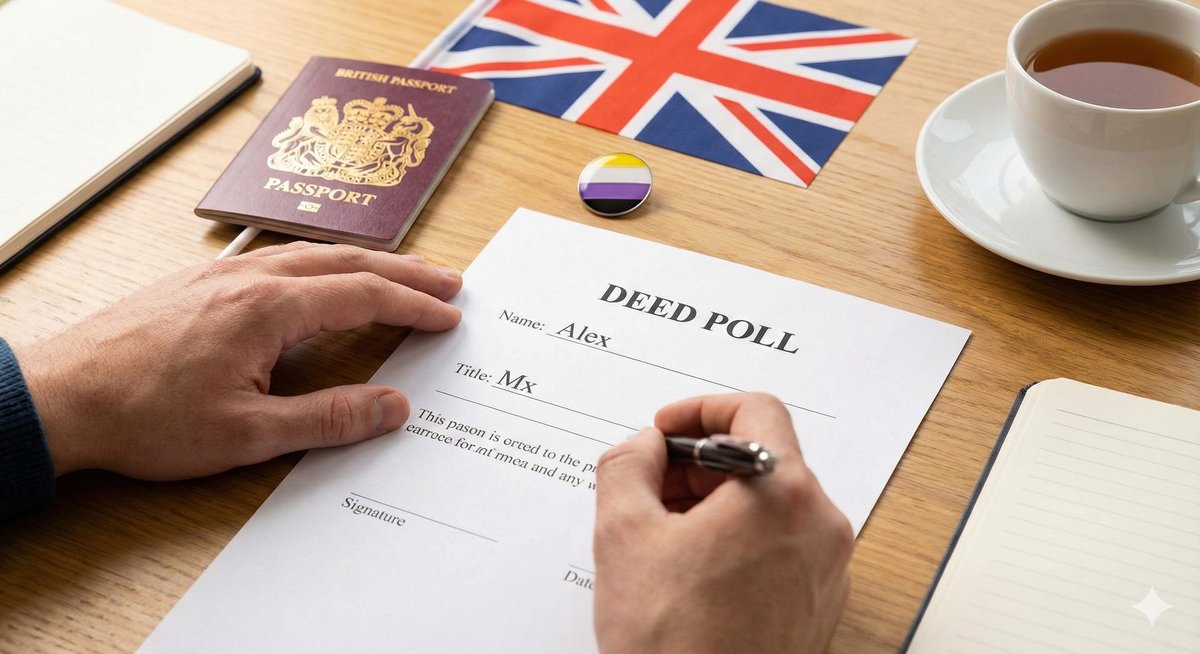
Yes-you can change your name in the UK at any time, and you do not need permission from the government, a court or anyone else. The freedom to call yourself whatever you like is a long-standing right under English common law. You simply start using your new name, and a deed poll is the accepted document that proves you have done so officially. This guide sets out the plain legal facts: what the law actually says, why no ‘good reason’ is required, and where a deed poll fits in.
The legal basis: a common-law right, not a government licence
In England, Wales and Northern Ireland, changing your name rests on a principle of common law that has stood for centuries: a person is free to be known by any name they choose, provided there is no intent to commit fraud or deceive. There is no Act of Parliament you must apply under, no register you must join, and no official who can refuse you.
This is one of the most liberal name-change systems anywhere in the world. In many countries a name change requires a court order, a published notice and a judge’s approval. In the UK, the right already belongs to you-the only question is how you prove it to the organisations that hold records in your name.
Scotland works differently in the detail (changes there can be recorded with National Records of Scotland), but the underlying freedom to choose your name is the same across the United Kingdom.
What ‘no permission needed’ really means
It means exactly what it says. You do not need to explain your decision, you do not need a marriage or divorce to justify it, and you do not need a ‘good reason’. You can change your name because you have separated from a partner, because you want your child to share a surname, because your current name no longer reflects who you are, or simply because you prefer something else. The law does not ask why.
If no permission is needed, why have a deed poll at all?
Here is the part that confuses people. Because the right is automatic, a deed poll does not grant you a new name-you already have the right to use one. What a deed poll does is provide formal, documentary evidence that you have changed your name and intend to use the new one for all purposes, abandoning the old one.
That evidence matters in the real world. HM Passport Office will not reissue a passport on your word alone; your bank will not rename your account because you asked nicely. They need to see a signed legal document. A deed poll is that document-the standard proof every UK institution recognises. For a full explanation of how the document is drafted, signed and witnessed, see our guide to what a deed poll is and how it works.
Enrolled vs unenrolled: both are legally valid
There are two types of deed poll, and a great deal of confusion surrounds them.
An unenrolled deed poll is a private document you sign in front of two independent witnesses. It is legally valid the moment it is signed, and it is accepted by HM Passport Office, the DVLA, HMRC, the NHS, banks, employers and schools. Around 98% of UK name changes are done this way.
An enrolled deed poll is the same document, but additionally entered on the public record at the Royal Courts of Justice and published in the London Gazette. Enrolment costs £53.05, takes two to three weeks, and makes your name change a matter of public record. Crucially, it adds no extra legal validity-an enrolled deed poll is no ‘more legal’ than an unenrolled one. For most people it is an unnecessary cost and a needless loss of privacy.
The legal facts at a glance
- No government permission. Changing your name is a common-law right, not a licence you apply for.
- No ‘good reason’ required. You never have to justify the change to anyone.
- One restriction: the change must not be for fraudulent or deceptive purposes.
- Age: anyone aged 16 or over can change their own name and sign their own deed poll. Under-16s need the consent of everyone with parental responsibility.
- A title is not part of your legal name. Switching between Mr, Mrs, Ms, Mx or Dr needs no deed poll at all.
- An unenrolled deed poll is fully valid and accepted by every UK authority that matters.
Wondering whether your particular situation qualifies-new arrivals to the UK, dual nationals, or changing a child’s name? Our companion article on who can change their name in the UK and the eligibility rules covers the edge cases in detail.
How a name change actually happens, start to finish
Because the legal right is already yours, the practical process is refreshingly short:
- Decide on your new name. You can change your forename, surname or both. There are sensible limits-no numbers, no symbols, nothing offensive-but the choice is otherwise yours.
- Sign a deed poll. The document records your old name, your new name and your declaration to use the new one for all purposes. It must be signed in wet ink and witnessed by two independent adults (18 or over), neither of whom is a relative, partner or anyone living at your address.
- Update your records. Send the original wet-ink signed deed poll (or certified copies where an organisation accepts them) to the bodies that hold your details-passport, driving licence, bank, HMRC, NHS, employer and so on.
You can get a professionally printed, ready-to-sign document with our adult deed poll service from just £14.49, with same-day dispatch on orders placed before 3pm and free Royal Mail Tracked delivery. A solicitor would charge £150-£300 or more to produce the very same document, which is simply not necessary.
What it costs to update everything afterwards
Most updates are free. The DVLA updates your driving licence at no charge, and banks, HMRC, the NHS, employers and utility providers all update your name for free. The main unavoidable cost is a new passport: £102 online or £115.50 by post (with faster 1-week Fast Track at £192 and 1-day Premium at £239.50 available if you are in a hurry). Always send these organisations the original wet-ink signed deed poll, not a photocopy.
Frequently asked questions
Is it legal to change your name in the UK?
Completely legal — and easier than most people expect. Under English common law, any adult (and 16–17 year olds) can adopt a new name at any time, for any honest reason, without government permission. A deed poll is simply the formal document that proves the change so official bodies update your records. The only limits: you cannot change your name to defraud, and a small set of names are refused as offensive or misleading.
Do I need a solicitor to change my name in the UK?
No. There is no legal requirement to involve a solicitor. The right to change your name belongs to you under common law, and a properly drafted deed poll is all the evidence you need. A solicitor would simply produce the same document for £150-£300 or more.
Is an unenrolled deed poll legally valid?
Yes, completely. An unenrolled deed poll is legally valid as soon as it is signed and witnessed, and it is accepted by HM Passport Office, the DVLA, HMRC, banks, the NHS, employers and schools. Roughly 98% of UK name changes use an unenrolled deed poll.
Do I need a reason to change my name?
No. UK law does not require you to give any reason. You can change your name for any personal reason-or none at all-provided the change is not intended to commit fraud or deceive.
How old do I have to be to change my own name?
You must be at least 16 to change your own name and sign your own deed poll. For a child under 16, everyone with parental responsibility must consent to the change.
Does enrolling my deed poll make it more legal?
No. Enrolment at the Royal Courts of Justice (£53.05) places your name change on the public record and publishes it in the London Gazette, but it adds no legal validity. An unenrolled deed poll is just as binding.
Do I need a deed poll to change my title?
No. A title such as Mr, Mrs, Ms, Mx or Dr is not legally part of your name, so you can change it without any deed poll.
Ready to make it official?
You already have the legal right-all that’s left is the proof. Order a professionally printed, court-quality adult deed poll from just £14.49, trusted by more than 160,000 customers. Order before 3pm for same-day dispatch with free tracked delivery, and start using your new name with confidence.