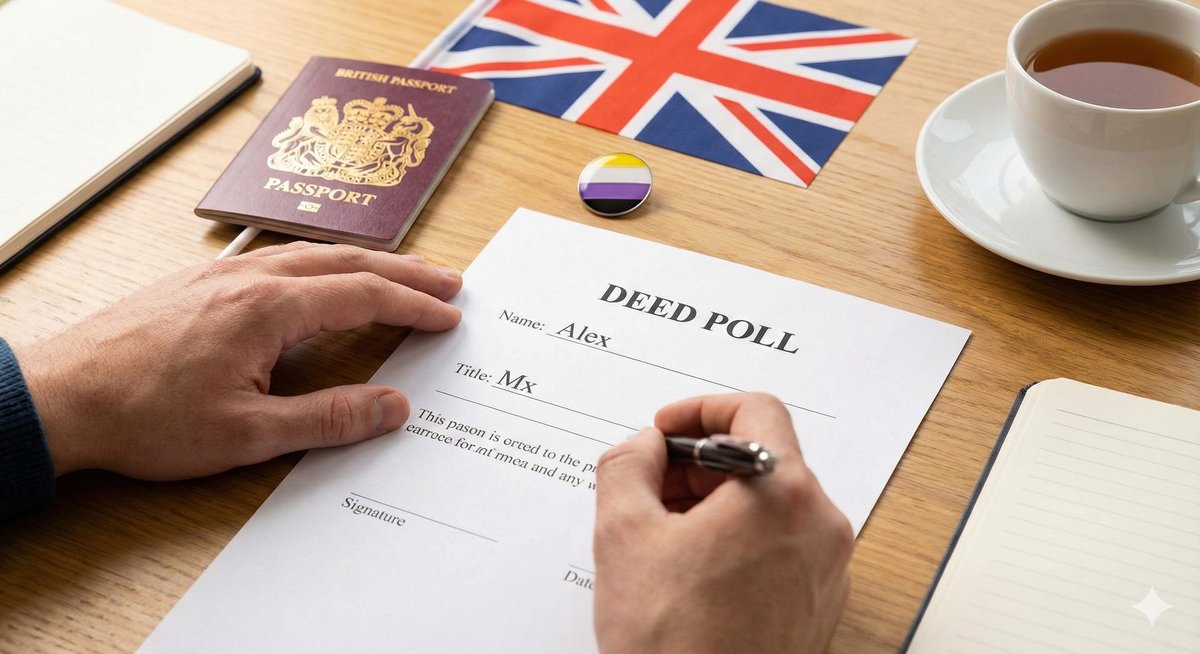
Yes, you can legally remove your surname in the UK and go by a single name - a mononym - and a deed poll is how you record it. English and Welsh law sets no rule that you must have both a forename and a surname, so dropping the family name is perfectly lawful. The catch is purely practical: passports, banks, the DVLA and countless computer systems are built around the assumption that everyone has at least two names, and they will not always know what to do with someone who has one. This guide covers exactly how to drop your surname, where the friction shows up and how to get round it.
Is it legal to remove your surname entirely?
It is. Under the common law of England and Wales there is no statute that requires you to hold a forename and a surname - you are free to be known by a single name, several names, or any combination you choose. A deed poll is simply the document that evidences the change so that officials, employers and banks will accept it.
What you cannot do is pick a name that breaks the rules: nothing offensive, no numbers or symbols, nothing that misleadingly implies a title or rank, and nothing impossible to pronounce. A single name still has to clear those hurdles. We explain them in detail in our guide to choosing a name that will be accepted in the UK, which is worth a read before you commit.
One quick clarification: a title such as Mr, Mrs, Ms, Mx or Dr is not legally part of your name, so dropping a title needs no deed poll at all. We’re talking strictly about removing the surname itself.
The honest reality: where a single name causes friction
Here is the part most people aren’t told. Removing your surname is legal, but a huge amount of UK and international infrastructure assumes a two-part name. You won’t be breaking any law - you’ll be fighting forms. Expect the following.
The passport office
HM Passport Office can issue a passport to a person with one name, but it follows international civil-aviation rules, which require both a surname and a forename field to be populated. In practice the office places your single name in the surname field and enters “XXX” in the forename field. That is standard and accepted worldwide - but it means your boarding passes, visa applications and airline bookings may show “XXX” as a given name, and some overseas border systems and travel websites handle it awkwardly. None of this stops you travelling; it just invites the occasional double-take. A standard adult passport costs £102 online or £115.50 by post.
Banks and financial systems
Most banks will update your name on production of the original deed poll, but their software often refuses to save a record with an empty name field. Front-line staff usually solve this by entering your single name in both the first-name and last-name boxes, or by using a placeholder. It works, but it can produce odd-looking statements and the occasional mismatched card. Updating your name with a bank is free.
The “computer says no” factor
Payroll software, utility accounts, insurance portals, NHS records, loyalty schemes and online checkouts are frequently coded to require two names. You may be asked to repeat your name in both fields, add a full stop or hyphen as a stand-in, or speak to a human to override the form. Nothing here is a legal barrier - it’s a database design problem - but if you change your name expecting a frictionless life with one word, you will be disappointed several times a year.
Should you choose a new surname instead?
For a lot of people, the smoother route is not to delete the surname but to replace it - keep your forename and adopt a short, neutral new family name. You still escape a surname you dislike, you keep a clean two-part record that every system understands, and you avoid the “XXX” passport quirk entirely. It is the path of least resistance.
That said, if the single-name identity genuinely matters to you - for artistic, religious, cultural or personal reasons - the mononym is fully available and the friction is manageable once you know it’s coming. If you want the deeper walkthrough of living with one name, including real-world workarounds, see our dedicated single-name (mononym) deed poll guide for 2026. This post stays focused on the decision to drop the surname; that one covers the day-to-day mechanics.
How to remove your surname by deed poll
The process is the same as any name change, and you do not need a solicitor - a solicitor would charge £150-£300+ for an identical document.
- Decide on your single name and make sure it clears the acceptability rules above.
- Order an unenrolled deed poll. Ours starts at £14.49, is professionally printed, dispatched same day if you order before 3pm, and sent with free Royal Mail Tracked delivery.
- Sign it in wet ink in front of two independent adult witnesses. Each witness must be 18 or over and must not be a relative, your partner, or anyone living at your address.
- Notify the organisations that matter - passport, DVLA, bank, HMRC, NHS, employer, utilities. Each will want the original signed deed poll, not a photocopy.
An unenrolled deed poll is legally valid and accepted by HM Passport Office, the DVLA, HMRC, banks, the NHS, employers and schools - around 98% of all UK name changes are unenrolled. Updating your driving licence with the DVLA is free, and banks, HMRC, the NHS, employers and utilities all update your name for free too. Ready to start? You can order your adult deed poll here in a few minutes.
What about enrolment?
Enrolling your deed poll at the Royal Courts of Justice costs £53.05, takes 2-3 weeks and publishes your new name publicly in The London Gazette. It is entirely optional and adds no legal validity - an unenrolled deed poll is exactly as legally effective. Most people skip it.
Frequently asked questions
Can I legally have just one name in the UK?
Yes. There is no law in England and Wales requiring you to have both a forename and a surname. You can be known by a single name and record the change with a deed poll. The only constraints are the usual ones: the name can’t be offensive, misleading or contain numbers or symbols.
Will I be able to get a passport with one name?
Yes. HM Passport Office issues passports to single-name holders by placing your name in the surname field and “XXX” in the forename field, in line with international standards. You can travel normally, though some airline and visa systems handle the “XXX” placeholder clumsily, so allow extra time when booking.
Do I need a solicitor to drop my surname?
No. A deed poll is a do-it-yourself document; a solicitor would charge £150-£300+ for the same thing. You only need a correctly worded deed poll signed in wet ink before two independent adult witnesses.
Is it easier to change my surname rather than remove it?
Usually, yes. Replacing your surname with a new one keeps a standard two-part name that every computer system understands, so you avoid the “XXX” passport entry and the form-filling friction. Removing it entirely is fine if a single-name identity matters to you, but it does create recurring small hassles.
Does removing my surname affect my passport or driving licence cost?
No. A name change doesn’t change the standard fees. A passport is £102 online (£115.50 by post), and updating your DVLA driving licence is free. Banks, HMRC and the NHS also update your name at no charge.
Ready to drop your surname?
If you’ve weighed up the friction and a single name is right for you, the next step is a properly drafted deed poll. UK Name Change has helped over 160,000 customers, with prices from £14.49 and same-day dispatch before 3pm. Order your adult deed poll today and make it official.