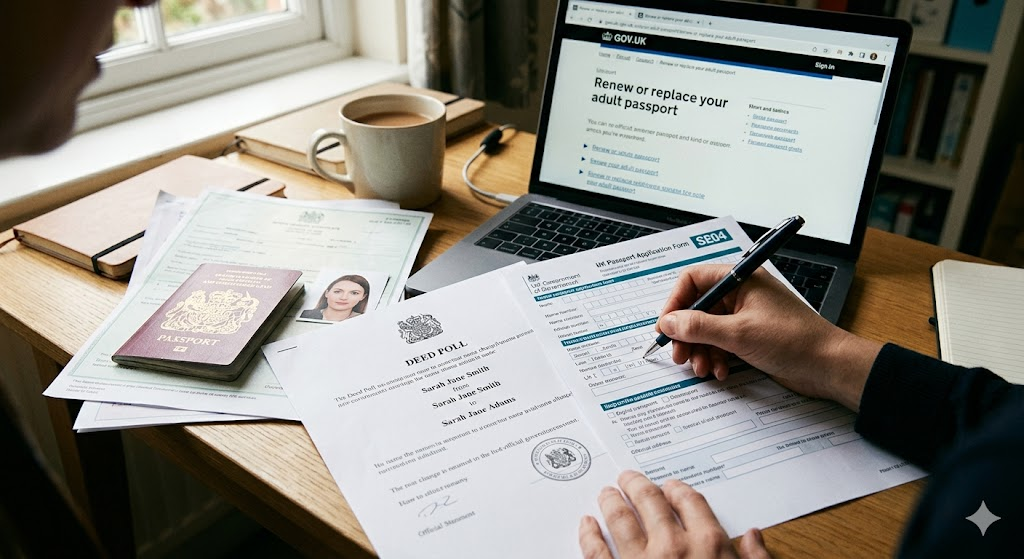
Plenty of people change their name without paperwork. You moved to the UK and started using the English form of your name. A stepfather’s surname gradually became yours. You dropped a forename in your twenties and nobody has used it since. All perfectly lawful — in England and Wales a name changes by use and repute, not by magic words on paper. The problem arrives years later, at a counter: usually HM Passport Office’s.
Why a Deed Poll Signed Today Doesn’t Work On Its Own
HMPO’s guidance accepts an unenrolled deed poll only where it is a contemporaneous document — made at the time of the change. A deed you sign this week is plainly not contemporaneous with a change you made in 2011, and caseworkers are instructed accordingly. HMPO’s own stated remedy for people without contemporaneous evidence is a statutory declaration.
The Document That Fills the Gap
A statutory declaration of name history is a sworn statement of what actually happened: the name on your birth certificate, the name you use now, roughly when you started using it, and how the change came about — declared on oath before a solicitor or commissioner for oaths for the £5 fee fixed by law. It does not pretend a document existed; it supplies, honestly and under oath, the record that was never made at the time.
Our Retrospective Deed Poll pack (£24.99 including VAT, posted free) prepares three documents together: a change of name deed signed in both names before two witnesses, the statutory declaration of name history signed in your new name only, and an evidence checklist reproducing what HMPO asks to see — because the third document is where most applications actually fail.
The Evidence-of-Use Rule Nobody Warns You About
Your deed and declaration prove the name changed. HMPO separately wants proof you use it — usually one piece of evidence, such as a bank statement, utility bill or HMRC letter issued within the last 12 months, showing your full forename and surname. There is a second list of older evidence HMPO can accept (driving licences, identity cards), but its conditions are strict — including that the evidence must be issued after any change of name document — and since the documents in a retrospective pack are dated now, evidence you already hold will not meet it. Plan on the 12-month list; the checklist in the pack walks through it.
Before You Buy: Three Honest Checks
- Did you take your spouse’s surname on marriage? Then HMPO normally needs only your marriage or civil partnership certificate — you probably do not need this pack at all. It exists for the cases the certificate cannot cover: a surname that is not your spouse’s, a foreign certificate, a certificate that does not show the link.
- Did you use another name in between? The pack records a single change. A sworn history that skips a middle name is exactly what gets applications returned, so our form asks — and if there was an intermediate name, contact us and we will prepare your full history by hand instead.
- Did you once have a deed poll and lose it? That is a different declaration — one truthfully describing a document that existed and was lost, not one saying no record was made. Contact us rather than ordering this pack.
Frequently Asked Questions
Is my informal name change even valid?
Yes. Long use is a lawful way to change a name in England and Wales. What you lack is not validity but evidence — which is exactly the gap the sworn declaration addresses.
Will HMPO definitely accept the pack?
HMPO decides each application itself and we won’t promise otherwise. What the pack does is follow HMPO’s own published route — declaration plus evidence of use — and tell you honestly what to put in the envelope.
What does the whole thing cost?
£24.99 for the pack, £5 to the solicitor when you swear the declaration — about £30 all in. Full pricing context in our cost guide.
My name never actually changed — my documents just disagree.
Then you need the other document entirely: a one-and-the-same-person declaration, which confirms an identity without asserting any change.