To change the name of a child under 16 in the UK, you need the written consent of everyone who holds parental responsibility - not just the parent making the application. A child’s deed poll signed by one parent alone will be rejected by HM Passport Office and the DVLA if another person also has parental responsibility and has not consented. This guide explains exactly who must agree, how consent is recorded, and what your options are if a parent is absent, uncontactable or refusing to sign.
Who has parental responsibility?
Consent for a child’s name change is tied to a legal status called parental responsibility (PR), defined by the Children Act 1989. PR is not the same as being a biological parent, and it is not the same as paying maintenance or having contact - you can have one without the other. The people who normally hold PR are:
- The birth mother - automatically, from birth, in almost all cases.
- The father, if married to the mother at the time of the birth (or who married her afterwards).
- An unmarried father named on the birth certificate for a birth registered in England & Wales on or after 1 December 2003 (4 May 2006 in Scotland; 15 April 2002 in Northern Ireland).
- A second female parent who is the mother’s civil partner or spouse, or who is named on the birth certificate under the relevant rules.
- Anyone with a court order or formal agreement - for example a step-parent or grandparent named in a child arrangements order, a PR agreement, an adoption order, or a special guardianship order.
An unmarried father who is not on the birth certificate (or whose child was registered before the dates above) does not automatically have PR - and so, strictly, his consent is not legally required. In practice, though, passport and licensing offices may still ask about an absent parent, so it pays to understand the full picture before you apply.
How to check who is on the birth certificate
The simplest way to confirm who legally counts is to look at the child’s full birth certificate. Anyone listed as a parent there, for a post-2003 registration, will normally have PR. If you are unsure whether a court order grants PR to someone else, check the wording of the order itself rather than relying on memory.
Whose consent do you actually need?
The rule is straightforward: every living person who holds parental responsibility must give written consent for the child’s name to be changed. It does not matter who the child lives with, who pays for them, or whose surname the child currently uses. If two people have PR, you need two signatures. If three people have PR (for example after a special guardianship order), you need three.
This consent is recorded on a parental consent declaration that accompanies the child’s deed poll. When you order a deed poll for a child from us, the consent wording is built into the document set, so each person with PR signs in the right place and the paperwork is accepted first time. Both the deed poll and the consent must be the original wet-ink documents - HM Passport Office and the DVLA will not accept photocopies or scans.
What about the child’s own view?
A child aged 16 or 17 changes their own name and signs their own deed poll; parental consent is no longer required at that age. For younger children, there is no fixed age at which a child’s wishes become decisive, but courts expect older children’s views to be taken into account. Many parents sensibly involve a child of, say, ten or eleven in the decision even though the law does not require their signature.
Do I need consent if I have sole parental responsibility?
If you are genuinely the only person with parental responsibility, there is no one else whose consent is required - but you will usually need to evidence that fact rather than simply assert it. You might be the sole holder of PR if:
- You are the birth mother and the father is not married to you and not named on the birth certificate; or
- The other parent has died (you may be asked for a death certificate); or
- A court order or adoption order has left you as the only person with PR.
In these situations a declaration of sole parental responsibility, signed by you, takes the place of a second consent. Being the day-to-day carer is not the same as sole PR, though - an absent parent who is on a post-2003 birth certificate still has PR even if you haven’t seen them for years.
What if the other parent is absent or uncontactable?
This is one of the most common problems parents bring to us. If someone with PR cannot be found or will not respond, you cannot simply leave their signature off the consent form and proceed - the name change would be open to challenge, and a passport application is likely to be refused. You generally have two routes:
- Make genuine, documented efforts to obtain consent - for example, writing to the parent’s last known address by recorded delivery and keeping copies. Evidence that you have tried matters if the matter ever reaches a court.
- Apply to the family court for permission to change the name without that parent’s consent.
The specifics - including how the surname versus first-name distinction is treated and what evidence helps - are covered in our dedicated guide to changing a child’s surname without the other parent’s consent. Start there if your situation involves an absent or silent co-parent.
What if a parent with PR refuses to sign?
If a person with parental responsibility actively objects, you cannot override them with a deed poll alone. The decision moves to the family court, which can grant a Specific Issue Order authorising the change, or a Prohibited Steps Order if a parent is trying to prevent a change. The court’s only concern is the welfare of the child, not which parent is “right”. If your case involves a refusal, read our comparison of the deed poll versus court order route for a child’s name change before spending money on either.
Adults in the same household sometimes update their own names at the same time. If you, as a parent, are also changing your surname, you can do that in minutes with an adult deed poll - there is no consent requirement for anyone aged 16 or over.
How much does a child name change cost?
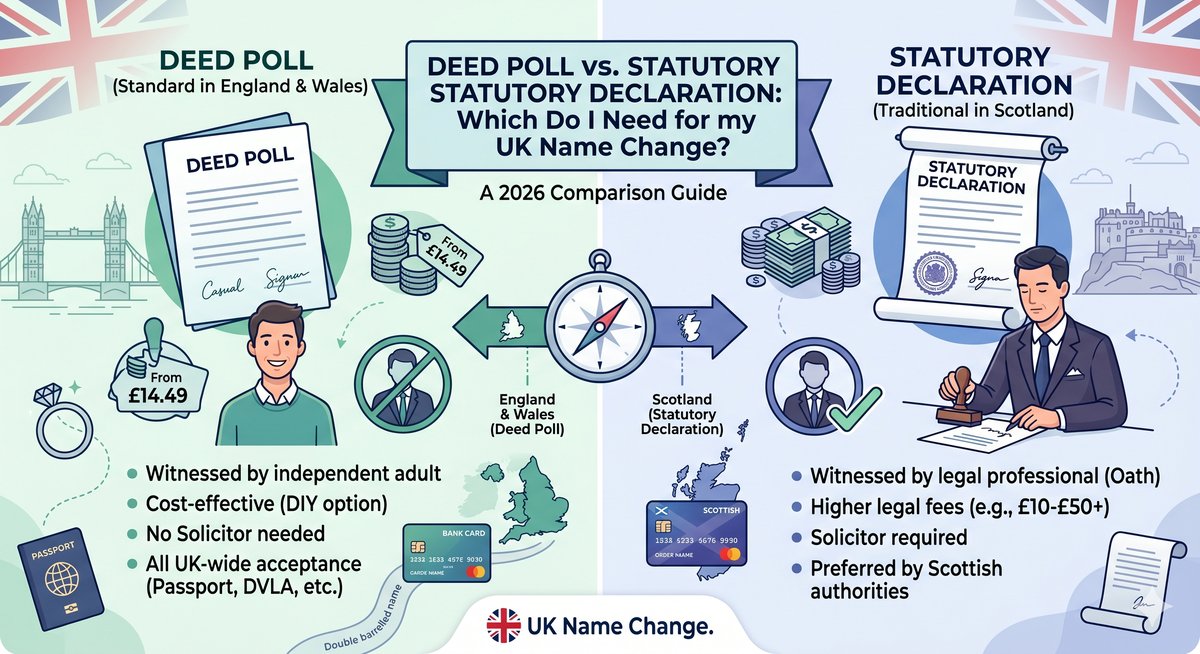
Our professionally printed child deed poll set - including the consent declaration - starts from £14.49, with same-day dispatch on orders placed before 3pm and free Royal Mail Tracked delivery. The deed poll is unenrolled, which is the route used for around 98% of UK name changes and is fully accepted by HM Passport Office, the DVLA, the NHS, banks and schools. Enrolment at the Royal Courts of Justice (£53.05) is entirely optional and adds no legal validity. A solicitor would charge £150-£300+ for the very same paperwork.
Frequently asked questions
Does the father have to consent if he is not on the birth certificate?
If the child was registered in England & Wales on or after 1 December 2003 and the father is not named on the certificate, and he was never married to the mother, he does not automatically have parental responsibility - so his consent is not legally required. If he is on the certificate, or has PR through a court order, his consent is required.
Can grandparents or step-parents need to consent?
Only if they hold parental responsibility - for example through a special guardianship order, an adoption order, or being named in a child arrangements order. A step-parent or grandparent who simply lives with the child, without a formal order, does not have PR and does not need to sign.
Does paying child maintenance give a parent the right to consent?
No. Maintenance and parental responsibility are separate. A parent can pay maintenance without holding PR, and a parent can hold PR without paying maintenance. Consent depends solely on whether the person has parental responsibility.
Can a 16-year-old change their own name without parental consent?
Yes. Anyone aged 16 or over can change their own name and sign their own deed poll. Parental consent is only needed for children under 16.
What happens if I just leave the other parent off the consent form?
The name change becomes vulnerable to challenge, and HM Passport Office is likely to refuse a passport application once it identifies a second person with PR. If you cannot obtain consent, follow the no-consent or court route rather than omitting a required signature.
Ready to change your child’s name?
If everyone with parental responsibility agrees, you can have the whole document set - deed poll plus consent declaration - in hand within days. Order your child’s deed poll from £14.49 with same-day dispatch and free tracked delivery, and update the passport, school and GP records as soon as it arrives.