For a child’s name change in the UK, the rule is simple: use a deed poll when everyone with parental responsibility agrees, and apply to the family court for a Specific Issue Order only when a parent refuses to consent or cannot be found. A deed poll is not a “lesser” option - where there is full agreement it is the correct, complete and legally accepted route. A court order is what you fall back on to break a deadlock, not a routine upgrade.
This guide explains exactly which path your situation calls for, what each one costs, and how to avoid spending hundreds of pounds and months in court when a free consent letter would have done the job.
The one question that decides it: does everyone with parental responsibility agree?
The fork in the road is consent. A child under 16 cannot change their own name - the change must be authorised by everyone who holds parental responsibility (PR) for that child. So before anything else, work out who has PR:
- The mother always has PR automatically.
- The father has PR if he was married to the mother, or if he is named on the birth certificate (for births registered in England and Wales from 1 December 2003), or by a PR agreement or court order.
- A step-parent, guardian or local authority may hold PR through a court order or agreement.
If every PR-holder agrees to the new name, you do not need a court. You need a deed poll plus written consent from each of them. If even one PR-holder objects, withholds consent, or simply can’t be located, you cannot lawfully proceed on a deed poll alone - that is when the family court enters the picture.
Route 1: Everyone agrees - the child deed poll
This is by far the most common scenario. When both parents (and anyone else with PR) are on the same page, a deed poll is all you need to legally change your child’s forename, surname or both.
How it works
A parent with PR signs the deed poll on the child’s behalf (or the child signs too if they are old enough to understand it). Every other person with parental responsibility provides written consent. The document, once signed and witnessed by two independent adults aged 18 or over - not a relative, partner or anyone living at your address - is immediately valid. HM Passport Office, the DVLA and banks need the original wet-ink signed deed poll, not a photocopy.
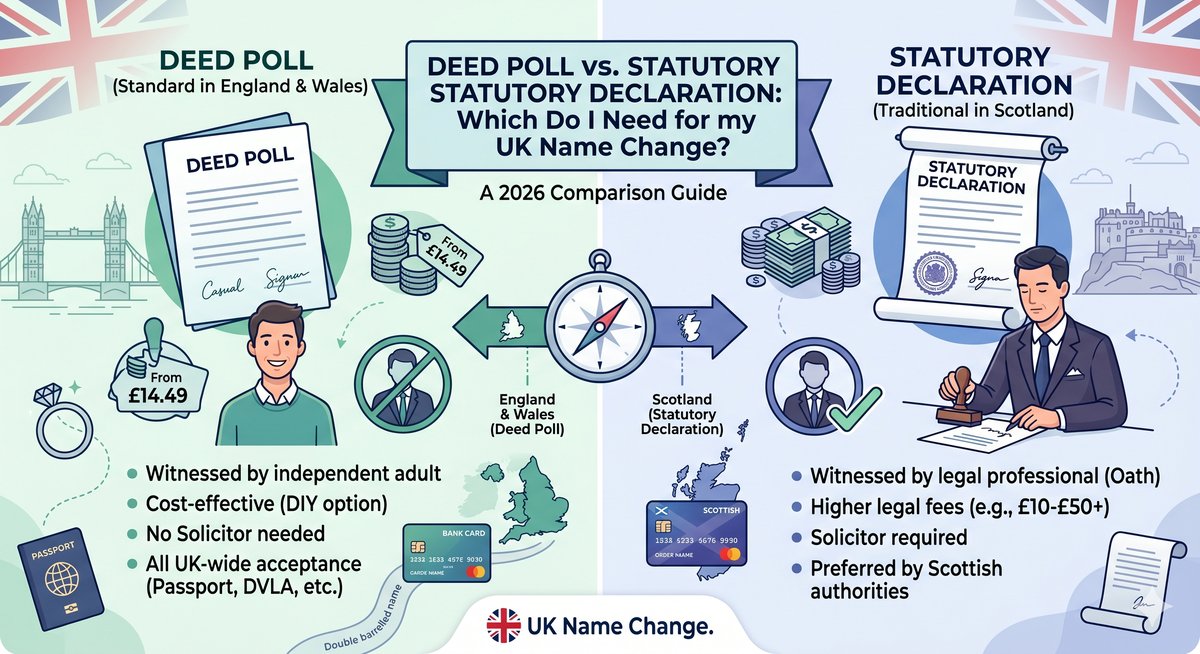
An unenrolled deed poll is fully legal and is accepted by HM Passport Office, the DVLA, schools, the NHS, banks and HMRC. Around 98% of all UK name changes are unenrolled, and there is no legal advantage to paying for enrolment. You do not need a solicitor - a solicitor would charge £150-£300+ for the very same document.
What it costs
A professionally printed child deed poll from UK Name Change starts at £14.49, with same-day dispatch on orders placed before 3pm and free Royal Mail Tracked delivery. After that, updating your child’s records is largely free: the NHS, schools and banks update names at no charge. A child passport can then be reissued in the new name through HM Passport Office (an adult UK passport costs £102 online or £115.50 by post, for reference).
For the full step-by-step on consent, witnessing and updating records, see our guide on how to change a child’s surname legally in the UK.
Route 2: A parent refuses or can’t be found - the Specific Issue Order
If a person with parental responsibility will not consent - or has disappeared and cannot be traced - you cannot simply sign a deed poll and proceed. Changing a child’s name against the wishes of a PR-holder, or without their knowledge, can be challenged and reversed. The lawful way to resolve the disagreement is to ask the family court to decide.
How it works
You apply for a Specific Issue Order under section 8 of the Children Act 1989, using form C100. This is the order the court uses to settle a single, specific question about a child’s upbringing - in this case, their name. In most cases you must first attend a MIAM (a mediation information meeting) before the court will accept your application, unless an exemption such as domestic abuse applies.
The court’s only test is the welfare of the child - not what either parent wants. A judge will weigh the reasons for the change, the child’s wishes (depending on their age and understanding), the importance of the link to each parent, and whether the new name is in the child’s best interests. If the court grants the order, that order is your legal authority to change the name; you can then issue a deed poll to evidence it for passports and records.
What it costs
The court application fee for a C100 is £263 (you may qualify for fee remission on a low income). If the case is contested and you instruct a solicitor or barrister, legal costs frequently run into four figures. This is precisely why the court route should be reserved for genuine disputes - it is slower, more stressful and far more expensive than a consent-based deed poll.
If you’re in this position, read our detailed walkthrough on changing a child’s surname without the other parent’s consent, which covers the court process, evidence and what to do when a parent can’t be found.
Side-by-side: deed poll vs Specific Issue Order
| Deed poll (all agree) | Specific Issue Order (dispute) | |
|---|---|---|
| When to use it | Everyone with PR consents | A PR-holder refuses or can’t be found |
| What you need | Deed poll + written consent from each PR-holder | Form C100 application to the family court |
| Who decides | The parents | A family court judge |
| Cost | From £14.49 | £263 court fee + any legal costs |
| Timescale | Same-day dispatch before 3pm | Several months, often longer if contested |
Do you need to “enrol” a child’s deed poll?
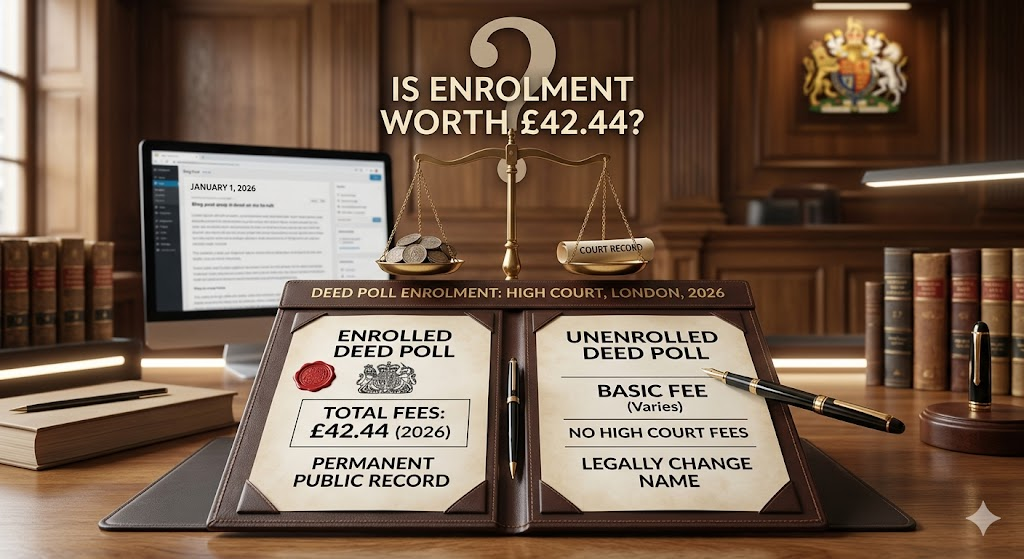
No. Enrolment at the Royal Courts of Justice is optional and costs £53.05. It simply publishes the name change publicly in the London Gazette and takes 2-3 weeks - it adds no legal validity. An unenrolled deed poll is just as binding and is accepted everywhere that matters. Most parents skip it.
One important point that catches people out: enrolling a child’s deed poll still requires the consent of everyone with PR. Enrolment is not a workaround for a missing or objecting parent - only a Specific Issue Order can resolve that.
Frequently Asked Questions
Can I change my child’s name with a deed poll if the other parent disagrees?
No. If anyone with parental responsibility objects, a deed poll alone is not enough and can be challenged. You must apply to the family court for a Specific Issue Order, which lets a judge decide based on the child’s welfare.
What if the other parent has disappeared and I can’t get consent?
You cannot lawfully proceed without their consent just because they are absent. You should apply for a Specific Issue Order; the court can deal with situations where a parent cannot be traced. There is more detail in our guide on changing a child’s surname without the other parent.
Is a deed poll cheaper than going to court?
Considerably. A child deed poll starts at £14.49, while a C100 court application costs £263 before any solicitor fees, which can run into the thousands if the matter is contested.
Does my child need a court order to change just their first name?
Not if everyone with PR agrees - a deed poll covers forenames and surnames alike. A court order is only needed where there is a dispute, regardless of which part of the name is changing.
At what age can a child change their own name?
From 16 a young person can change their own name and sign their own deed poll. Under 16, the change must be authorised by everyone with parental responsibility.
Do I still need a deed poll after I win a Specific Issue Order?
Yes, usually. The court order authorises the change, but a deed poll is the practical document that HM Passport Office, the DVLA and banks use to update records. Adults changing their own name can use our adult deed poll service; for a child, you’ll need a child deed poll.
Ready to change your child’s name?
If everyone with parental responsibility agrees, you don’t need a court - you need a properly drafted, legally valid deed poll. Order a professionally printed child deed poll from UK Name Change for just £14.49, with same-day dispatch before 3pm and free tracked delivery. Trusted by over 160,000 customers.