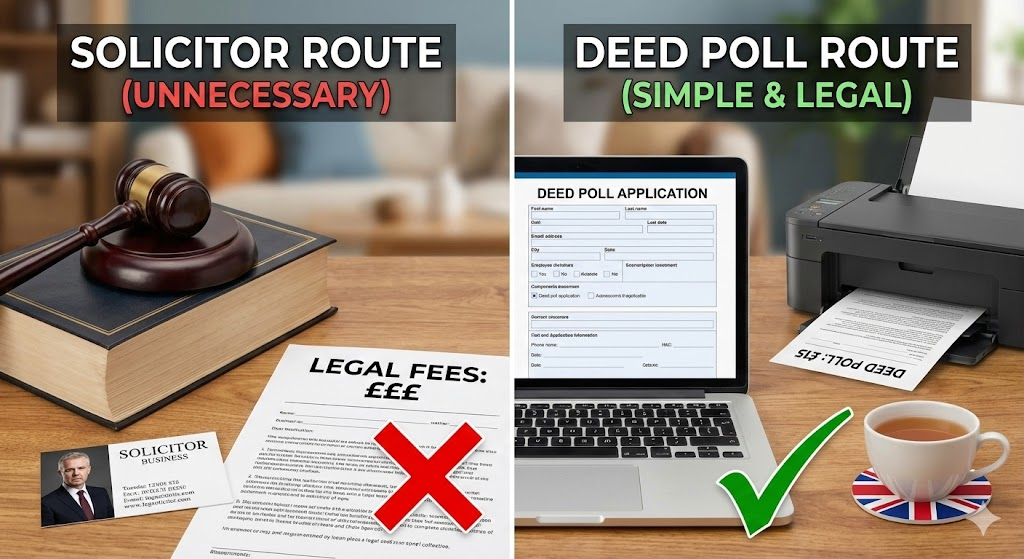
In the vast majority of cases, changing your name in the United Kingdom is a seamless, administrative task that takes less than fifteen minutes. However, when life becomes complicated—particularly in matters involving children, absent parents, or legal disputes—the path to a new identity can feel like a maze. At UK Name Change, we are more than just a document provider; we are your thought partner in navigating these high-stakes transitions across London and the wider UK.
One of the most frequent questions we receive in 2026 is whether a standard deed poll is "enough" or if the situation requires a Court Order. While we specialise in providing legally valid deed polls, understanding when the court must step in is crucial to ensuring your documents are accepted by the Passport Office and the DVLA. This guide breaks down the legal distinction between these two routes and helps you determine the right path for your unique situation.
The General Rule: When a Deed Poll is Sufficient
For most adults and many families, a deed poll is the only legal document required to change a name. You do not need court involvement if:
- You are 16 or over: You have the legal capacity to choose your own name. No one else’s permission is required.
- Unanimous Consent for Children: If you are changing the name of a child under 16 and everyone with Parental Responsibility (PR) agrees to the change in writing.
In these scenarios, our solicitor-approved deed polls are exactly what you need. They are affordable, instant, and guaranteed to be accepted by all major UK institutions. However, the legal landscape shifts significantly when consent is missing.
The Power of Parental Responsibility (PR)
To understand why you might need a court order, you first need to understand Parental Responsibility. In England and Wales, PR gives a parent the legal right to make important decisions about a child’s upbringing—including their name.
PR is automatically held by the mother. A father typically has PR if he was married to the mother at the time of birth or is named on the birth certificate (for births registered after December 2003). Even if you are the primary caregiver or have "sole custody," if the other parent has PR, you cannot legally change the child's surname without their written consent or a court order.
When is a Court Order Required?
A court order acts as a legal "override." It is required in complex situations where the standard deed poll process reaches a standstill. There are two primary scenarios where you must look to the family courts:
1. Disagreement Between Parents
If you wish to change your child’s surname (for example, to a double-barrelled name or to match your own new surname) but the other parent with PR refuses to sign the consent form, you cannot simply use a deed poll. If you try to do so, the HM Passport Office will reject the application. You must apply for a Specific Issue Order (SIO) under Section 8 of the Children Act 1989.
2. The Absent Parent Scenario
This is a common "complex situation" for many families in London. If the other parent has PR but has been absent for years and cannot be located, you still legally need their consent. While you can attempt to provide evidence of "reasonable steps" to find them, government bodies are increasingly strict. A court order is the most robust way to ensure the name change is recognised without future challenges.
Understanding Specific Issue Orders (SIO)
A Specific Issue Order is a directive from the family court that determines a specific question regarding a child’s welfare—in this case, their name. When a judge hears a case for a name change, they do not focus on the "rights" of the parents; they focus entirely on the Welfare Checklist.
The court will consider:
- The child's emotional and physical needs.
- The likely effect on the child of a change in circumstances.
- The child’s age, maturity, and their own wishes (particularly if they are over 12).
- The importance of maintaining a link with the paternal/maternal surname.
Note for 2026: Courts are increasingly favourable toward double-barrelled surnames as a compromise that preserves the child's link to both families while satisfying the resident parent’s desire for a name change.
The Cost and Process of a Court Order
Unlike a deed poll, which is nearly instantaneous with UK Name Change, a court order involves a timeline of months and higher costs. As of 2026, the application fee for a C100 form (Specific Issue Order) is £232. This does not include potential solicitor fees if you choose to be represented in court.
| Feature | Unenrolled Deed Poll | Specific Issue Order (Court) |
|---|---|---|
| Cost | From £19.49 | £232 (Application fee only) |
| Timeline | Instant Download | 3 - 6 Months |
| Requirement | Unanimous PR Consent | Used when consent is refused |
| Acceptance | 100% (with consent) | High (Legally mandates the change) |
How UK Name Change Helps in Complex Cases
You might think that if you need a court order, you don't need a deed poll. In fact, it is usually the opposite. Once the court grants you a Specific Issue Order, you still need a deed poll to serve as the formal evidence of the change for organisations like your child's school, the NHS, and the Passport Office.
When you have a court order, you use our service to generate a deed poll, and you present the Deed Poll + Court Order together as a "complete legal set." This combination is ironclad and ensures that no bank or government clerk in the UK can refuse your request.
Prohibited Steps Orders (PSO)
It is also worth mentioning the "defensive" side of this legal coin. If you have Parental Responsibility and you discover that the other parent is attempting to change your child's name without your consent, you can apply for a Prohibited Steps Order. This legally prevents them from taking that step until a judge has made a final decision on the matter.
Summary: Which Path is Right for You?
If you are in a "complex situation," the best approach is to try and reach an agreement first. Mediation is often a mandatory first step before the court will even hear an SIO application. If an agreement is reached, a standard child deed poll from our platform is all you need, saving you hundreds of pounds in court fees.
However, if the safety or well-being of the child is at stake, or if the other parent is truly absent, the court order provides the finality and legal protection you need. Once that order is in your hand, UK Name Change provides the professional documentation to finalise the process instantly.
A name change is a deeply personal journey, but it must be built on a solid legal foundation. Whether your situation is simple or involves the complexities of the family court, we are here to ensure your transition is legally sound and stress-free.
Ready to see if a deed poll is sufficient for your family? Explore our Child Deed Poll options today. If you are navigating a dispute and need to understand exactly how our documents interact with a Specific Issue Order, please contact our expert support team for a confidential consultation.