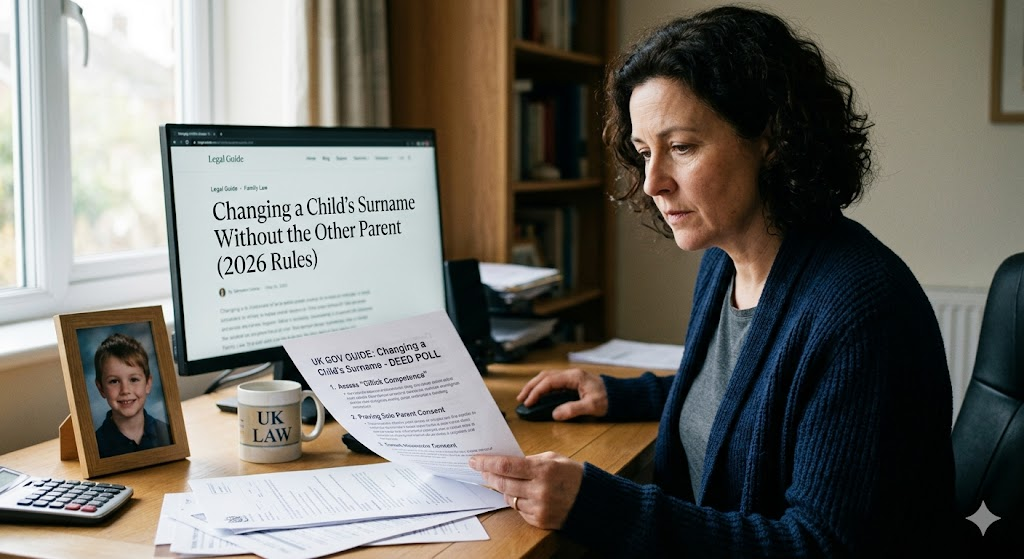
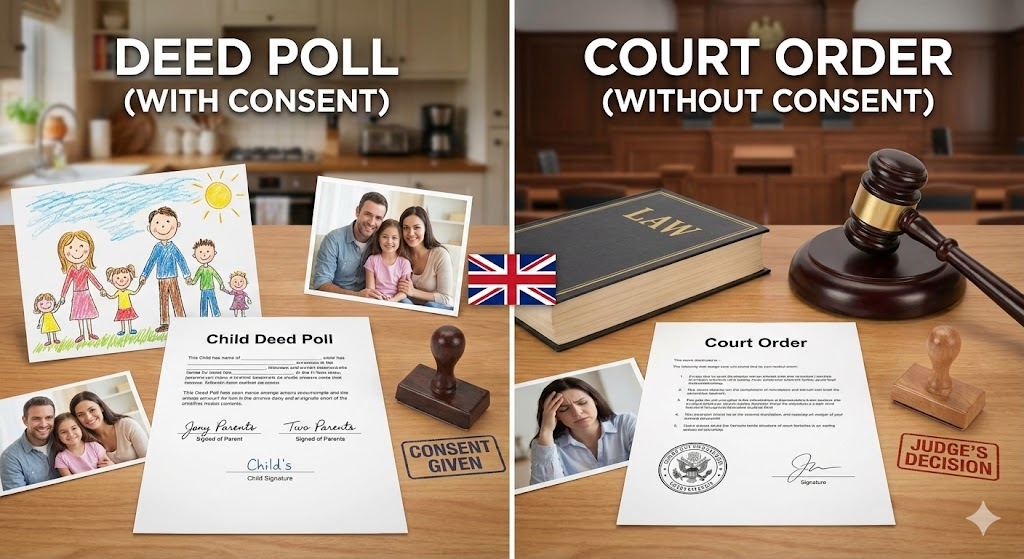
In a surname dispute between parents, neither the father nor the mother has the final say on their own-changing a child’s surname requires the agreement of everyone who holds parental responsibility, or a court order if they cannot agree. The law does not give either parent a casting vote because of their sex, who the child lives with, or whose surname the child currently uses. What matters is parental responsibility (PR), and the deciding standard, if it ever reaches a judge, is always the welfare of the child.
Why neither parent automatically “wins”
It is one of the most common misconceptions in UK family law: parents often assume that the mother, the resident parent, or the parent the child lives with most of the time can simply decide. That is not how it works. A child’s surname is treated as a matter of shared parental responsibility, and the settled legal position is that you cannot change a child’s surname without the written consent of every person who holds PR for that child.
So the practical answer to “who has the final say?” is: nobody acting alone. If both parents hold parental responsibility, both must agree. If only one parent holds PR, that parent can change the name-but disputes most often arise precisely because more than one person has a say.
First, work out who holds parental responsibility
Disputes are won and lost on this single question, so establish it before anything else.
Mothers
A child’s birth mother automatically has parental responsibility from birth, and she does not lose it on separation or divorce.
Fathers
A father has parental responsibility if he was married to (or in a civil partnership with) the mother when the child was born, or-for children in England and Wales born from December 2003-if he is named on the birth certificate. He can also acquire PR by a parental responsibility agreement with the mother or by a court order.
The crucial point
If the father holds PR, the mother cannot change the child’s surname without his consent, and vice versa. A father who is not on the birth certificate and never married the mother may not have PR-but he can still apply to the court to object to a change, and a judge can stop it. Having no PR does not mean a parent has no voice.
The three flashpoints where disputes erupt
1. At birth registration
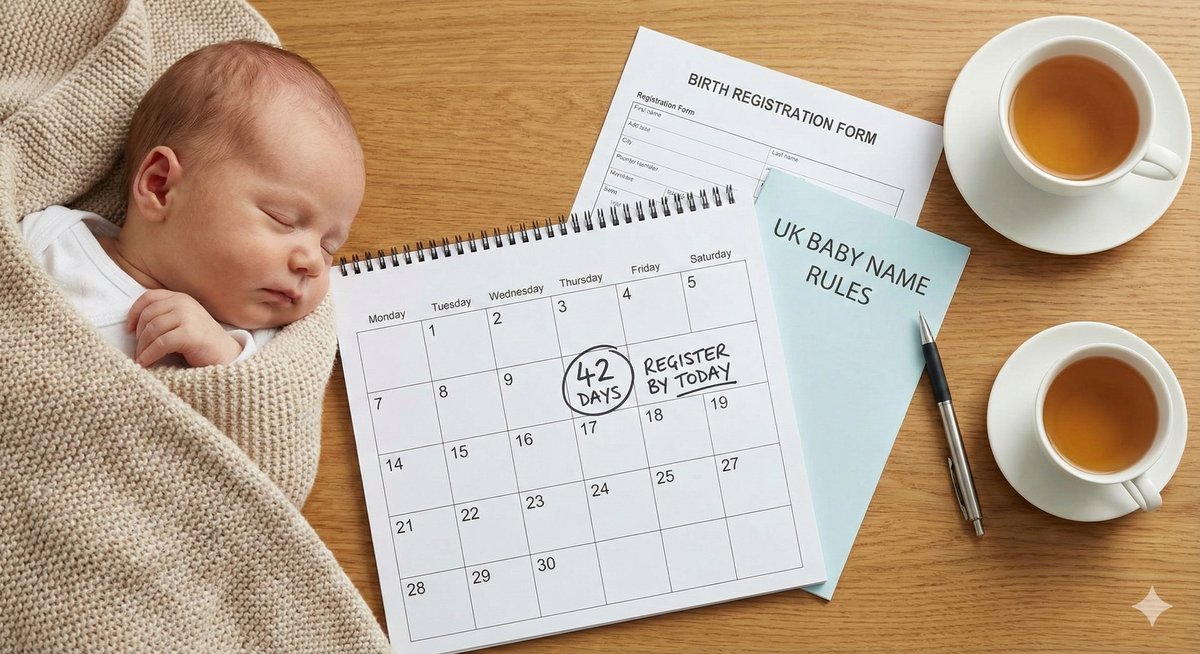
Married parents register the birth jointly and have equal rights, so the surname is agreed between them. An unmarried mother can register the birth and choose the surname on her own-but if the father is then added to the certificate (acquiring PR), any later change needs his consent too. Many disputes begin here, when one parent registers a surname the other never agreed to.
2. When one parent wants to change the surname
This is the classic father vs mother flashpoint-typically after separation, when one parent wants the child to take a new partner’s name, revert to a maiden name, or be double-barrelled. To do this lawfully by deed poll, every PR-holder must sign. A child’s deed poll signed by only one of two PR-holders is not valid and will be rejected by HM Passport Office, the DVLA, schools and the NHS.
3. Everyday use of an unofficial name
Calling a child by a different surname at school or the GP without consent is not a legal name change, and it frequently triggers a dispute when the other parent finds out. It also will not change the name on a passport or any official record.
How the law resolves a deadlock
If the PR-holders genuinely cannot agree, the only routes forward are mediation or court. Before most family court applications you are expected to attend a Mediation Information and Assessment Meeting (a MIAM) to consider mediation first-it is far cheaper and faster than litigation and keeps the decision in the parents’ hands.
If agreement is still impossible, either parent can apply to the family court. The parent who wants the change applies for a Specific Issue Order; the parent who opposes it applies for a Prohibited Steps Order to prevent it. The court then decides using the welfare checklist-it asks what is best for the child, not which parent has been wronged or who pays the bills.
What the court actually weighs up
- The child’s welfare, which is the paramount consideration in every case.
- The reasons for and against the proposed change.
- The effect on the child’s sense of identity and their links to both parents.
- The child’s own wishes and feelings, weighted by age and understanding.
- The maintenance of the relationship with the parent whose name might be dropped.
Courts are generally cautious about removing a parent’s surname, because a name is an important link to that side of a child’s family. A common compromise is a double-barrelled surname combining both parents’ names-a solution judges order frequently because it preserves the child’s connection to each parent. The dispute and court route is covered in more depth in our guide to choosing between a deed poll versus a court order for a child’s name change.
Children aged 16 and over
Once a young person reaches 16, they can change their own name and sign their own deed poll-the consent battle between parents no longer applies. For under-16s, the consent of everyone with parental responsibility remains essential, which is exactly where disputes arise.
If you both agree: the simple, low-cost route
Where every PR-holder consents, you do not need a solicitor or a court. A professionally printed child’s deed poll, signed by all PR-holders, is all you need to update the passport, school records, NHS and bank accounts. Our child deed poll service starts from £14.49 with same-day dispatch if ordered before 3pm and free Royal Mail Tracked delivery-a fraction of the £150-£300+ a solicitor would charge for the same document. If an adult in the family also wants to change their surname at the same time, our adult deed poll service works the same way and is accepted by HM Passport Office, the DVLA, HMRC and banks.
An unenrolled deed poll is fully legally valid-around 98% of UK name changes are unenrolled, and enrolment at the Royal Courts of Justice (£53.05) is optional and adds no legal validity. Once the deed poll is signed by all PR-holders and an independent adult witness, you can update the DVLA, banks, HMRC and the NHS for free.
Frequently Asked Questions
Can a mother change her child’s surname without the father’s consent?
Not if the father holds parental responsibility. If he does, his written consent is required, or a court order. Our guide on changing a child’s surname without the other parent explains the limited circumstances where it is possible.
Can a father stop the mother changing the child’s surname?
Yes. A father with PR can simply withhold consent, which blocks a deed poll change. Even a father without PR can apply to the court for a Prohibited Steps Order to prevent the change.
Does the parent the child lives with have the final say?
No. Being the resident parent gives no extra power over the surname. All PR-holders must still agree, regardless of who the child lives with.
What happens if we simply cannot agree?
You attend a MIAM and try mediation first, and if that fails either parent applies to the family court. The judge decides on the child’s welfare, not on which parent “deserves” it. Double-barrelling is a frequent compromise.
Is using a different surname at school a legal change?
No. Informal use changes nothing on official records and cannot update a passport. A legal change needs a valid deed poll signed by all PR-holders, or a court order.
Do both parents have to sign the child’s deed poll?
If both hold parental responsibility, yes-every PR-holder must sign, along with two independent adult witnesses. A deed poll missing a required signature will be rejected by HM Passport Office and other bodies.
Ready to change your child’s surname the right way?
If everyone with parental responsibility agrees, there is no need for a solicitor or the courts. Order a professionally printed, legally valid child deed poll from just £14.49, with same-day dispatch before 3pm and free tracked delivery-trusted by over 160,000 customers. If consent is the sticking point, read our companion guides first so you take the right route the first time.