In the UK there is no legal limit on how often you can change your name - you can do it as many times as you like. Under English common law your name is simply the name by which you are known, so you are free to adopt a new one whenever you wish, executing a fresh deed poll each time. There is no waiting period between changes, no maximum number, and no official register that “uses up” your allowance. The only real considerations are practical: keeping a clear paper trail, updating your records consistently, and making sure repeat changes never look like you are trying to hide something.
What the law actually says
The right to change your name in England and Wales is rooted in common law, not in any statute that caps the number of changes. The Enrolment of Deeds (Change of Name) Regulations and the practice of the Royal Courts of Justice both proceed on the assumption that a person may change their name freely. Nowhere in UK law is there a clause that says “you may only do this once” or “you must wait X years before changing again”.
In practice, this means a single person could, over a lifetime, change their name at marriage, change it back after divorce, adopt a new name for personal reasons, and change it again later - all entirely lawfully. Each change is evidenced by its own deed poll. Around 98% of UK name changes are done with an unenrolled deed poll, which is legally valid and accepted by HM Passport Office, the DVLA, HMRC, banks, the NHS, employers and schools.
So if it’s unlimited, why do people worry?
The confusion usually comes from conflating legal limits with practical scrutiny. While the law places no cap on frequency, organisations that issue high-security documents - chiefly HM Passport Office - are alert to fraud. Frequent name changes in a short window are not illegal, but they can prompt a few sensible extra checks.
This is not a punishment and it does not mean your change is invalid. It simply means that if you have, say, changed your name three times in two years, an examiner may want reassurance that you are genuinely using your new name and are not assuming identities to evade debt, criminal records or other obligations. The fix is straightforward: keep good records and be ready to show them.
What “extra scrutiny” looks like
If a passport or other application triggers a second look, you might be asked to provide:
- Each deed poll in the chain, not just the most recent one;
- Evidence that you have actually used the new name - bank statements, utility bills, payslips or an employer’s letter;
- In rare cases, a short interview to confirm your identity.
None of this blocks a legitimate change. It is friction, not a barrier, and it disappears entirely when your paperwork is consistent and complete.
The golden rule: keep a clean paper trail
If there is one thing that matters more than how many times you change your name, it is whether the documents tell a coherent story. A clean paper trail links every name you have legally held, in order, so that anyone reviewing your history can follow it without gaps.
Keep every deed poll - forever
Never throw away an old deed poll, even after you have changed your name again. Each one is a legal record of a specific change. When you apply for a mortgage, a security-vetted job, an enhanced DBS check or a renewed passport, you may be asked to evidence the whole chain from your birth name to your current one. A single missing link can cause delays that take weeks to untangle. Store both the original wet-ink documents and clear scans somewhere safe.
Update your records consistently and promptly
When you change your name, update all your records to the same new name at roughly the same time - passport, driving licence, bank, HMRC, NHS, employer and utilities. Mismatched records (a bank in your old name, a passport in your new one) are the single most common cause of awkward questions. Updating most of these is free: the DVLA driving licence name change costs nothing, and banks, HMRC, the NHS, employers and utilities all update for free. The main cost is a new passport (£102 online, £115.50 by post).
Avoid overlapping or inconsistent names
Trouble starts when someone uses one name in one place and a different name in another at the same time. That is what creates the impression of hiding something. Pick a date, change everything across to the new name, and keep the deed poll that proves it.
Common reasons people change their name more than once
Multiple name changes are completely ordinary, and examiners see them all the time. The usual situations include:
- Taking a spouse’s name on marriage, then reverting after divorce - we cover the revert in detail in our guide on changing your name back to your original name in the UK;
- Adjusting a name during or after gender transition;
- Correcting a poorly worded DIY deed poll by issuing a clean, professionally drafted one;
- Personal, cultural or religious reasons, or simply preferring a different name.
If you already know you will be making more than one change - for example, a first name now and a surname later - it is worth sequencing them sensibly. Our guide to planning multiple name changes strategically explains how to time changes to minimise the number of times you re-document everything.
Does enrolment help if I change my name often?
Some people assume that enrolling a deed poll at the Royal Courts of Justice gives a frequent name-changer more legitimacy. It does not. Enrolment (£53.05) publishes your name change publicly in the London Gazette and takes 2-3 weeks, but it adds no extra legal validity over an unenrolled deed poll. Your unenrolled deed poll is just as legally binding for a first change as for a fifth. The only thing enrolment changes is that the record becomes public - which most people changing their name repeatedly would rather avoid.
Do it properly each time
Because every change needs its own document, the quality of each deed poll matters. A correctly drafted, properly witnessed deed poll is exactly what prevents the “hiding something” impression and keeps your paper trail clean.
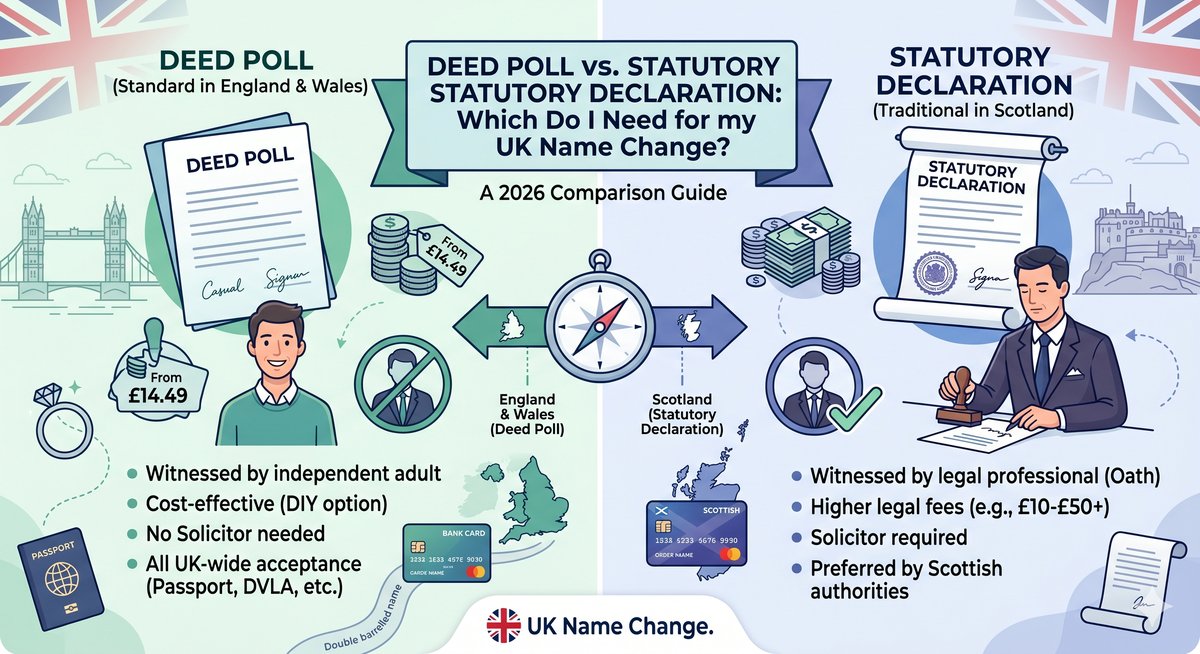
Remember the essentials: anyone aged 16 or over can change their own name and sign their own deed poll; each witness must be an independent adult aged 18 or over who is not a relative, partner or someone living at your address; and HM Passport Office, the DVLA and banks all require the original wet-ink signed deed poll, not a photocopy. A solicitor would charge £150-£300+ for the same document, which is entirely unnecessary. You can get a professionally printed adult deed poll from £14.49 with same-day dispatch on orders placed before 3pm and free Royal Mail Tracked delivery.
Frequently Asked Questions
Is there a maximum number of times I can change my name in the UK?
No. There is no legal maximum and no statutory limit. You can change your name as many times as you wish over your lifetime, with a separate deed poll for each change. The only practical advice is to keep every deed poll and update your records consistently.
Do I have to wait a certain time between name changes?
No. There is no mandatory waiting period between changes under UK law. You could legally change your name again the day after a previous change. Bear in mind, though, that very frequent changes may prompt extra identity checks from organisations like HM Passport Office, so be ready to evidence each one.
Will changing my name several times flag me as a fraud risk?
Not on its own. Multiple changes are lawful and common. What matters is consistency: keep all your deed polls, use the new name everywhere at once, and be able to show bills or statements in your name if asked. A clear paper trail removes any suspicion.
Do I need a new deed poll for every change?
Yes. Each name change must be evidenced by its own deed poll. You cannot reuse an old document or simply “amend” it. Keep all previous deed polls as proof of the full chain from your birth name to your current name.
Does each name change cost the same?
The deed poll itself starts from £14.49 each time. The other costs are the same whenever you update records: the DVLA licence change is free, banks, HMRC, the NHS and employers update for free, and a new adult passport is £102 online or £115.50 by post.
Should I enrol my deed poll if I change my name regularly?
There is no benefit to it. Enrolment costs £53.05, takes 2-3 weeks and publishes your name in the London Gazette, but adds no legal validity. An unenrolled deed poll is accepted everywhere that matters and keeps your change private.
Ready to change your name the right way?
Whether it’s your first change or your fifth, a properly drafted document keeps your paper trail clean and your change accepted everywhere. Order your professionally printed adult deed poll from £14.49 with free tracked delivery and same-day dispatch before 3pm - trusted by over 160,000 customers.