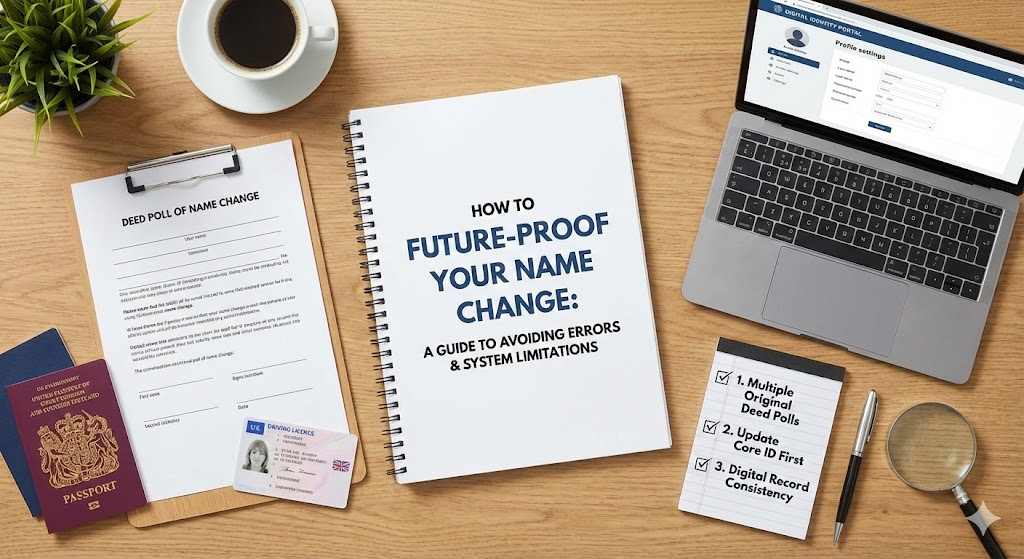
If you know you’ll change your name more than once - perhaps in transition stages, or with a marriage followed by a further change - the smartest strategy is to plan around your passport renewal and your “final” name, batch your updates so you only run the admin once, and use a low-cost unenrolled deed poll for each step. Get the sequence right and you can avoid paying twice for the same expensive documents and the same hours of form-filling.
This guide is purely about sequencing multiple changes. If you simply want to know whether repeated changes are allowed, read our pillar guide on how often you can change your name in the UK; if you’re considering returning to a former name, see changing your name back to your original name.
Why sequencing matters: the cost is in the records, not the deed poll
A deed poll itself is cheap. Our professionally printed, legally valid unenrolled deed poll starts at just £14.49, and the same document is accepted by HM Passport Office, the DVLA, HMRC, banks, the NHS, your employer and schools. Around 98% of UK name changes are unenrolled, so for most people a second or third deed poll is a small, predictable cost.
The real expense and effort sit in the records you update after signing - above all your passport. A UK adult passport costs £102 online (£115.50 by post). Renew it twice in close succession because you changed your name twice and you’ve effectively doubled that bill. The whole point of strategic sequencing is to make sure each expensive update happens once, against your settled name.
Map your changes before you start
Write down every name you expect to hold and roughly when. A typical multi-stage path might look like this:
- Transition in stages: a first name change early on, then a later refinement once the right name feels settled.
- Marriage plus a further change: taking a spouse’s surname, then adjusting a first or middle name afterwards (or vice versa).
- A combined change: realising part-way through that two planned steps can be merged into one.
Once it’s on paper, one question usually answers itself: can any of these steps be combined? The cheapest multiple name change is the one you turn into a single change.
The golden rule: time your passport around your final name
Your passport is the costliest and slowest document to update, so it should anchor your whole plan. Wherever possible, avoid renewing your passport for an interim name. If you can hold off updating it until you’ve reached the name you intend to keep, you pay the £102 fee once instead of twice.
That said, never let an out-of-date passport block essential travel. If you must fly under an interim name, your passport must match your ticket - so update it, and treat the later change as a fresh (but planned) cost. If you do need it quickly, the 1-week Fast Track service is £192 and the 1-day Premium service is £239.50, which makes the case for planning ahead even stronger.
Front-load the free updates between changes
Not everything needs to wait. Plenty of records are free to change, so during an interim stage you can keep daily life consistent without spending a penny:
- DVLA driving licence - free to update.
- Banks, building societies and credit cards - free.
- HMRC, the NHS, your GP and pharmacy - free.
- Employer, payroll and pension - free.
- Utilities, council tax, insurers and subscriptions - free.
The exception is the driving licence if it’s your main photo ID. If a further change is imminent and you don’t need the licence for ID, it can be sensible to update it once at the end alongside the passport - but since it’s free, there’s no financial penalty for changing it at each stage.
Keep records consistent: maintain a clean “identity chain”
The biggest risk with multiple changes isn’t cost - it’s a broken paper trail. An organisation may need to see how you got from your birth name to your current one. Each deed poll links one name to the next, so keep every deed poll you’ve ever signed, in order, even the superseded ones.
Store the originals, not just copies
HMPO, the DVLA and banks require the original wet-ink signed deed poll, not a photocopy or scan. Keep each original safe and in date order. If you change your name twice, you may need to show both documents to prove the full chain - for example, “birth name → name A” and then “name A → name B”. A missing link in the middle is what causes records to be refused.
Update everything to the same name before you stop
After each change, work methodically through a checklist so no account is left on an old name. A single overlooked record - an old store card, a dormant pension, a utility account - can resurface months later and force you to dig out a deed poll you’d filed away. Consistency now saves a scramble later.
One deed poll per change - don’t cut corners
Every distinct change of name needs its own deed poll executed for that specific change. You can’t reuse one document for two changes, and you shouldn’t try to “skip” the intermediate document - doing so breaks the identity chain we described above.
The good news is that each one is inexpensive and fast. A new adult deed poll from UK Name Change is dispatched the same day if you order before 3pm, with free Royal Mail Tracked delivery, so a planned second change need not slow you down. Compare that with a solicitor charging £150-£300+ for an identical document and the savings across multiple changes add up quickly.
Remember what doesn’t need a deed poll
A title - Mr, Mrs, Ms, Mx or Dr - is not legally part of your name, so changing only your title needs no deed poll at all. If one of your planned “changes” is really just a title update, you can cross it off the list and update records directly, for free.
Should you ever enrol a deed poll in a multi-change plan?
Enrolling a deed poll at the Royal Courts of Justice costs £53.05, publishes your name change publicly in the London Gazette and takes 2-3 weeks. Crucially, it adds no legal validity - your unenrolled deed poll is already fully accepted. If you expect further changes, enrolment is usually the wrong choice: you’d pay the fee and create a permanent public record for a name you may soon replace. Most people changing names in stages are better off staying unenrolled at every step.
Weighing it up first? Our companion piece on the costs and benefits of multiple name changes covers when a second change is worth it.
Frequently Asked Questions
How long should I wait between name changes?
There’s no legal waiting period - you can change your name again as soon as a new deed poll is signed and witnessed. Strategically, though, leave enough time to settle on a name you’ll keep, so you don’t pay to renew your passport for an interim name. Our guide on how often you can change your name covers the rules in full.
Do I need a new deed poll for each change, or can I reuse one?
You need a separate deed poll for each change. A deed poll records one specific change from your old name to your new one, so a second change requires a fresh document. Keep every original - together they prove the chain from your birth name to your current name.
Can I combine a marriage name change and a further change into one deed poll?
Yes. If you know you want both your married surname and a different first or middle name, you can change to the full final name in a single deed poll rather than doing two separate updates. This is the cheapest, cleanest route - one document, one round of record updates.
What’s the cheapest way to handle several name changes?
Combine steps where you can, time your passport renewal around your settled name, and front-load all the free updates (DVLA, banks, HMRC, NHS, employer) between changes. Use a low-cost unenrolled deed poll - from £14.49 - for each genuine change and avoid optional enrolment.
Will changing my name twice confuse banks or the passport office?
Not if your paper trail is intact. Present your deed polls in date order so each one links to the next, and always provide the original wet-ink document. A complete chain is exactly what HMPO, the DVLA and banks need to accept multiple changes.
Is it worth enrolling my deed poll if I’ll change my name again?
Usually not. Enrolment costs £53.05, takes 2-3 weeks and publishes your name in the London Gazette, but adds no legal validity. If a further change is likely, you’d be paying to publicise a name you intend to replace. Stay unenrolled at each stage.
Plan once, change confidently
A multi-stage name change doesn’t have to mean double the cost or double the admin - it just needs a plan. Settle on your final name, anchor the timing around your passport, keep every deed poll safe in order, and batch your record updates. When you’re ready for your next step, order your adult deed poll from £14.49 with same-day dispatch and free tracked delivery - trusted by over 160,000 customers.