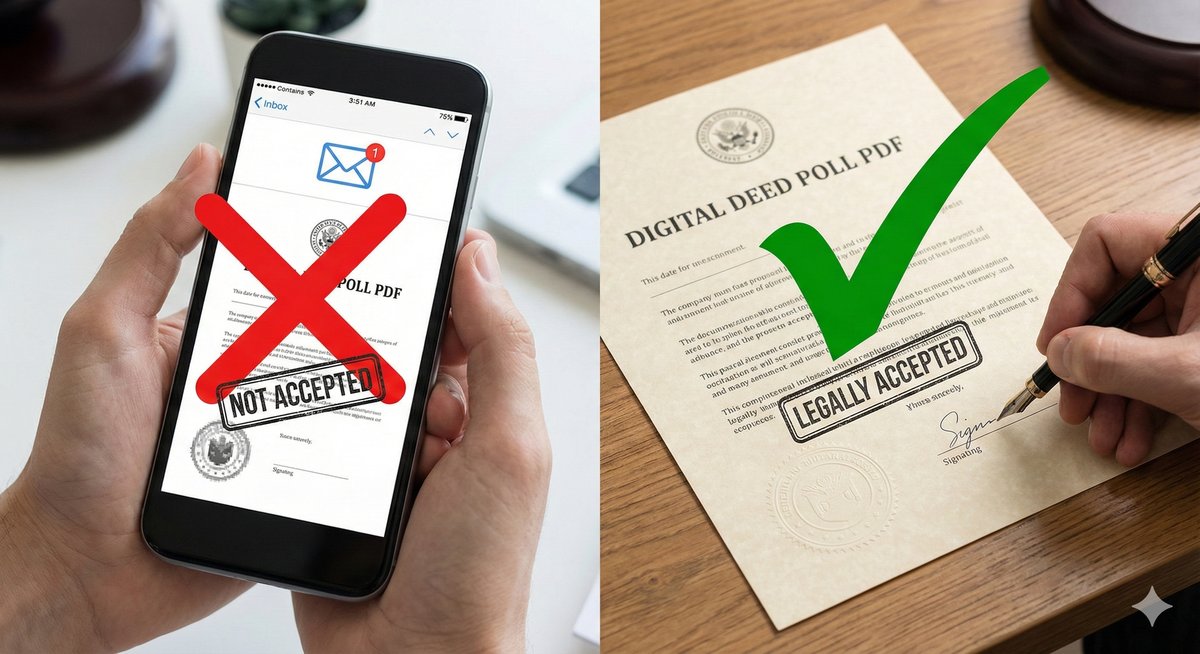
Yes - a deed poll is legally recognised throughout the United Kingdom. A correctly executed deed poll is a binding legal document that proves you have abandoned your former name and adopted a new one. It does not need to be registered with the government, stamped by a court, or approved by anyone. Its authority comes from centuries-old common law, and it is accepted by HM Passport Office, the DVLA, HMRC, the NHS, banks, employers and schools right across England, Wales, Scotland and Northern Ireland.
What does ‘legally recognised’ actually mean?
People often assume that for a name change to be “official”, the state must record it in a central register - the way a birth or marriage is registered. That is not how names work in the UK. There is no national name registry, and you are not legally required to ask the government for permission to be known by a different name.
Under the law of England and Wales (and the equivalent common-law positions in Scotland and Northern Ireland), you are free to call yourself whatever you wish, provided there is no intent to defraud. Your legal name is, in essence, the name you use and are known by. A deed poll simply puts that change into formal, written, evidential form - a single document everyone can rely on as proof.
So “legally recognised” here means two things: first, that the act of changing your name is lawful and effective; and second, that the deed poll document is accepted as valid evidence of that change by the organisations that matter.
The legal basis: common law, not statute
A deed poll is rooted in English common law, which has long permitted a person to change their name freely. The word “deed” describes a particular, time-honoured category of legal document - one that records a solemn, binding declaration. A “poll” historically referred to a deed with a clean-cut (polled) edge, made by one party rather than two.
In practice, your deed poll contains three promises: that you give up your old name, that you adopt and will use your new name at all times, and that you require everyone to address you by your new name. Once you sign it in front of two witnesses, that declaration is legally binding. There is no Act of Parliament you must satisfy and no official body whose stamp you must obtain. The document stands on its own. If you want a fuller breakdown of how the document is structured and operates, see our guide to what a deed poll is and how it works.
What makes a deed poll legally binding?
Recognition is not automatic - the document has to be executed correctly. A deed poll becomes legally binding when two conditions are met:
1. You sign it in wet ink
You must sign your deed poll by hand, in pen, using both your old and new signatures as the document directs. Anyone aged 16 or over can change their own name and sign their own deed poll. For under-16s, everyone with parental responsibility must consent.
2. Two independent adults witness your signature
Your signature must be witnessed by two independent adults aged 18 or over. Neither witness can be a relative, your spouse or partner, or anyone who lives at the same address as you. They watch you sign, then add their own signature, name and address. This independent witnessing is what gives the deed its evidential weight - it confirms that you, and only you, made the declaration freely.
That is genuinely all it takes. There is no requirement to have a solicitor draft or sign it - a solicitor would typically charge £150-£300+ for exactly the same document - and no requirement to enrol it at court. Our professionally printed adult deed poll arrives ready to sign, with clear instructions, from £14.49.
Enrolled and unenrolled deed polls are equally valid
This is the single biggest source of confusion, so let’s be unambiguous: an unenrolled deed poll carries exactly the same legal force as an enrolled one. Both prove your name change. Neither is “more legal” than the other.
An unenrolled deed poll is the standard document. You sign it, it is witnessed, and it is immediately effective. Around 98% of UK name changes are done this way. It is accepted by HM Passport Office, the DVLA, HMRC, banks, the NHS, employers and schools without issue.
An enrolled deed poll is the same document, except a copy is lodged with the Royal Courts of Justice and your name change is published publicly in The London Gazette. Enrolment costs £53.05, takes around 2-3 weeks, and creates a permanent public record. Crucially, enrolment adds no legal validity whatsoever - it is purely an optional public-register and archival step. Most people skip it, and there is rarely any practical reason not to.
In other words, the £14.49 unenrolled deed poll and the deed poll that has been through the £53.05 court enrolment process change your name with identical legal effect.
Who recognises a deed poll?
A properly executed deed poll is accepted as proof of your new name by every major UK institution, including:
- HM Passport Office - to issue a passport in your new name (an adult passport is £102 online or £115.50 by post).
- The DVLA - to update your driving licence (this is free).
- HMRC - for your tax records and National Insurance (free to update).
- The NHS - to update your medical records and NHS number details (free to update).
- Banks and building societies - to update accounts, cards and mortgages (free to update).
- Employers, schools and universities - for payroll, records and certificates.
One important practical point: these organisations need to see the original, wet-ink signed deed poll - not a photocopy or a scan. Always keep your original safe and send it (or present it) when asked, then have it returned. For more on using the document day to day, read our guide to using a deed poll as official proof of your name.
Do you need the government’s permission?
No. Because the right to change your name sits in common law, no part of central government grants, approves or registers an ordinary name change. The government’s only role is downstream: updating its own records (passport, driving licence, tax) once you present a valid deed poll. We cover this fully in our explainer on whether you need the UK government to change your name.
Frequently Asked Questions
Is a deed poll legally binding?
Yes. A deed poll is a formal legal deed — binding from the moment it is signed in wet ink before two independent adult witnesses. It commits you to using your new name for all purposes, and it obliges UK organisations to update your records when you present it. It does not expire and does not need renewing or registering.
Is an unenrolled deed poll legally binding?
Yes — exactly as binding as an enrolled one. Enrolment at the Royal Courts of Justice only adds a public-record entry for £53.05; it does not add legal force. Around 98% of UK name changes are made with an unenrolled deed poll (from £14.49).
Is an unenrolled deed poll legally recognised, or do I have to enrol it?
An unenrolled deed poll is fully legally recognised. Enrolment at the Royal Courts of Justice (£53.05) is entirely optional and adds no legal validity - it only publishes your name change publicly in The London Gazette. Around 98% of name changes in the UK are unenrolled.
Does a deed poll need to be signed by a solicitor to be valid?
No. A deed poll does not need a solicitor at all. It becomes legally binding once you sign it in wet ink and an independent adult witnesses your signature. A solicitor would charge £150-£300+ for the identical document, which is unnecessary.
Who can witness my deed poll?
Any independent adult aged 18 or over who is not a relative, your spouse or partner, and does not live at your address. They must watch you sign and then add their own signature, full name and address.
Is a deed poll recognised in Scotland and Northern Ireland?
Yes. A deed poll is recognised across the whole of the UK. The right to change your name by deed exists at common law in England, Wales and Northern Ireland, and Scotland recognises name changes too. UK-wide bodies such as HM Passport Office, the DVLA and HMRC accept a valid deed poll regardless of where you live.
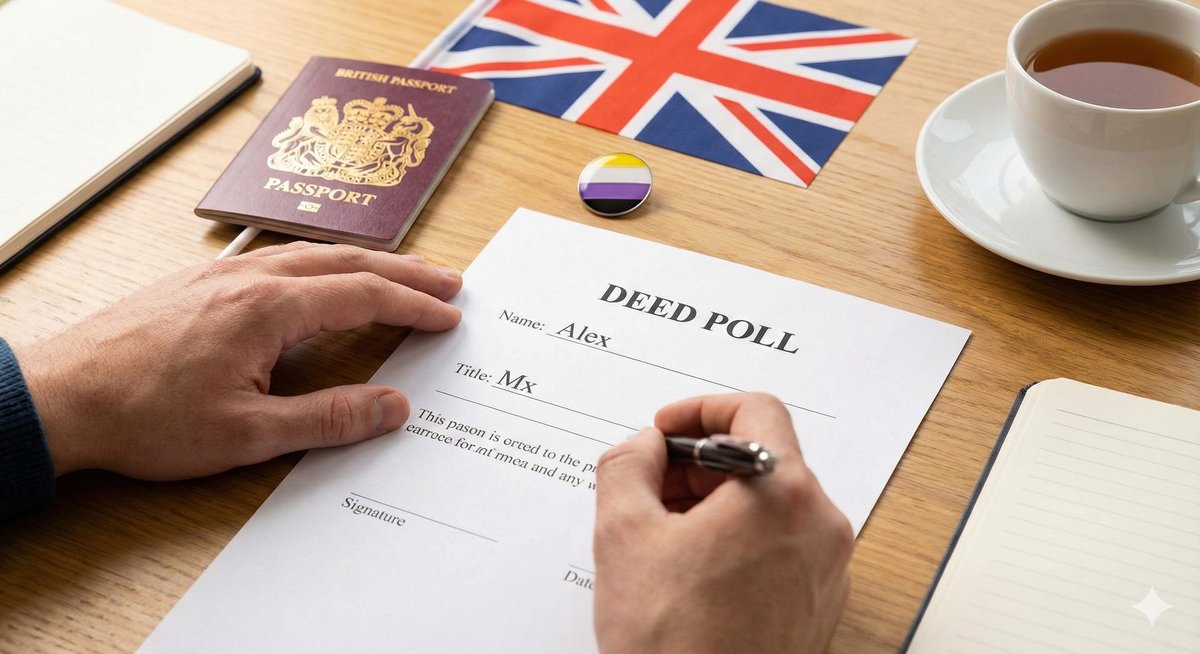
Do I need a deed poll to change my title, like Mr to Mx or Dr?
No. A title such as Mr, Mrs, Ms, Mx or Dr is not legally part of your name, so no deed poll is required to change it. You can simply ask organisations to update the title they hold for you.
Change your name with a deed poll that’s recognised everywhere
A deed poll is legally recognised across the UK from the moment it is correctly signed and witnessed - no court, no government approval and no solicitor needed. Order your professionally printed adult deed poll from £14.49, with same-day dispatch on orders placed before 3pm and free Royal Mail Tracked delivery. Trusted by 160,000+ customers.