If you want to keep your maiden name when you marry in the UK, you don’t have to do anything at all. Marriage never automatically changes your surname - that’s a myth. Your name stays exactly as it is on your birth certificate, passport, bank accounts and every other document unless you actively choose to change it. Keeping your maiden name is the simplest, cheapest and most common-sense option of all: it costs nothing, requires no paperwork, and is completely legal.
This guide is for anyone who wants reassurance that “keeping my own name” is a real, respectable, normal choice - and a clear picture of what it means day to day. If you have decided you do want to take your spouse’s surname, see our companion guide on how to change your surname after marriage in the UK instead.
You don’t have to change anything - here’s why
In English and Scottish law, getting married has no effect on your legal name. The tradition of a wife adopting her husband’s surname is exactly that - a tradition, not a legal requirement. There is no law, anywhere in the UK, that obliges you to change your name when you marry, whoever you marry.
If you do nothing, you simply remain known by the name you already have. There is no form to fill in, no fee to pay, no deadline to meet and no one you need to notify. Your passport, driving licence, NHS records, bank accounts and employment records all stay precisely as they are. This is the choice made by a large and growing number of people - and it is becoming more common with every passing year.
Your options at a glance
“Keeping your maiden name” can actually mean a few slightly different things. Here are the main routes people take.
1. Keep your name entirely (the “do nothing” option)
You carry on exactly as before. No paperwork, no cost, nothing to update. Your maiden name is your name, full stop. This is by far the easiest path and is fully recognised by every UK authority.
2. Keep your maiden name professionally, use your married name socially
Some people legally take their spouse’s surname but continue to use their maiden name at work - for their byline, their reputation, their professional contacts or their qualifications. This is perfectly normal: a title and the name you go by socially carry no legal weight on their own. If you want your legal name to change while keeping a professional name, that’s covered in our surname-change-after-marriage guide.
3. Add your spouse’s name without losing yours
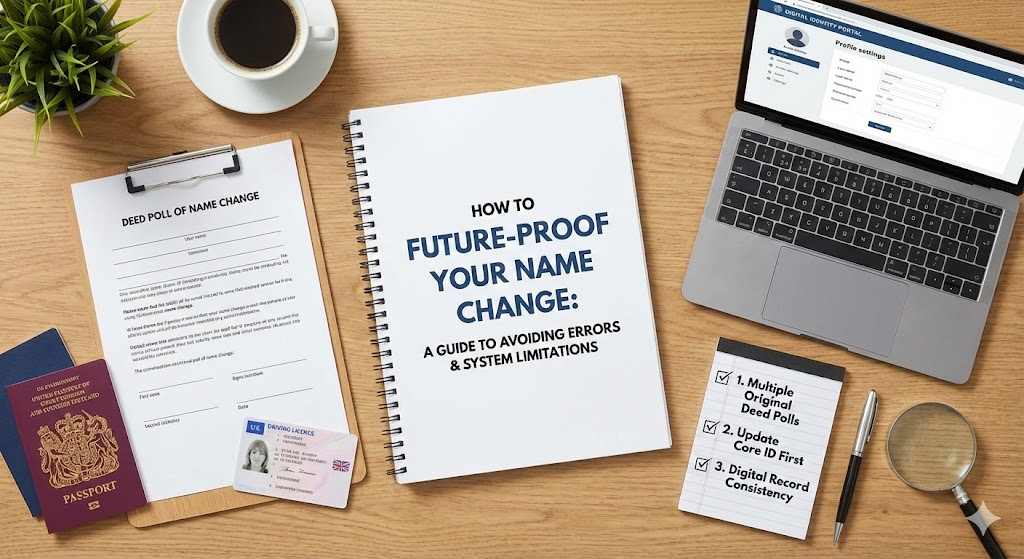
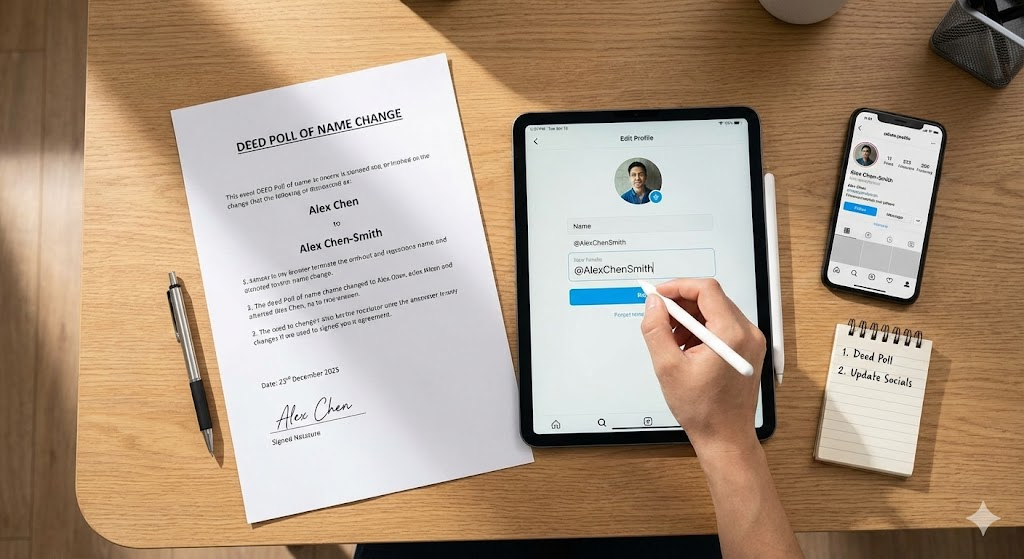
You might want to keep your maiden name but also add your spouse’s surname - for example double-barrelling the two (Smith-Jones), or moving your maiden name to a middle name. These genuinely change your legal name, so they need a deed poll rather than a marriage certificate. A marriage certificate only lets you swap your surname for your spouse’s; it cannot create a double-barrelled name, a blended name or a meshed name. For any of those, a deed poll is the document you need.
If you are simply keeping your maiden name unchanged, though, you need none of this - that’s the whole point.
‘Mrs’, ‘Ms’ or ‘Miss’? It’s entirely your choice
Your title is not legally part of your name, so you can use whichever you like - and you can change it whenever you want, with no deed poll and no paperwork. Keeping your maiden name doesn’t lock you into ‘Miss’.
- Ms - the most popular choice for married people keeping their maiden name. It says nothing about your marital status, which many find tidy and modern.
- Mrs - you can absolutely be “Mrs” with your maiden name. ‘Mrs’ signals that you’re married; it does not require your husband’s surname.
- Miss - perfectly fine to keep using if you prefer it.
To switch titles, just start using the new one and tell organisations when it’s convenient - your bank, GP and employer will update it on request, free of charge. Because a title isn’t part of your legal name, there’s nothing official to file.
Travel and your passport
This is the question that worries people most, and the answer is reassuring: if you keep your maiden name, your passport already matches it, so there is nothing to do and nothing to explain at the airport.
The golden rule of travel is that your ticket must match the name in your passport. If your passport says your maiden name and you book your flights in your maiden name, everything lines up perfectly - which is exactly the situation you’re in by keeping your name. You won’t need a marriage certificate, you won’t need to update anything, and you can honeymoon the day after the wedding without a second thought.
For context, if you were changing your name, a UK adult passport costs £102 online or £115.50 by post (with 1-week Fast Track at £192 and 1-day Premium at £239.50). Keeping your maiden name means you skip that cost entirely.
Children’s surnames when parents have different names
Keeping your maiden name has no bearing on what surname your children can have - you have complete freedom here. Children can take either parent’s surname, a double-barrelled combination of both, or a blended name entirely of your choosing. None of this depends on the parents sharing a surname.
A few practical notes:
- Registering a baby: when you register the birth, you simply state the surname you’ve chosen. There’s no requirement for it to match either parent.
- Travelling with your children: if your child’s surname differs from yours, border officials very occasionally ask for proof of your relationship. Carrying the child’s birth certificate (which names you as the parent) resolves this instantly. It’s rare, but easy to plan for.
- Changing a child’s surname later: this is done by deed poll and needs the consent of everyone with parental responsibility. Our child deed poll service covers exactly that.
Documents and admin: the short answer
The best part of keeping your maiden name is the admin you avoid. There is no list of organisations to notify, no documents to reissue and no fees to pay. For comparison, someone changing their name typically updates their passport, driving licence (free at the DVLA), bank, HMRC, NHS, employer and utilities - all of which are free to update, but all of which take time. By keeping your name, every one of those records is already correct.
If you change your mind later
Keeping your maiden name now never closes the door. You can take your spouse’s surname at any point after the wedding using your marriage certificate - there’s no time limit - or change to any name you like by deed poll whenever you wish. And if a marriage later ends, you’re already in the simplest position of all; for context on the reverse situation, see our guide on reverting to your maiden name after divorce.
Frequently Asked Questions
Do I have to change my name when I get married in the UK?
No. There is no UK law requiring you to change your name when you marry. Marriage does not automatically change your surname. If you do nothing, you keep your maiden name and every existing document stays valid - no paperwork, no fee, no deadline.
Can I be called ‘Mrs’ if I keep my maiden name?
Yes. A title is not legally part of your name, so you can be ‘Mrs’ with your maiden surname if you like. Many people who keep their name choose ‘Ms’ instead, as it doesn’t indicate marital status. You can switch titles any time, with no deed poll needed.
Will keeping my maiden name cause problems at the airport?
No. Travel only requires your ticket to match your passport. Since your passport already shows your maiden name, booking in that same name means everything matches and there’s nothing to prove or update.
Can my children have a different surname from mine?
Yes. Children can take either parent’s surname, both double-barrelled, or another name of your choice, regardless of whether the parents share a surname. If a child’s surname differs from yours, carrying their birth certificate easily covers any questions when travelling.
Can I take my husband’s name later if I change my mind?
Yes. There is no time limit. You can adopt your spouse’s surname later using your marriage certificate, or change to any name by deed poll whenever you wish. Keeping your maiden name now keeps all your options open.
Do I need a deed poll to keep my maiden name?
No - not if you’re simply keeping it unchanged. You only need a deed poll if you want to actively change your name, such as double-barrelling your maiden name with your spouse’s or moving it to a middle name, since a marriage certificate can’t do those.
Want to combine names instead of just keeping yours?
If keeping your maiden name has you thinking about double-barrelling, blending your two surnames, or moving your maiden name to a middle name, a marriage certificate can’t do it - but a deed poll can. UK Name Change provides a professionally printed, legally valid unenrolled deed poll from £14.49, accepted by HM Passport Office, the DVLA, HMRC, banks, the NHS and employers, with same-day dispatch on orders before 3pm and free Royal Mail Tracked delivery. Trusted by over 160,000 customers. Order your adult deed poll here.