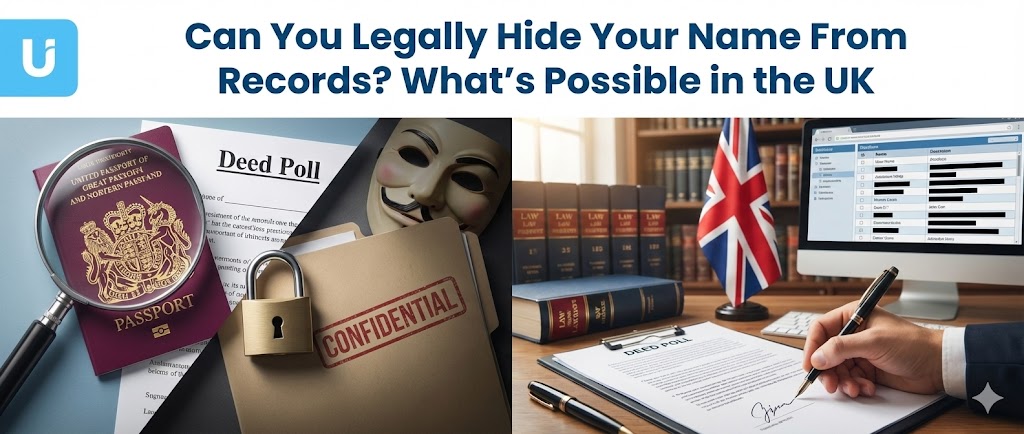
In an age of digital footprints and open data, maintaining privacy is becoming a luxury. Whether you are a high-profile individual, a survivor of domestic abuse, or simply someone who values their anonymity, you might be asking: "Can I legally hide my name from public records?"
The short answer is: You cannot be a ghost to the government, but you can be invisible to the public.
While HMRC, the police, and the Passport Office must always know who you are, there are specific legal mechanisms in the UK to remove your name and address from publicly searchable databases. At UK Name Change, we help clients navigate the balance between legal compliance and personal privacy. Here is what is possible.
1. The "Deed Poll" Privacy Trap
If your goal is privacy, your first step—changing your name—is where most people make a critical mistake.
The Trap: "Enrolling" your Deed Poll. When you enroll a Deed Poll with the Royal Courts of Justice, your old name, new name, and home address are published in The London Gazette. This is a permanent, searchable online record. It effectively announces your new identity to the world.
The Solution: Use a Standard (Unenrolled) Deed Poll. This is a private legal document. It is accepted by all government bodies (Passport Office, DVLA, HMRC) but is never published. It creates no public link between your old and new identities.
2. Hiding from the Electoral Roll
The Open Register (or "Edited Register") is a version of the electoral roll that can be bought by anyone—marketing firms, private investigators, and "people finder" websites.
- Level 1: Opt Out of the Open Register. You can do this simply by ticking a box on your annual canvass form. This stops your data being sold, but you remain on the "Full Register" (visible at local council offices).
- Level 2: Anonymous Registration. If your safety is at risk (e.g., from domestic abuse or stalking), you can apply to register anonymously. This means your name and address will not appear on any version of the register. You will need to provide evidence, such as a court order or an attestation from a senior police officer or social worker.
3. Companies House (Directors & Business Owners)
Historically, becoming a company director meant publishing your home address online. Laws have since tightened to protect privacy.
- Home Address: You can (and should) use a "Service Address" (like an accountant's office) for the public register. Your home address is then kept on a private register, accessible only to credit agencies and the police.
- Suppressing History: If you previously used your home address as your registered office, you can apply (Form SR01) to have it removed from historical documents for a fee.
- "Serious Risk" Protection: In extreme cases where you are at serious risk of violence, you can apply to have your name protected from the public register entirely, though this is rare and requires significant proof.
4. Land Registry
Property ownership in England and Wales is a matter of public record. Generally, anyone can pay £3 to find out who owns a specific house.
However, if you are at risk, you can apply to the Land Registry to verify your identity and prevent your personal details from being easily accessed. You can also put a Restriction on your title (Form RQ) to stop your property being sold or mortgaged without your specific consent, which protects against property fraud.
5. The "Right to Be Forgotten" (GDPR)
You have the right to ask organisations to delete your personal data if it is no longer necessary. This applies to:
- Old social media accounts.
- Marketing databases.
- Search engine results (in some cases).
However, this right is not absolute. You cannot ask a bank to delete your credit history, nor can you ask the police to delete a criminal record, as these are considered "public interest" or legal obligations.
Summary: What Can You Hide?
| Record Type | Can you hide it? | How? |
|---|---|---|
| Name Change | YES | Use an Unenrolled Deed Poll. |
| Electoral Roll | YES | Opt out of Open Register; Apply for Anonymous Registration if at risk. |
| Company Directorship | PARTIAL | Use a Service Address; Apply to suppress home address. |
| Land Ownership | DIFFICULT | Requires proof of "serious risk" to hide ownership details. |
| Criminal/Tax Records | NO | Government bodies must hold accurate data. |
Protect Your Privacy from Day One
If you are planning a name change to secure your privacy, starting with the right documentation is vital. Our Complete Package provides you with a private, unenrolled Deed Poll—the foundation of a discreet identity change.
Secure your privacy today. Start your confidential application.
HTML