If you are changing your name to help escape domestic abuse, the safest route is a privately printed, unenrolled deed poll - it is fully legal, accepted everywhere your name is needed, and, unlike the optional enrolment service, it never publishes your old name, new name or address anywhere public. This guide is written gently and without judgement. If you are in immediate danger, please call the police on 999 now. For confidential support at any time, the National Domestic Abuse Helpline is open 24 hours a day on 0808 2000 247.
You are not alone, and you do not have to decide everything today
Leaving an abusive relationship - or planning to - takes enormous courage, and a name change can be one part of building a life that feels like your own again. For some people it is about safety and not being found. For others it is about closure: shedding a name that carries painful memories and choosing one that feels like a fresh start. Both reasons are completely valid, and you do not owe anyone an explanation.
This guide focuses on doing it privately and safely. Take what is useful, leave the rest, and go at your own pace. Where your situation also involves a current or former partner following or contacting you, our companion guide on changing your name safely as a victim of stalking or harassment covers that angle in more depth.
Why an unenrolled deed poll is the private, safe choice
In the UK there are two ways to formalise a name change, and the difference matters enormously for your safety.
Unenrolled deed poll (recommended for privacy)
An unenrolled deed poll is a signed and witnessed legal document that you keep yourself. It is not held on any public register. Around 98% of UK name changes are done this way, and it is legally valid and accepted by HM Passport Office, the DVLA, HMRC, the NHS, banks, employers and schools. From £14.49, we print a professional document on quality paper and dispatch it the same day if you order before 3pm, with free Royal Mail Tracked delivery. There is nothing for an abuser to search, find or be notified about.
Enrolled deed poll (avoid if privacy matters)
Enrolment at the Royal Courts of Justice costs £53.05 and adds no extra legal validity. Crucially, it publishes your old name, new name and home address in The London Gazette - a public record that is indexed by search engines and can be found by anyone, including the person you are trying to get away from. It also takes around 2-3 weeks. For survivors of abuse, enrolment is almost always the wrong choice. An unenrolled deed poll does everything you need without ever putting your details into the public domain.
A solicitor would charge £150-£300+ for the very same document, which is unnecessary. You can start a private, secure adult deed poll in minutes - anyone aged 16 or over can change their own name and sign their own deed poll.
Keeping your new name confidential
Changing your name is one step; keeping it private is another. A few practical safeguards make a real difference.
Opt out of the open electoral register
When you register to vote, your details go on the electoral roll, which has two versions. The open register can be bought by companies and viewed by the public; the full register is restricted. You can ask to be removed from the open register at any time - contact your local council’s electoral services team, free of charge. This is one of the most common ways people are traced, so it is well worth doing as soon as your new name is registered.
Consider an Anonymous Elector’s Registration
If being on the electoral roll at all would put you at risk, you may be able to register anonymously, so your name and address do not appear on either version of the register. This usually requires supporting evidence, such as a court order or a letter from a senior professional (for example a police officer, a refuge manager or a social worker). Your local electoral services team can explain how to apply.
Tell organisations one at a time, in your own order
You do not have to update everything at once. Many survivors start with the essentials - bank, GP surgery, mobile phone provider - and work outwards. Updating your records is free with the DVLA, HMRC, the NHS, your bank, your employer and your utilities. Ask each organisation how they protect your data, and whether they can add a note that your details must not be shared.
Protect your digital footprint
Update privacy settings on social media, consider removing your name from people-search and directory sites, and use a new, secure email address for your name-change admin. If you suspect tracking software on your phone, a support worker or the police can advise on checking your device safely.
Your passport and driving licence in your new name
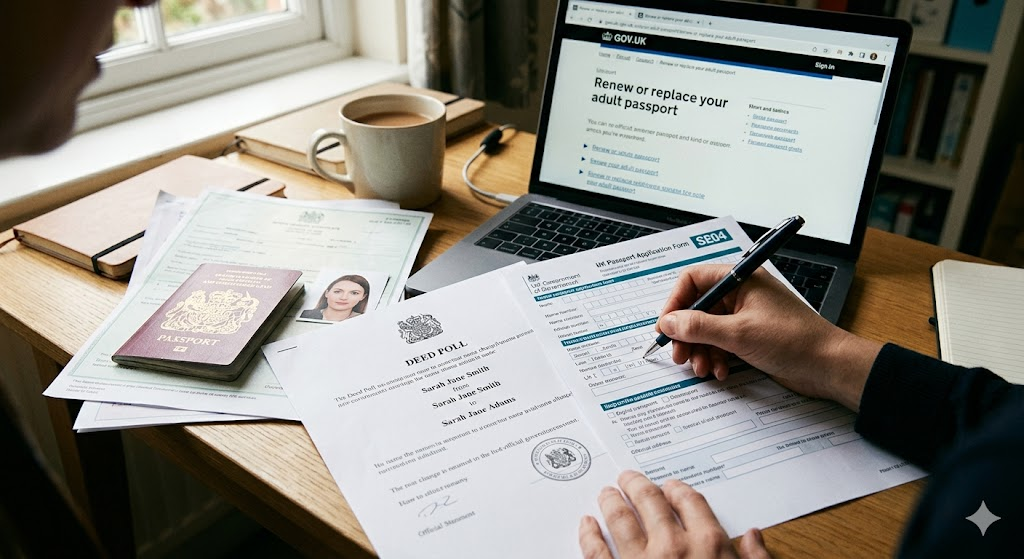
Once you have your deed poll, you can update your official ID. Send the original wet-ink signed deed poll (not a photocopy) - HM Passport Office, the DVLA and banks all need the original. A new passport costs £102 online or £115.50 by post, with a 1-week Fast Track at £192 or 1-day Premium at £239.50 if you need it urgently. A DVLA driving licence name update is free. If you have moved to a refuge or safe address, ask whether you can use a care-of or alternative correspondence address.
One small but reassuring point: a title such as Mr, Mrs, Ms, Mx or Dr is not legally part of your name, so you never need a deed poll simply to change or drop a title.
Protecting your children
If you are also thinking about changing a child’s name, this needs extra care. Under-16s require the consent of everyone with parental responsibility - which often includes the other parent - unless a court order says otherwise. Because abuse situations can make consent complex and sensitive, we have a dedicated guide to changing a child’s name safely for protection that walks through consent, court applications and keeping the change confidential.
Working with support services
You do not have to manage this alone, and the right support can make every step feel less daunting. The National Domestic Abuse Helpline (0808 2000 247), run by Refuge, is free and confidential, 24/7. Local domestic abuse services, Independent Domestic Violence Advisers (IDVAs), Citizens Advice and family law solicitors can help with safety planning, housing, protective orders and the practicalities of starting over. If you are at immediate risk, always call 999 - if you cannot speak, press 55 when prompted on a mobile to alert the operator.
Frequently Asked Questions
Will changing my name by deed poll be visible to my abuser?
Not if you use an unenrolled deed poll. It is a private document kept by you and is not listed on any public register. Only enrolment at the Royal Courts of Justice (£53.05) publishes your details in The London Gazette, which is why we recommend survivors avoid it.
Is an unenrolled deed poll really legally valid?
Yes. An unenrolled deed poll is fully legal and accepted by HM Passport Office, the DVLA, HMRC, banks, the NHS, employers and schools. Around 98% of UK name changes are unenrolled, and enrolment adds no legal weight.
Can I keep my new address hidden when updating documents?
Often, yes. Ask each organisation about safe-address options, care-of addresses, or adding a confidentiality flag to your record. Opting out of the open register and, where eligible, registering as an anonymous elector also helps keep your address private.
Do I need anyone’s permission to change my own name?
No. Anyone aged 16 or over can change their own name and sign their own deed poll without anyone else’s consent. Your deed poll does, however, need to be signed by two independent adult witnesses - not a relative, partner or anyone living at your address.
How quickly can I get my deed poll?
If you order before 3pm, your professionally printed deed poll is dispatched the same day with free Royal Mail Tracked delivery, so you can start updating your records quickly.
Take a safe, private first step
Choosing a new name can be a quiet act of reclaiming your future. When you feel ready, you can begin your confidential, unenrolled name change from £14.49 - trusted by over 160,000 customers. There is no rush, and help is always available on the National Domestic Abuse Helpline, 0808 2000 247, or the police on 999 in an emergency.