If your name contains accents or diacritics - such as é, ñ, ü, ç or å - you almost certainly do not need a deed poll to remove them for travel or UK systems. UK passports drop accents automatically using a standard international transliteration system, so “Björk” becomes “Bjork” and “François” becomes “Francois” on the passport data page. The change happens by design at the print stage; you are not legally changing your name, so a deed poll is only relevant if you want to permanently adopt the unaccented spelling across all your records.
Why UK passports remove accents and diacritics
UK passports follow rules set by the International Civil Aviation Organization (ICAO), the body that standardises travel documents worldwide. Machine-readable passports can only store a restricted set of Latin characters - the basic A-Z alphabet - so any accented letter has to be converted into its closest plain equivalent. This is called transliteration, and HM Passport Office applies it automatically when your passport is produced.
The result is that the printed name on your passport may differ slightly from the spelling on your birth certificate, EU identity card or foreign documents. Common conversions include:
- é, è, ê, ë → E (so “Renée” becomes “Renee”)
- á, à, â, ã → A
- ñ → N (so “Peña” becomes “Pena”)
- ç → C (so “Garçon” becomes “Garcon”)
- ü, ö, ä → U, O, A (German passports often expand these to UE, OE, AE instead - another source of mismatch)
- å → A, and ø → O
None of this requires your permission, a form or a fee. It is simply how the document is encoded.
The part that actually matters: the Machine Readable Zone
Look at the bottom of your passport’s data page and you will see two lines of capital letters and chevrons (<<). This is the Machine Readable Zone (MRZ) - the only part of your passport that border systems and airline computers actually read. The MRZ never contains accents; it uses the plain transliterated form. This is the single most important thing to understand, because it dictates how you should book travel.
Always book flights, trains and travel using the spelling exactly as it appears in the MRZ of your passport. If your passport prints “MUELLER” in the MRZ, book as Mueller - not Müller. A name that matches the MRZ will sail through automated gates and airline check-in, even if it differs from your birth certificate.
Why mismatches happen - and why they usually do not matter
Accent-related mismatches are extremely common and rarely cause problems, because the systems that check your identity are built around the transliterated form. The issues people worry about tend to fall into three buckets:
1. Booking against the wrong spelling
The most frequent (and most avoidable) problem is booking a ticket with accents when the passport MRZ has none, or using a foreign-document spelling that differs from the UK passport. Airlines match the travel-document name, so a small mismatch - an accent here, an expanded umlaut there - can occasionally trigger a manual check. The fix is simply to book against the MRZ spelling, not to change your name.
2. Two countries, two spellings
If you hold more than one passport, each country may transliterate your name differently - one keeps the accent, another drops it, a third expands it. That is a name-format issue rather than an accent issue, and it deserves its own approach. We cover it in detail in our guide to resolving name-format conflicts for dual nationals in the UK.
3. Inconsistent records across UK systems
Your bank might hold “García” with the accent, your passport shows “Garcia” without it, and your driving licence has something else again. This is cosmetic, but it can be irritating - and it is the one situation where you might choose to standardise. More on that below.
Do you need a deed poll to remove accents? Usually not
Here is the key legal point: removing an accent through transliteration is not a change of name. “Muñoz” and “Munoz” are treated as the same name - one is simply the machine-readable rendering of the other. Because no legal change has occurred, no deed poll is required to use the unaccented form. You can present your accented birth certificate alongside your unaccented passport and they will be accepted as referring to the same person.
You also do not need a deed poll to:
- Book travel in the transliterated spelling that matches your MRZ.
- Open or update a bank account in the plain-letter version of your name.
- Ask an organisation to update its records to match your passport spelling - many will do this on request with a copy of the passport, for free.
When a deed poll genuinely helps
A deed poll becomes useful when you want to make a deliberate, permanent choice to drop the accents everywhere and have a single document that proves it. For example:
- You want every record - passport, licence, bank, HMRC, NHS, employer - to read “Munoz” with no accent, consistently, and you want one piece of evidence that ties the spellings together.
- You are tired of explaining the discrepancy and would rather formally adopt the simplified spelling as your legal name.
- You are changing the spelling for reasons that go beyond transliteration - for instance, anglicising the structure of the name rather than just stripping accents. (If that is your situation, our guide to transliterating names and fixing spelling inconsistencies in the UK is the better starting point.)
In those cases an unenrolled adult deed poll is the simplest route. It is legally valid, accepted by HM Passport Office, the DVLA, HMRC, banks, the NHS and employers, and it gives you one authoritative document to present when you ask organisations to standardise your spelling. Around 98% of UK name changes are unenrolled, and a professionally printed deed poll from UK Name Change starts at just £14.49 - compared with the £150-£300+ a solicitor would charge for the identical document.
How to make your records consistent (the practical method)
Whether or not you use a deed poll, the goal is the same: pick one spelling and align everything to it.
Step 1: Decide on your “source of truth”
For travel and most official UK purposes, your passport is the document everything else should match. Note the exact spelling in the MRZ - that is your target.
Step 2: Update the free-to-change records first
Updating your name (or spelling) is free at the DVLA, banks, HMRC, the NHS, your employer and utility providers. Contact each one, explain you want the spelling to match your passport, and supply a copy of the passport (and a deed poll if you have chosen to use one). Most are happy to accept the transliterated form without fuss. (A new UK adult passport costs £102 online or £115.50 by post if you do later renew it in the simplified spelling, but you do not need to reissue your passport just to match other records to its MRZ.)
Step 3: Keep your supporting documents together
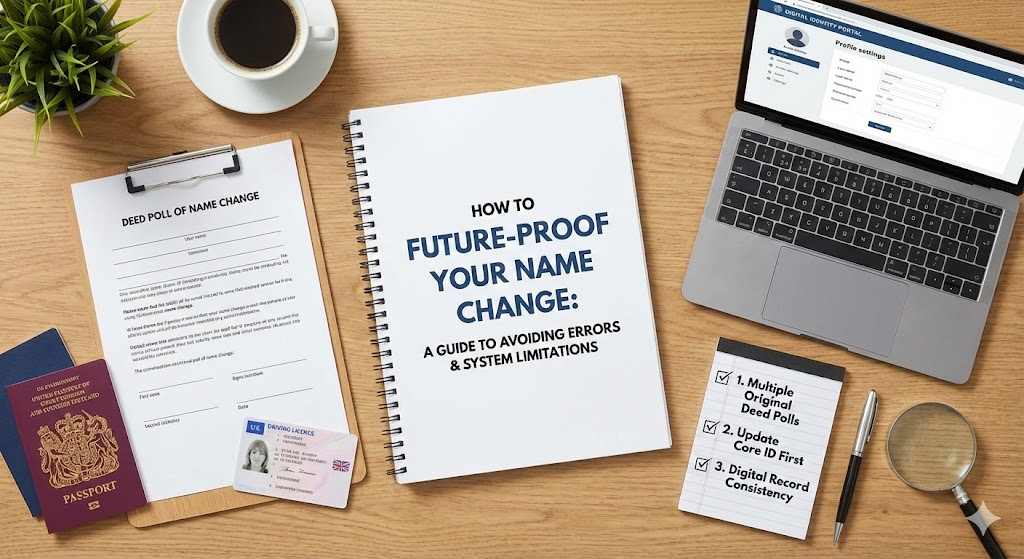
If your birth certificate keeps the accent and your passport does not, that is normal - hold on to both. They prove the link between the spellings. If you have used a deed poll, remember that HM Passport Office, the DVLA and banks need the original wet-ink signed deed poll, not a photocopy.
Step 4: Book travel against the MRZ - every time
This is the habit that prevents almost every accent-related travel headache. Match the booking to the bottom two lines of your passport and you will rarely have an issue at the gate.
Frequently Asked Questions
Will I have trouble at the airport if my ticket has no accent but my home documents do?
No. Airlines and border systems match the machine-readable transliterated form of your name, which never contains accents. As long as your ticket matches the spelling in your passport’s Machine Readable Zone, the absence of an accent is a non-issue.
Is “Munoz” legally a different name from “Muñoz”?
No. Transliteration is treated as the same name in a machine-readable form, not a new name. You do not need a deed poll to use the unaccented version, and you can present accented and unaccented documents together as referring to the same person.
Can I ask for my passport to keep the accent?
No. HM Passport Office applies ICAO transliteration automatically to all UK passports because the document can only encode the basic Latin alphabet. Accents are removed at the print stage and cannot be retained.
Should I get a deed poll just to remove accents?
Usually not - the removal is automatic and carries no legal weight to undo. A deed poll only helps if you want to permanently and consistently adopt the unaccented spelling across all records and have one document proving it. An unenrolled deed poll from £14.49 covers that, and enrolling it at the Royal Courts of Justice (£53.05) is optional and adds no legal validity.
My bank has the accent but my passport doesn’t - how do I fix it?
Contact the bank, ask them to update the spelling to match your passport, and send a copy of the passport (and a deed poll if you have one). Banks update name records for free. The same applies to the DVLA, HMRC, the NHS and your employer.
What if my two passports spell my name differently?
That is a dual-nationality name-format issue rather than a simple accent question. Each country may transliterate differently, so see our dedicated guide to name-format conflicts for dual nationals for how to handle it.
Standardise your name with confidence
Removing accents for travel is automatic and free - but if you want every record to read the same way, permanently, a deed poll gives you the clean, single source of proof to make it happen. Order a professionally printed, legally valid adult deed poll from UK Name Change for just £14.49, with same-day dispatch on orders before 3pm and free Royal Mail Tracked delivery. Trusted by more than 160,000 customers.