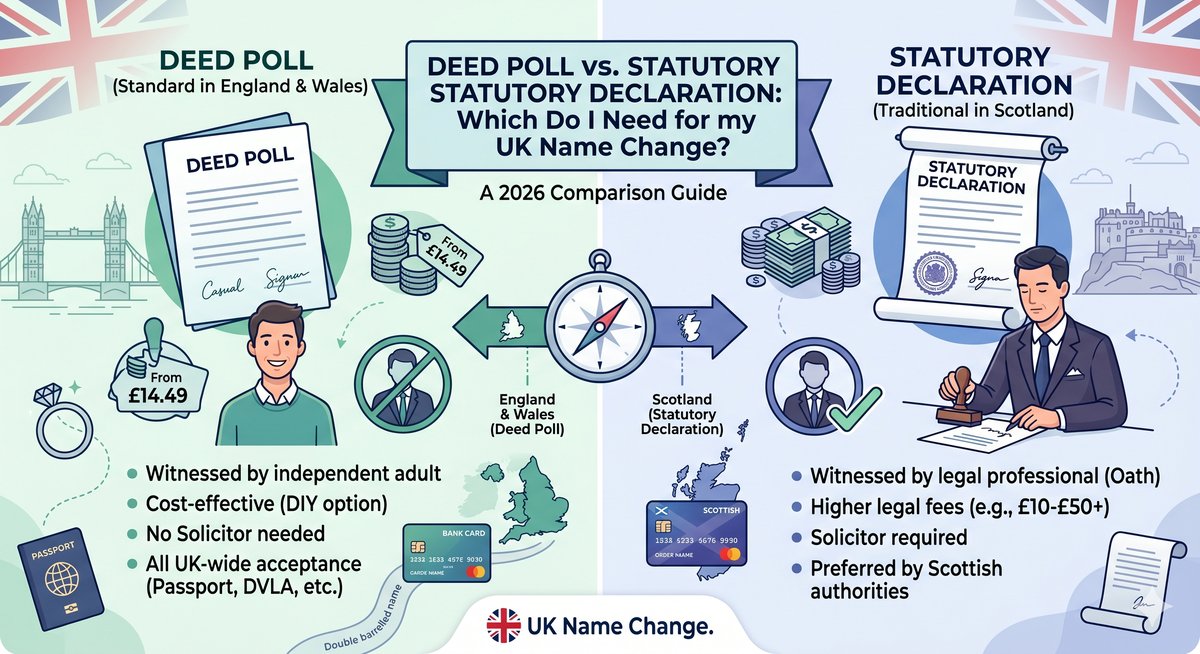
A UK deed poll changes your name under UK law, but it does not automatically update a foreign passport or overseas record - each country sets its own process. Some authorities accept a UK deed poll directly; many require it to carry an apostille, and several also demand a certified translation into the local language. For dual nationals there is an extra wrinkle: HM Passport Office expects the names on all the passports you hold to match, so the order in which you update each one matters and is country-specific.
Why a UK deed poll does not change a foreign passport automatically
A deed poll is a UK legal document. It is recognised by HM Passport Office, the DVLA, HMRC, the NHS, banks and employers because they operate under UK law. A foreign government is not bound by it. To them, your deed poll is simply foreign-issued evidence of a name change, and they will apply their own national rules before they amend their records or issue a passport in your new name.
This matters most for dual nationals, who hold a passport from another country alongside their British one. After your deed poll you can end up holding a UK passport in your new name and a foreign passport in your old name - a mismatch that causes problems at borders, with airlines and with banks. HM Passport Office generally expects the names across all your valid passports to be consistent, so the fix is to update both - but the route, and the order, differ entirely depending on the issuing country.
Step 1: Get the right document before you start
Foreign authorities almost always require the original, wet-ink signed deed poll, not a photocopy or scan, and many will want it legalised. Make sure your deed poll is correctly executed: signed by you, signed by two independent adult witnesses (18 or over, not a relative, partner or anyone living at your address), and dated. A poorly drafted document can be rejected abroad just as easily as at home.
Our professionally printed adult deed poll service produces a document from £14.49 that is accepted by UK and overseas authorities alike, with same-day dispatch on orders placed before 3pm and free Royal Mail Tracked delivery. A solicitor would charge £150-£300 or more for the same thing, which is unnecessary. If a foreign embassy asks for additional originals, you can order more than one copy - useful when an apostille office keeps the document for processing.
Step 2: Understand apostilles and certified translations
Two requirements come up again and again with foreign authorities, so it is worth understanding them before you apply.
The apostille
An apostille is an internationally recognised certificate that confirms a UK document is genuine. It is issued by the Legalisation Office (part of the Foreign, Commonwealth & Development Office) and is accepted by the 120-plus countries that are party to the Hague Apostille Convention. If a foreign authority asks you to “legalise” or “authenticate” your deed poll, an apostille is usually what they mean. You apply directly to the FCDO, which charges a per-document fee plus return postage; allow a couple of weeks for the standard service.
The certified translation
If the receiving country’s official language is not English, you will often need a certified translation of your deed poll - and sometimes of the apostille too. “Certified” means produced by a professional translator or agency who attaches a signed statement of accuracy; some embassies keep a list of approved translators and will reject anything else. Always confirm the exact wording and format the authority expects before paying for translation, because requirements vary widely.
You only need enrolment at the Royal Courts of Justice (£53.05, taking 2-3 weeks) if a particular foreign body specifically insists on a court-registered deed poll. Enrolment adds no legal validity in the UK and publishes your name change publicly in the London Gazette, so most people never need it - around 98% of UK name changes use an unenrolled deed poll. Check first; do not enrol “just in case”.
Country-by-country: how foreign authorities treat a UK deed poll
Rules change, so always verify with the relevant embassy or consulate, but the broad patterns are well established.
European Union countries (France, Germany, Spain, Italy, Poland and others)
Most EU states are Hague Convention members, so they accept a UK deed poll carrying an apostille, usually with a certified translation into the local language. Be aware that some EU countries have restrictive naming laws - France and parts of Germany, for example, historically limit which names you may adopt - so a name that is fine in the UK may need extra justification, or in rare cases may not be accepted at all for the foreign record.
The United States
The US generally recognises a foreign court order or deed poll, but practice varies between US embassies and the agencies that issue Social Security and state documents. Expect to provide the apostilled deed poll and supporting ID, and check whether your specific consulate wants a translation (English documents are usually fine for US purposes). A name change on a US passport is a separate application from any state-level record update.
India and Pakistan
Both are common for British dual nationals and both have detailed procedures. India typically requires a newspaper gazette publication plus supporting documents for passport changes; Pakistan’s NADRA process has its own forms and evidence requirements. A UK deed poll usually needs apostille legalisation and is treated as one supporting document among several, not as the change itself. Contact the High Commission for the current checklist.
Commonwealth and other non-Hague countries
Some countries are not part of the Apostille Convention. For these you may need full consular legalisation - the document is certified by the FCDO and then stamped by that country’s embassy in London - rather than a single apostille. This takes longer and costs more, so factor it into your timeline.
Beware name-format mismatches
Foreign passports and ID systems often structure names differently from the UK - separating given names and surnames in fixed fields, requiring a patronymic, or limiting characters. A UK deed poll naming “Alex Jordan Lee” may not map cleanly onto a system that expects a single surname. These conflicts deserve careful handling, and we cover them in detail in our guide to dual-nationality name-format issues. Sorting the format before you apply prevents a passport being issued with the wrong field order.
What order should you update your passports in?
If you hold only a British passport, apply for the new one straight away: a current UK passport in your new name is itself strong evidence overseas, and you can update your other UK records in parallel. A UK adult passport costs £102 online or £115.50 by post, with 1-week Fast Track at £192 and 1-day Premium at £239.50. Updating your DVLA driving licence is free, as is updating your bank, HMRC, the NHS and your employer.
For dual nationals the sequence is the opposite of what many people assume. Because HM Passport Office generally expects the names on all your valid passports to match, it is usually best to change the foreign passport first (using your apostilled, translated deed poll), and then apply for the British passport in the new name once the documents line up. Trying to update the UK passport first can leave you holding two passports in conflicting names. Use the time while apostilles and translations are being prepared to update your free UK records, so everything lands in step.
If you live overseas, the order of operations and the offices you deal with shift further - we walk through the full sequence in our guide to changing your name as a British citizen living abroad.
Frequently Asked Questions
Does a UK deed poll change my foreign passport?
No. A UK deed poll changes your name under UK law only. Each foreign authority decides whether to accept it and on what terms - often requiring an apostille and a certified translation before it will issue a passport or amend its records in your new name.
Should I change my UK or foreign passport first?
If you only hold a UK passport, change it first. If you are a dual national, it is usually better to change the foreign passport first, because HM Passport Office generally expects all your valid passports to show the same name - then apply for the British passport once they match.
Do I need to enrol my deed poll for foreign authorities?
Almost never. An unenrolled deed poll is legally valid and accepted by HM Passport Office and abroad. Only enrol (£53.05, 2-3 weeks) if a specific foreign body insists on a court-registered document - confirm before paying, as it adds no legal validity.
What is an apostille and where do I get one?
An apostille is an FCDO-issued certificate confirming your UK deed poll is genuine, accepted across the 120-plus Hague Convention countries. You apply to the Legalisation Office for a per-document fee. Non-Hague countries may instead require full consular legalisation via their embassy.
Will I need a translation of my deed poll?
If the receiving country’s official language is not English, yes - usually a certified translation by an approved translator, and sometimes of the apostille too. Always confirm the exact format the embassy accepts before paying, because requirements differ between countries.
Start your name change the right way
Whether you are updating a UK passport, a foreign one, or both, it all begins with a correctly drafted deed poll that authorities at home and abroad will accept. Order your professionally printed UK deed poll from £14.49 today - same-day dispatch before 3pm, free tracked delivery, and trusted by more than 160,000 customers.