Ideally, choosing a family name is a moment of unity. You decide to merge your names, double-barrel them, or pick a new one together. But in the real world, it isn’t always that simple.
We frequently hear from clients in deadlock. Perhaps a husband is insisting his wife takes his name for "tradition," but she refuses. Perhaps separated parents are fighting over whose surname their newborn should carry. Or maybe a father wants to change his child's name to match his own, but the mother says no.
When the conversation stops working, what does the law say? Here is what happens when spouses (and ex-spouses) disagree on surnames in the UK.
Scenario 1: Disagreeing on Your Partner’s Name
This is the most common dispute we see: one partner expects the other to change their name after marriage, and the other refuses.
The Legal Standpoint: Total Autonomy.
In the UK, your name is your own legal property. No one—not a spouse, not a parent, and not even a court—can force an adult to change their name against their will.
- Husbands cannot force wives: You cannot legally compel your wife to take your surname. Even if "tradition" dictates it, the law supports her right to keep her maiden name.
- Ex-husbands cannot force ex-wives: This is a frequent point of contention during divorce. If your ex-wife wants to keep using your surname (perhaps to match the children), you cannot stop her. Once she has legally assumed the name, it is hers to keep for as long as she likes.
The Solution: This is purely a relationship issue, not a legal one. If you cannot agree, the default position is that everyone keeps their current name.
Scenario 2: Disagreeing on a Child’s Name (At Birth)
What happens if you have just had a baby and you are standing in the Registry Office arguing over the surname?
If You Are Married
Either parent can register the birth alone.
- The Risk: If one parent goes to the registry office alone, they can legally register the baby with any surname they choose. They do not theoretically need the other parent's written permission to do this (though doing so behind a spouse's back is likely to lead to immediate legal action).
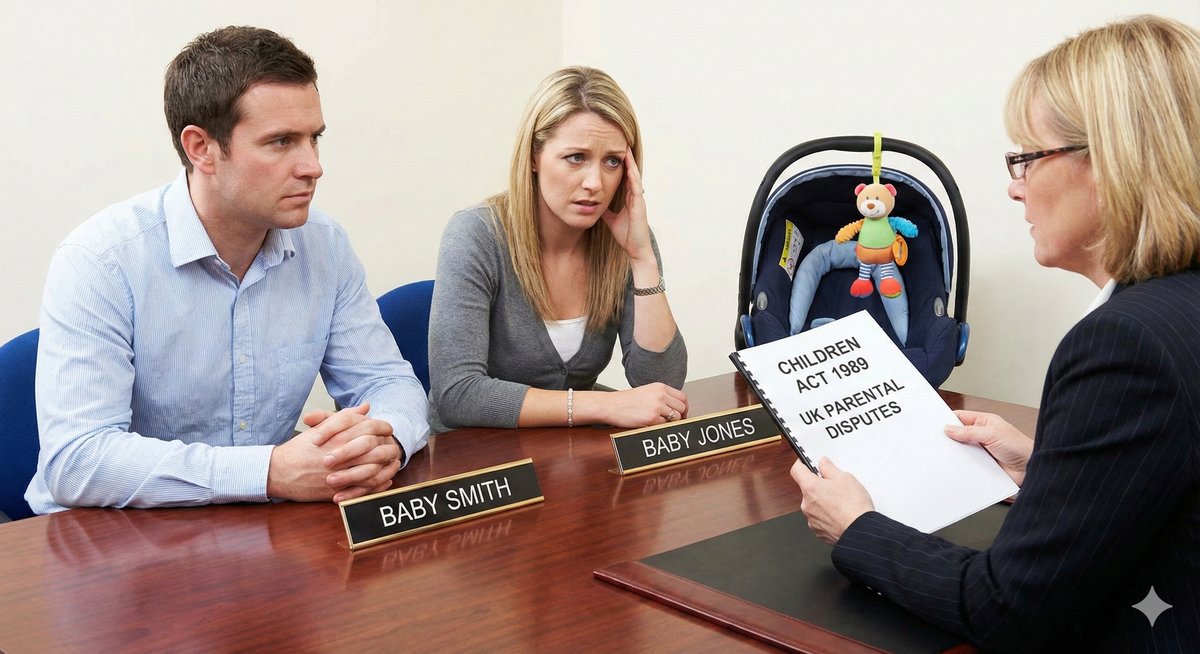
- The Standoff: If both parents attend the registry office and tell the registrar they cannot agree on a name, the registrar cannot register the birth. They will usually send you away to resolve the dispute. If you still cannot agree, you may need a court order to determine the name before the birth can be registered.
If You Are Unmarried
The mother has the primary control.
- If the mother registers the birth alone, she is not legally required to include the father's details (and therefore his name) unless he is present to sign the register.
- Consequently, unmarried mothers often have the final say on the surname at the point of registration if the father is not present.
Scenario 3: Changing a Child’s Name Later (The "Parental Responsibility" Rule)
This is where the law becomes extremely strict. Once a child’s name has been registered, changing it requires the consent of everyone with Parental Responsibility.
Who has Parental Responsibility?
- The mother (always).
- The father (if married to the mother, or if listed on the birth certificate).
The Dispute: If you want to change your child’s surname (e.g., to double-barrel it or revert to a maiden name) and the other parent refuses, you cannot do it.
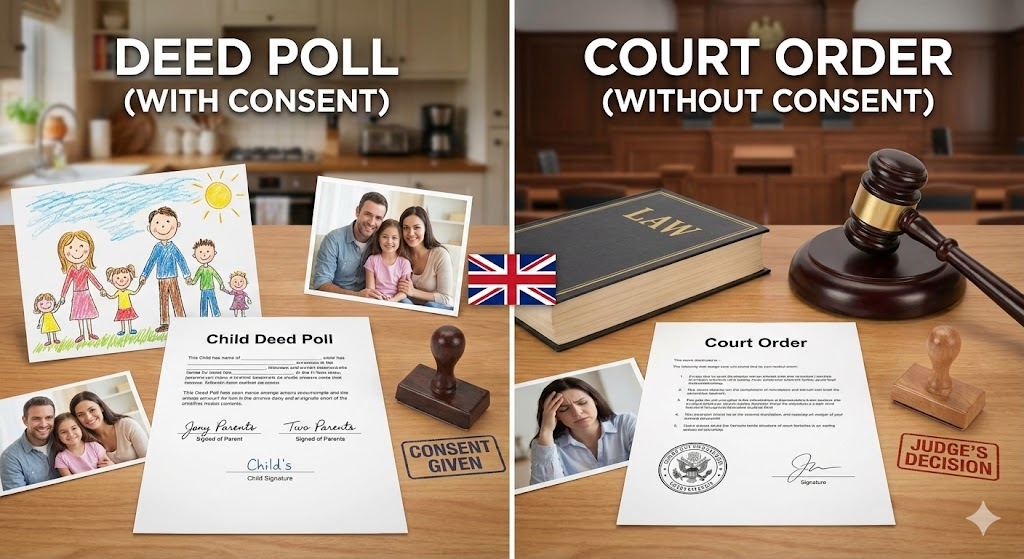
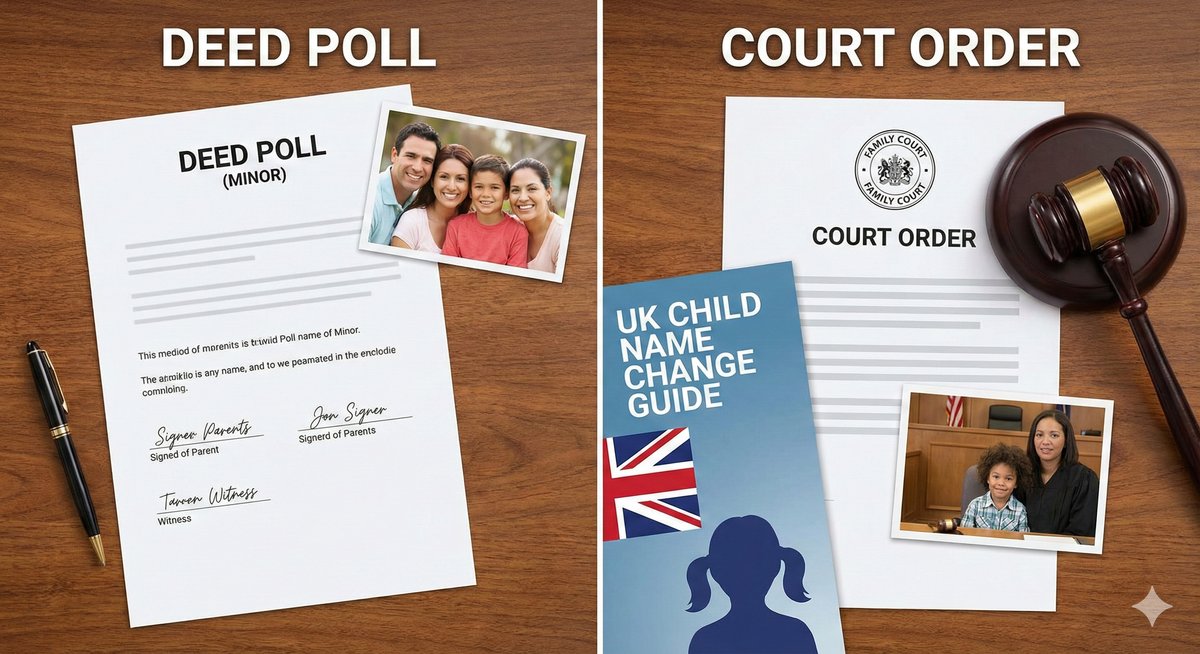
We cannot issue a Child Deed Poll without the written consent of both parents. If you try to change a child's name at a school or doctor's surgery without this consent, the other parent can take you to court to have the name reversed.
The Last Resort: The Specific Issue Order
If you and your partner are in a total deadlock over a child's name, the only way to break it is to apply to the Family Court for a Specific Issue Order.
A judge will decide the name for you. They will base their decision solely on the welfare of the child, not the wishes of the parents.
What courts usually prefer:
- Stability: Courts rarely change a name if the child has used it for years.
- Maintenance of Links: Courts often like children to have a link to both parents. This means judges frequently order double-barrelled surnames as a compromise, so the child carries both identities.
Compromise Options Before Court
Before spending thousands on legal fees, consider these compromises:
- Double-Barrelling: The most common solution. Join the names with a hyphen (Smith-Jones).
- The "Middle Name" Compromise: One parent's surname becomes the child's surname, and the other parent's surname becomes a middle name. This ensures the name is still on the passport/ID, even if not used daily.
- Alternating (for siblings): Rare, but some parents give the first child one name and the second child the other.
Summary
When it comes to adults, you cannot control another person's name. When it comes to children, you must agree. The days of one parent unilaterally dictating the family surname are over.
If you have reached an agreement and need to formalise it—for example, by double-barrelling your child's name to settle a dispute—we can help.
Ready to make the compromise official? Contact our team today to draft a Child Deed Poll that satisfies both parents.