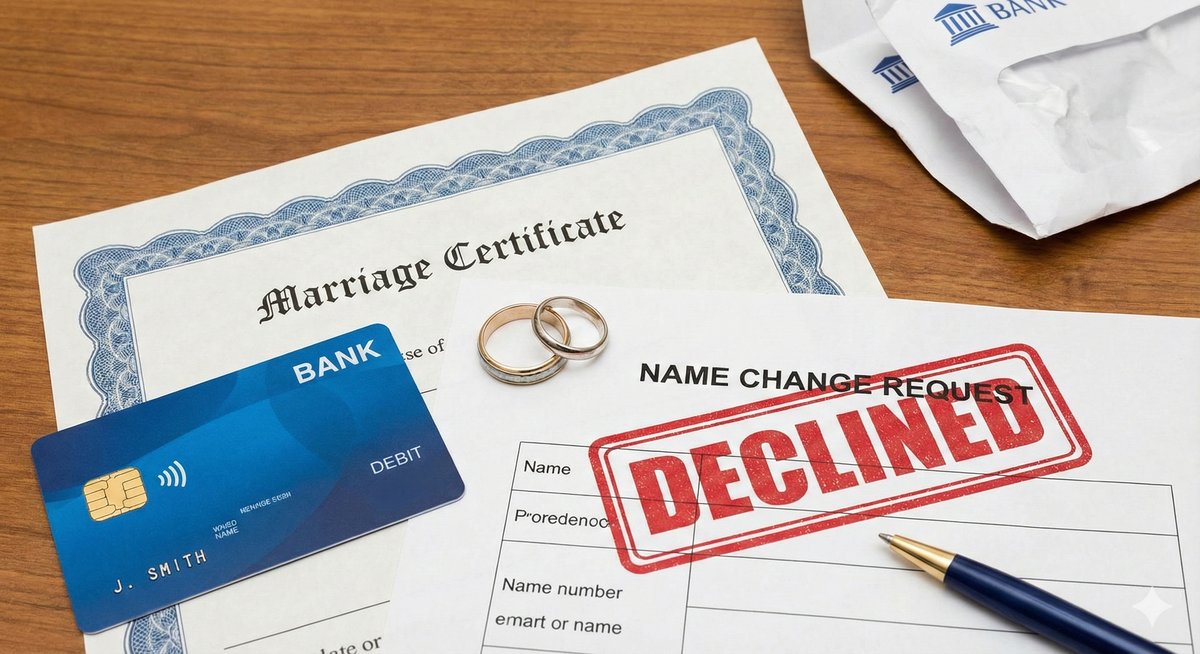
To update your bank accounts and credit records after a UK name change, show each bank your original wet-ink deed poll plus photo ID, wait for new cards and statements to arrive in your new name, then let the three credit reference agencies - Experian, Equifax and TransUnion - update automatically as your lenders report the change (you can also notify them directly to speed things up). Done in the right order, your credit history follows you intact and your file ends up showing your new name with your old name kept as a linked ‘alias’.
This is purely the banks-and-credit side of changing your name. For the full list of everyone else who needs telling - from HMRC to the DVLA to your employer - see our guide to who you need to notify after a name change.
Why the order matters: don’t become a ‘credit ghost’
Your credit file is built from data your lenders send to the credit reference agencies every month. Update your bank and other credit accounts properly and that history carries over seamlessly. Skip it - or do it piecemeal - and you risk a fragmented file, where some accounts sit under your old name and some under your new one. At worst, a lender searching your new name finds little or no history and treats you as a fresh, higher-risk applicant.
The fix is simple: update the accounts that report to the agencies (current accounts, credit cards, loans, mortgages) and make sure you’re on the electoral roll under your new name. The agencies then stitch your old and new identities together. You do not need to pay anyone to ‘repair’ or ‘merge’ your file - that happens for free.
What every bank requires to change your name
Almost every UK bank asks for the same two things: proof of the change and proof it’s you. In practice that means:
- Your original deed poll - the wet-ink signed document, not a photocopy or scan. Banks return it to you; they only need to sight the original.
- Photo ID in your new or old name - usually a passport or driving licence.
- Sometimes proof of address - a recent utility bill or council tax letter, depending on the bank’s checks.
If you were married or in a civil partnership and are taking a spouse’s surname, a marriage or civil partnership certificate is usually accepted instead of a deed poll. For every other change - including reverting after divorce, a first name change, or any change unrelated to marriage - a deed poll is the document banks expect.
How different banks handle it
Traditional high-street banks (Barclays, Lloyds, Halifax, NatWest, Santander, HSBC) typically ask you to visit a branch so a member of staff can verify your original deed poll and ID in person. Some now accept documents by post or via a secure app upload - check your bank’s website before making a trip.
App-based banks (Monzo, Starling, Chase, Revolut) handle name changes in-app. You’ll usually photograph your deed poll and ID and submit them through a secure form; a human reviews the documents and updates your account, often within a few working days.
Building societies and savings providers follow the same logic - original deed poll plus ID - but some smaller ones still insist on posting documents or visiting a branch, so factor that in.
Deed polls are rejected far more often than they should be, almost always over avoidable technicalities like a copy instead of the original or an ineligible witness. Read why banks reject deed polls and how to guarantee acceptance before you go - it could save you a wasted branch visit.
The bank & credit update checklist
Work through these in order. Tick each one off as the new cards and statements arrive.
1. Current accounts
Start here, because your salary lands here and many other accounts are linked to it. Provide your original deed poll and ID, then confirm the bank will reissue your debit card, cheque book and statements in your new name. Ask how long the new card will take so you’re not caught short. Updating a bank account is free - no bank should charge you to change your name.
2. Credit cards and store cards
Update every card provider, including American Express and any retailer or catalogue cards. Credit cards report directly to the agencies, so updating them is one of the fastest ways to get your new name onto your credit file. Wait for the replacement card before destroying the old one.
3. Loans, car finance and overdrafts
Personal loans, car finance agreements, Buy Now Pay Later accounts and student loans all appear on your credit file. Notify each lender so the account continues reporting under your new name rather than orphaning under the old one.
4. Mortgage provider or landlord
Tell your mortgage lender so statements and any future remortgage paperwork are correct. Renting? Notify your landlord or letting agent so your tenancy and any rent-reporting schemes reflect your new name.
5. Savings, ISAs, pensions and investments
These don’t affect your credit score, but getting the names right now prevents headaches at withdrawal or claim time - and keeps your tax records clean.
6. Direct debits and standing orders
These transfer automatically when your account name changes - you don’t need to reset them. Just glance at your next statement to confirm nothing has dropped off.
Updating the credit reference agencies
The UK has three credit reference agencies: Experian, Equifax and TransUnion. Lenders may report to one, two or all three, so checking all of them matters.
In most cases you don’t need to contact them at all. Once your bank and card providers start reporting under your new name, the agencies update your file automatically and add your previous name as a linked ‘also known as’ entry. That alias link is good - it ties your full credit history to your new identity.
If you want to be thorough, or you spot accounts still showing the old name weeks later, you can notify each agency directly through their website and supply a copy of your deed poll. To check progress, use the free statutory access each agency offers (you’re entitled to see your statutory credit report at no cost). Many free credit-monitoring apps draw on this data too.
Get on the electoral roll under your new name
Registering to vote under your new name at GOV.UK is one of the single most useful things you can do for your credit file. The electoral roll is a primary identity check for lenders, and an up-to-date entry confirms your name and address - helping the agencies anchor your history to the new you.
You only need one document - and it must be the original
The single most important rule: banks, the DVLA and HM Passport Office all need to see your original, wet-ink deed poll, never a photocopy. One properly executed deed poll covers every bank, card and lender on this list. There’s no need to pay a solicitor - who would charge £150-£300+ for the very same document - and no need to enrol it at the Royal Courts of Justice (an optional £53.05 extra that publishes your change in the London Gazette but adds no legal validity).
A professionally printed adult deed poll from UK Name Change starts at just £14.49, with same-day dispatch on orders placed before 3pm and free Royal Mail Tracked delivery. More than 160,000 customers have used it to update their banks, passport and everything else - it’s.
And if you are organising finances as a couple while you are at it, the Smart Couple’s Guide to Managing Joint Accounts from Know Your Dosh is a genuinely useful companion read on the wider money side.
Frequently Asked Questions
Will changing my name hurt my credit score?
No. Changing your name does not reset or damage your credit history. As long as you update your accounts and stay registered on the electoral roll under your new name, your existing history follows you and your old name is kept as a linked alias on your file.
Do I have to contact Experian, Equifax and TransUnion myself?
Usually not. The agencies update automatically as your banks and lenders report the change. You can contact each one directly with a copy of your deed poll if you want to speed things up or correct an account that’s lagging behind.
Can I update my bank account without going into a branch?
Often, yes. App-based banks like Monzo and Starling let you submit your deed poll and ID in-app, and several high-street banks now accept documents by post or secure upload. Some traditional banks still ask for an in-branch visit, so check your bank’s policy first.
Does the bank keep my original deed poll?
No. The bank only needs to see your original to verify it, then returns it to you. Keep it safe - you’ll reuse the same original document for your passport, driving licence and any other organisations.
Do I need a separate deed poll for each bank?
No. A single original deed poll is all you need for every bank, card provider and lender. You simply present the same document to each one in turn.
How long does it take for my credit file to fully update?
Allow a couple of months. Most lenders report monthly, so your file typically reflects your new name across all three agencies within one to two reporting cycles after your accounts are updated.
Ready to update your banks and credit file?
It starts with one document. Order your professionally printed adult deed poll from £14.49 - same-day dispatch before 3pm and free tracked delivery - then work through the checklist above to keep your banks, cards and credit record perfectly in sync with your new name.
![[Person struggling with online form due to name error]](/media/blog/images/1.jpg)