Yes - you can take your partner’s surname without being married. In England, Wales and Northern Ireland any adult is free to call themselves whatever they like, and you change your surname to match your partner’s with a deed poll. You do not need to be married, in a civil partnership, or even engaged - and you do not need your partner’s permission to change your own name. The one firm boundary is the reverse: you cannot change your partner’s name for them without their consent.
Plenty of cohabiting couples want to share a surname - for the children, for the household paperwork, or simply because it feels right. The good news is that marriage is only one of several routes to a shared name, and for unmarried couples it is rarely the simplest. This guide explains exactly what you can and cannot do, and where the legal lines sit.
Can an unmarried couple legally share a surname?
Absolutely. There is no law in the UK that reserves a surname for married couples. A surname is not a piece of property that belongs to one family - it is simply the name you are known by, and you are entitled to adopt any name you choose (provided you are not doing so to commit fraud or escape a debt).
So if you and your partner live together and want to be the “Smiths” without a wedding, one of you simply changes their surname to the other’s by deed poll. From that point, the person who changed their name updates their passport, driving licence, bank and so on, and the household shares one surname - with no marriage certificate involved.
You can also get more creative than the married route typically allows. Unmarried couples sometimes choose to:
- Both adopt a brand-new shared surname (each partner does their own deed poll).
- Double-barrel their two surnames into a combined name - for example, “Khan-Roberts”.
- Have one partner simply take the other’s existing surname.
Each person who is changing their name needs their own deed poll. If only one of you is changing, only one deed poll is required.
Do I need my partner’s permission to take their surname?
No. This is the single biggest misconception. Changing your name is entirely your decision - your partner’s consent is not legally required, and nor is anyone else’s. You are not “borrowing” their name or joining their family in a legal sense; you are exercising your own right to be known by a name of your choosing.
In practice it is obviously courteous (and sensible for a relationship) to agree it together, but legally you could take your partner’s surname tomorrow without telling them. The deed poll only commits you: it is a signed declaration that you are abandoning your old name and adopting your new one.
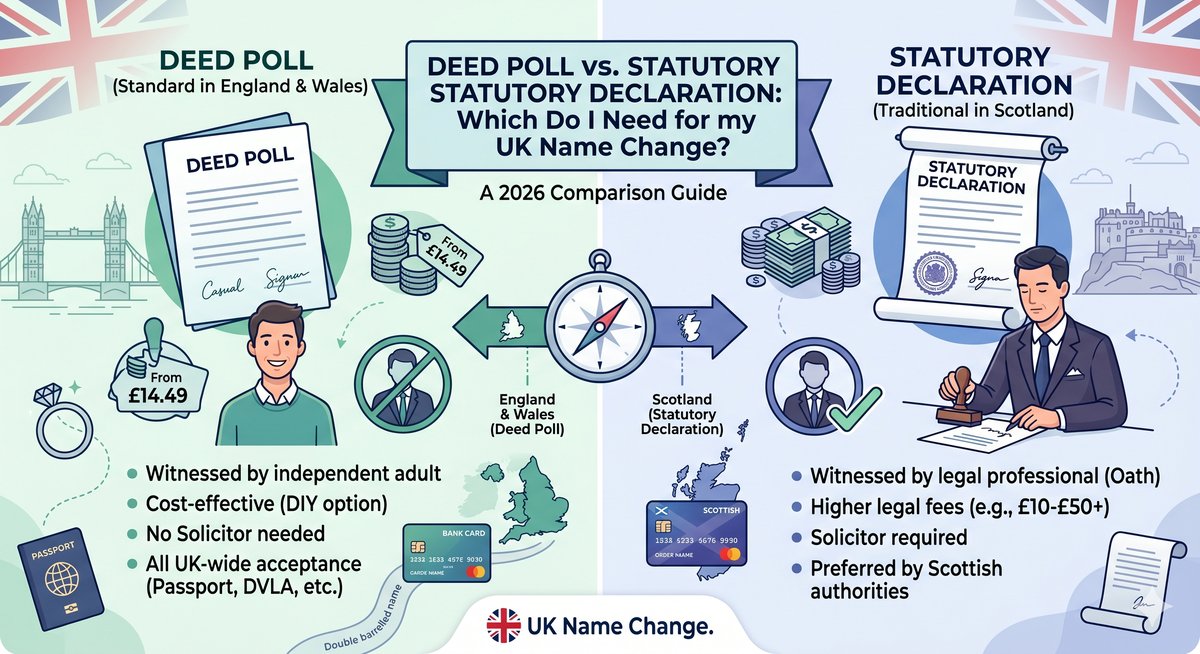
An unenrolled adult deed poll from UK Name Change starts at £14.49, with same-day dispatch on orders placed before 3pm and free Royal Mail Tracked delivery. It is accepted by HM Passport Office, the DVLA, HMRC, banks, the NHS and employers - the same document, whether you are married, cohabiting or single.
The legal boundary: you cannot change their name for them
Here is where the freedom stops. While you can change your own name freely, you have no power to change another adult’s name without their explicit consent. A deed poll only works because the person named on it signs it themselves, declaring their own intention.
That has a few practical consequences worth understanding:
You cannot “gift” a name change as a surprise
Romantic as it sounds, you cannot secretly arrange for your partner to take your surname and present it as a fait accompli. They have to want it, and they have to sign their own deed poll. The same applies to a partner who assumes you will take their name - you are under no obligation to.
Signing on someone else’s behalf is illegal
Signing a partner’s name on a deed poll, or filling one out and forging their signature, is forgery and a serious criminal offence. No legitimate provider will process a document the named person has not personally signed in front of an independent witness.
An ex-partner can keep your surname
If a former partner once took your surname (whether by marriage or deed poll), you cannot force them to give it back when you separate. Once someone has lawfully adopted a name, it is theirs to keep or change as they see fit. This frequently surprises people, but the principle is consistent: each adult controls their own name and no one else’s.
How a cohabiting partner changes their surname, step by step
- Choose your new surname. Take your partner’s surname, double-barrel both, or invent a shared one.
- Order your deed poll. An unenrolled deed poll is all you need - around 98% of UK name changes use one, and it carries exactly the same legal weight as the costly “enrolled” alternative.
- Sign it in wet ink with an independent witness. Your witness must be an adult aged 18 or over who is not a relative, not your partner, and does not live at your address.
- Update your records. Send the original signed deed poll (never a photocopy) to your passport office, the DVLA, your bank, HMRC and your employer.
Updating most records is free: the DVLA driving licence name change costs nothing, and banks, HMRC, the NHS, utilities and employers update your name at no charge. The main expense is a new passport - £102 online or £115.50 by post if you want it to show your new name.
Do unmarried couples need to enrol the deed poll?
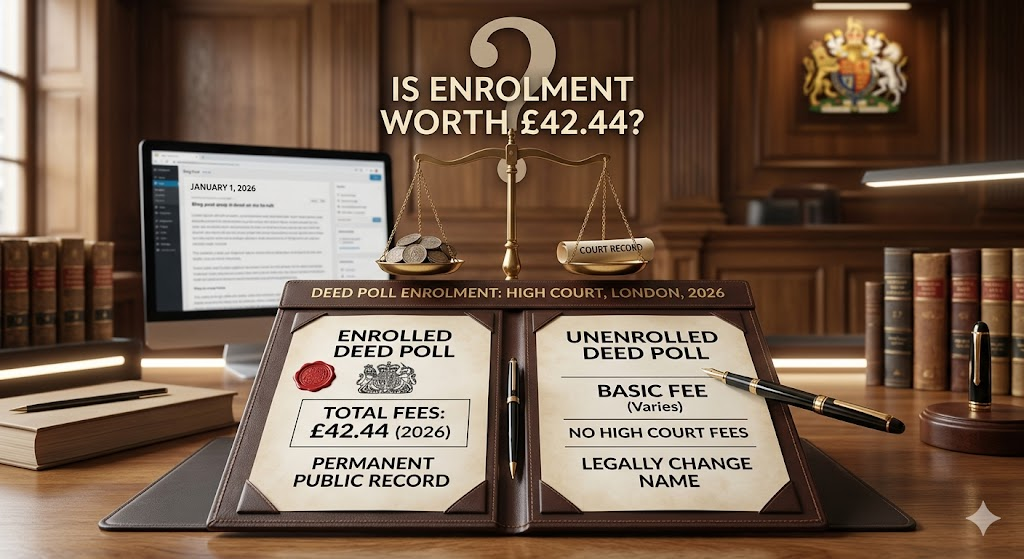
No. Enrolment at the Royal Courts of Justice (currently £53.05) is entirely optional and adds no extra legal validity. It simply publishes your name change publicly in the London Gazette and takes two to three weeks. For a cohabiting couple wanting a quiet, practical name change, an unenrolled deed poll is the right choice - and a solicitor charging £150-£300 for the same document is an unnecessary expense.
Frequently Asked Questions
Can I take my boyfriend’s or girlfriend’s surname without getting married?
Yes. You do not have to be married or in a civil partnership to take a partner’s surname. A deed poll lets any cohabiting adult adopt their partner’s name, and it is accepted by passport offices, the DVLA, banks and HMRC just like any other name change.
Does my partner need to give permission for me to use their surname?
No. You have the legal right to change your own name to anything you like, including your partner’s surname, without their consent. The only thing you cannot do is change their name without their agreement.
Can both of us change to the same new surname?
Yes. Many unmarried couples adopt a brand-new shared surname or a double-barrelled combination of their two names. Each person simply completes their own deed poll - one document per person changing their name.
Is a deed poll for cohabiting couples different from one used after marriage?
No, the document is identical. The difference is only in evidence: a married person can often change their surname using their marriage certificate, whereas an unmarried person uses a deed poll. If you are married and weighing your options, see our guide on changing your surname after marriage in the UK.
What if my partner wants me to take their name but I’m not sure?
The choice is entirely yours. No one - not a partner, not a parent - can compel you to change your name. You are free to keep your own surname, take theirs, or agree on a combined name together.
Can I be forced to give a surname back after a break-up?
No. If you lawfully adopted a partner’s surname, it is now your name and you may keep it after separating. Likewise, an ex who took your surname cannot be forced to drop it.
Ready to share a surname - no wedding required?
If you and your partner want one family name, you do not need a marriage certificate or anyone’s permission to change your own name. Order your professionally printed adult deed poll from just £14.49, with same-day dispatch before 3pm and free tracked delivery. Trusted by over 160,000 customers - it’s the simple, accepted way for cohabiting couples to share a surname.