No-getting married does not automatically change your name in the UK. There is no moment during the ceremony, and no act of signing the marriage register, that legally renames you. Taking your spouse’s surname is always a personal choice, never a legal consequence of the wedding. If you do choose to change your name, nothing happens by itself: you have to notify each organisation yourself, one at a time, using your marriage certificate as proof. Below we explain exactly what marriage does and doesn’t do to your name, and the few situations where a deed poll is needed instead.
Why people think marriage changes your name automatically
The myth is understandable. For generations, the social default was that a wife adopted her husband’s surname, and that custom became so ingrained that many people assume the law enforces it. It doesn’t. The UK has never had a law requiring anyone to change their name on marriage, and there is no government department that updates your records the moment you say “I do”.
What actually happens at a wedding is that your marital status changes-you go from single to married. Your name is a completely separate matter. The registrar records the names you already had on the day; signing the register simply confirms those existing names. It does not create a new one.
What your marriage certificate actually does
Your marriage certificate is one of the most useful documents you’ll ever own, but it’s important to understand its precise role. It is a piece of evidence, not an instruction to change your name and not a form of photo ID.
Here’s what it does and doesn’t do:
- It does serve as accepted proof when you choose to take your spouse’s surname-banks, HM Passport Office, the DVLA, HMRC and employers will all update your records when you show it.
- It doesn’t change any of your records by itself. You still have to contact every organisation individually.
- It doesn’t work as identification. You can’t use a marriage certificate to board a flight, prove your age, or pass a right-to-work check-it carries no photo and no date of birth.
- It only evidences a “traditional” surname change-adopting your spouse’s existing surname. It does not cover every option, which is where a deed poll sometimes comes in (more on that below).
So even in the most straightforward case, “automatic” is the wrong word. Nothing updates until you do the legwork.
Taking your spouse’s surname is a choice
Because nothing is automatic, you are completely free to decide what happens to your name. In the UK you might:
- Keep your current surname exactly as it is.
- Take your spouse’s surname (the traditional route).
- Double-barrel both surnames.
- Create a brand-new blended or “meshed” surname.
- Move your maiden name to a middle name and adopt your spouse’s surname.
This applies equally regardless of gender. A husband has exactly the same right to take his wife’s surname as a wife does to take her husband’s, and the same is true for both partners in a same-sex marriage or civil partnership. The law is neutral; the choice is yours.
If you’re weighing up the simplest traditional change, our step-by-step guide to changing your surname after marriage walks you through who to notify and in what order. And if you’re leaning the other way, see our breakdown of the options and implications of keeping your maiden name.
When the marriage certificate is enough-and when you need a deed poll
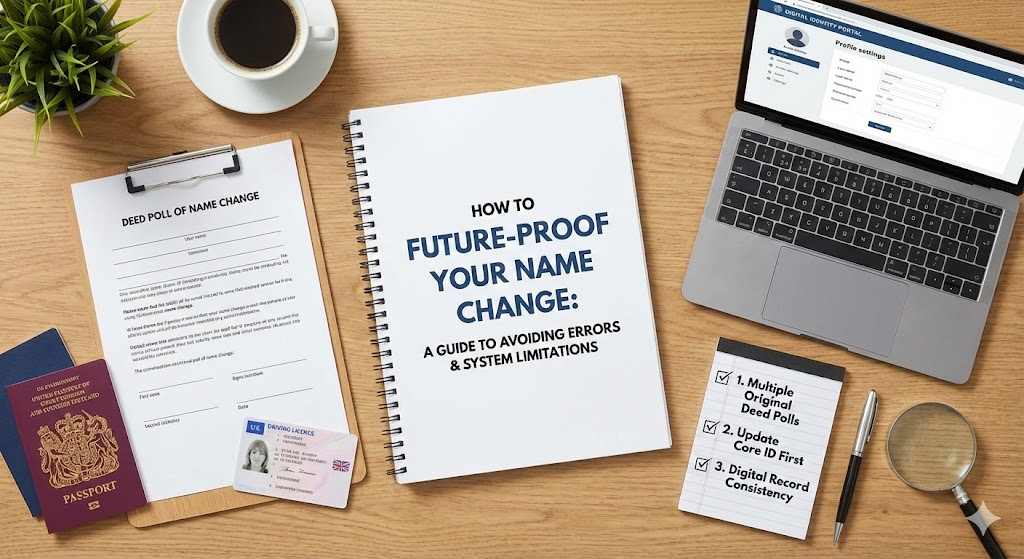
This is the part that trips people up. The marriage certificate only proves one specific change: that you have adopted your spouse’s existing surname. For anything more creative, organisations have nothing on the certificate to match against, so they ask for a deed poll instead.
| What you want to do | What you need |
|---|---|
| Take your spouse’s surname (traditional) | Marriage certificate |
| Double-barrel both surnames | Deed poll (recommended) |
| Create a new blended/meshed surname | Deed poll (required) |
| Move your maiden name to a middle name | Deed poll (required) |
| A husband taking his wife’s surname | Marriage certificate, but a deed poll is often smoother |
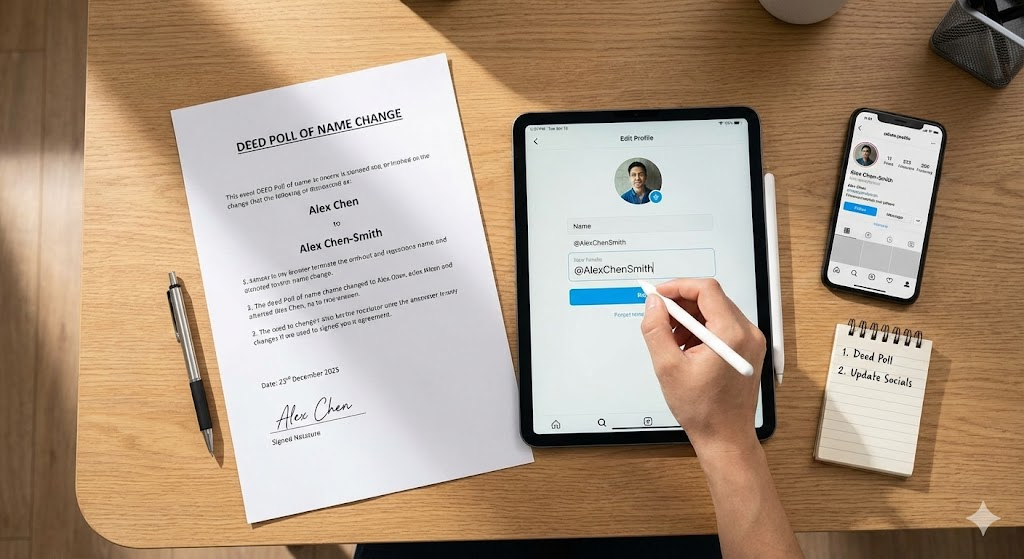
Why does a deed poll help even for a husband taking his wife’s name? Because some front-line staff are simply less used to seeing it, and a deed poll removes any room for argument. It is a clear, standalone legal document that says exactly what your name now is. A professionally printed unenrolled deed poll from UK Name Change starts at just £14.49, with same-day dispatch if you order before 3pm and free Royal Mail Tracked delivery-far cheaper than the £150-£300 a solicitor would charge for the identical document.
An unenrolled deed poll is fully legally valid and accepted by HM Passport Office, the DVLA, HMRC, banks, the NHS, employers and schools-around 98% of UK name changes are unenrolled. Enrolment at the Royal Courts of Justice is entirely optional, costs £53.05, takes 2-3 weeks and publishes your new name in the London Gazette; it adds no extra legal validity.
How a name change after marriage actually works
Once you’ve decided, the process is admin, not magic. With your marriage certificate (or deed poll) in hand, you contact each organisation and ask them to update your records. Most of this is free:
- DVLA driving licence: free to update.
- Banks, HMRC, the NHS, employers and utilities: free to update.
- UK passport: £102 online or £115.50 by post for a standard renewal in your new name (Fast Track is £192 for one week; Premium is £239.50 for one day).
A practical tip: always send or show the original document. HM Passport Office, the DVLA and banks need the original wet-ink marriage certificate or signed deed poll-a photocopy or scan won’t be accepted. There is also no deadline; you can update your name the week after the wedding or several years later. Nothing expires.
A note on titles
Changing from Miss to Mrs after marriage feels like part of the name change, but legally it isn’t. A title (Mr, Mrs, Ms, Mx or Dr) is not part of your legal name, so you never need a deed poll-or even a marriage certificate-to change one. You can simply ask organisations to update your title whenever you like.
Frequently Asked Questions
Does my name change the moment I sign the marriage register?
No. Signing the register records your marriage, not a new name. If you want to take your spouse’s surname, you then have to notify each organisation yourself using your marriage certificate as evidence. Nothing updates automatically.
Is there a time limit to change my name after marriage?
No, there is no deadline and no “30-day rule”. Your marriage certificate doesn’t expire, so you can change your surname the day after the wedding or many years later. You update each organisation in your own time.
Can I use my marriage certificate as ID to travel?
No. A marriage certificate is proof of marriage, not identification-it has no photo or date of birth. To travel under your married name you’ll need a passport issued in that name (£102 online or £115.50 by post).
Do I need a deed poll if I’m just taking my husband’s or wife’s surname?
For a straightforward traditional change, the marriage certificate is enough on its own. You only need a deed poll if you’re double-barrelling, meshing the two names, or moving your maiden name to a middle name-changes the certificate can’t evidence.
Can a man take his wife’s surname?
Yes. UK law treats both spouses identically, so a husband can take his wife’s surname using the marriage certificate. Because it’s less commonly seen, a deed poll often makes the updates run more smoothly and removes any doubt.
Do I need a deed poll to change from Miss to Mrs?
No. A title isn’t legally part of your name, so you can switch from Miss to Mrs (or Ms) just by asking organisations to update it-no deed poll or certificate required.
Ready to change your name with confidence?
If your chosen change goes beyond a simple swap to your spouse’s surname-or you just want a single, clear document every organisation will accept-a deed poll makes it effortless. Order your professionally printed deed poll from UK Name Change from £14.49, with same-day dispatch before 3pm and free tracked delivery. Trusted by over 160,000 customers.