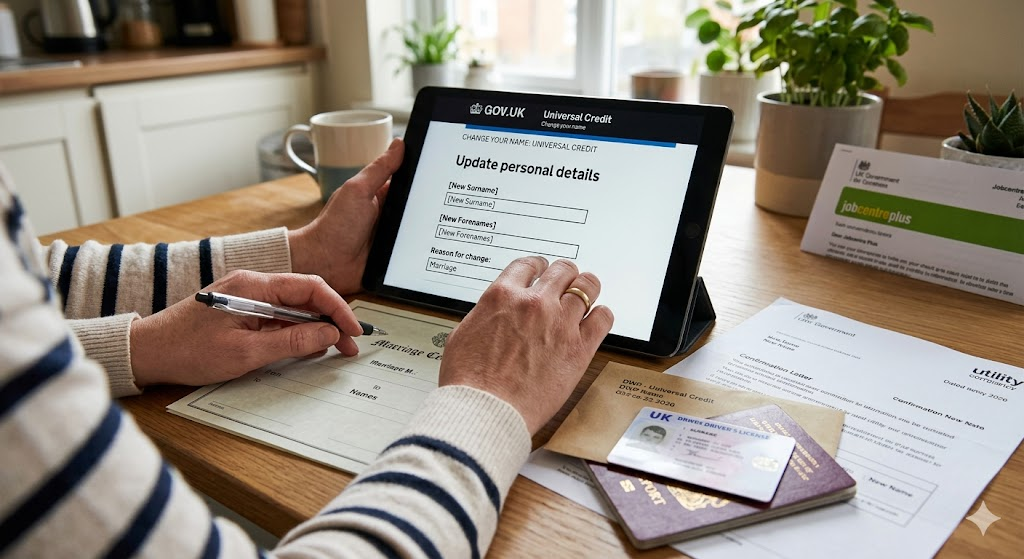
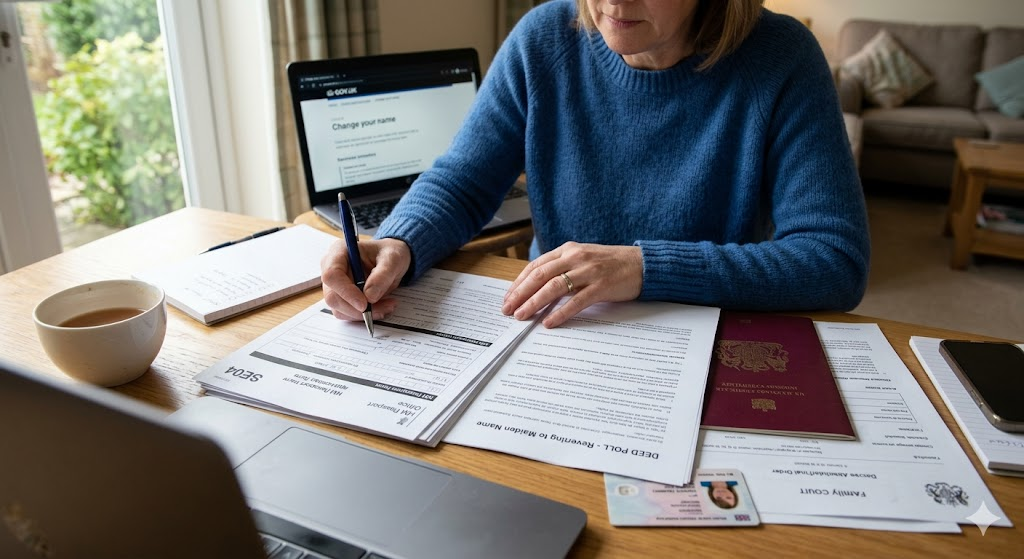
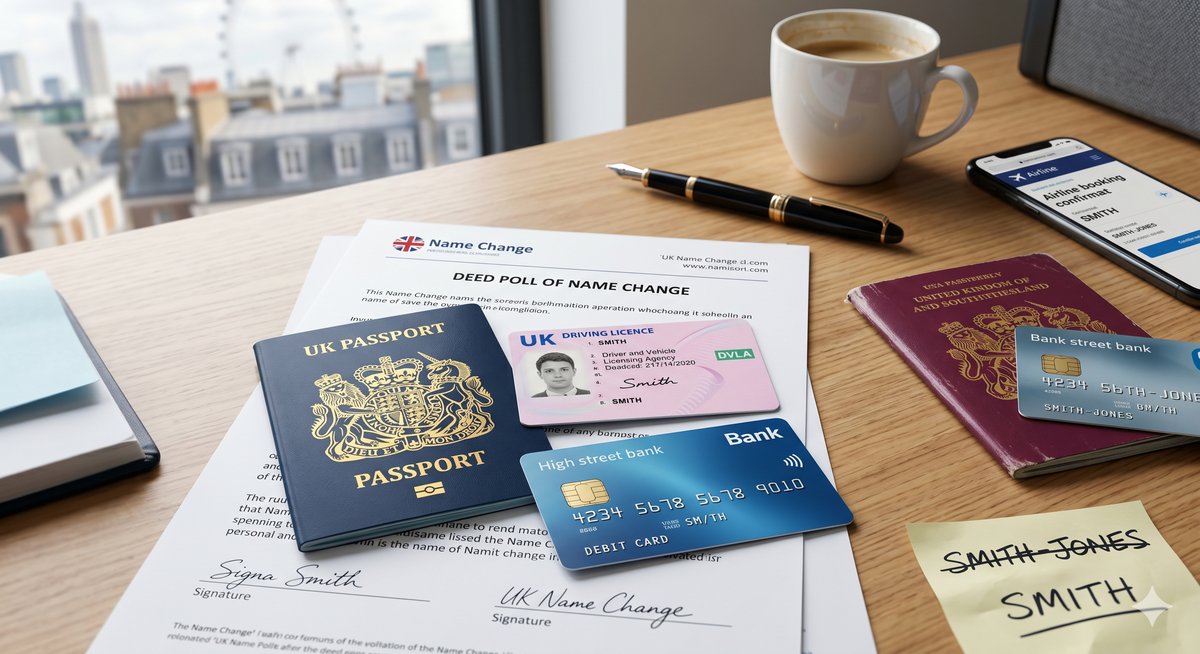
If you and your partner want a shared married surname that is genuinely your own - neither of your existing names - you create a brand-new surname by each signing a deed poll declaring the new name; once married, this is completely legal in the UK, and you can either ‘mesh’ your two names into one or invent something entirely new. There is no register to apply to and no permission to seek: a name is yours the moment you adopt it by deed poll, and an unenrolled deed poll from a provider like UK Name Change (from £14.49) is accepted by HM Passport Office, the DVLA, HMRC, banks and the NHS.
This guide is about building a new name from scratch. If instead one of you simply wants to take the other’s surname, see our guide on how to change your surname after marriage. If you’re torn between joining your names with a hyphen or fusing them, read hyphenated vs merged surnames. Here, we focus purely on the from-nothing approach.
What does ‘creating a new surname’ actually mean?
There are three distinct routes, and people often confuse them:
- Meshing (blending): you fuse parts of both surnames into a single new word - for example, Pugh and Griffin becoming ‘Puffin’, or Wills and Healey becoming ‘Willey’. The result is one undivided surname that didn’t exist before.
- Inventing: you choose a completely unrelated name - perhaps a place you both love, a meaningful word, or simply a name you like the sound of. Neither partner’s original surname need appear at all.
- Double-barrelling: you join both names with a hyphen (Smith-Jones). This keeps both names intact rather than creating something new, so it sits outside this guide - the pros, cons and legality are covered separately.
Meshing and inventing both produce a single, brand-new family name. That is what makes them different from taking a partner’s name or double-barrelling, and it is why the deed poll route matters: the marriage certificate alone cannot create a name that appears nowhere on it.
Why marriage alone doesn’t do this
A marriage certificate is powerful but limited. It is automatically accepted as evidence when one spouse adopts the other’s exact surname, and most organisations will update your records on the strength of it. But the certificate only records the names you each had on your wedding day - it cannot conjure a third name that belongs to neither of you.
So the moment you invent ‘Willey’ or pick ‘Vale’ out of nowhere, your marriage certificate proves nothing about it. The recognised legal instrument for adopting a name that isn’t on any existing document is a deed poll. It is a formal written declaration that you have abandoned your former name and will use the new one for all purposes. That single document is what passport, bank and DVLA staff are looking for.
Is it legal - and is there anything you can’t call yourselves?
It is entirely legal. Under English common law you may call yourself almost anything, provided you are not doing so to commit fraud, evade debt or deceive. In practice the only hard limits are sensible ones:
- No names that are deliberately offensive, vulgar or that promote criminal activity.
- No names that include numbers, symbols or punctuation (so ‘Sm1th’ or ‘Smith!’ will be rejected).
- No misleading titles or ranks dressed up as a name (you can’t become ‘Lord’ or ‘Sir’ as part of your legal name).
- The name must be pronounceable and made up of letters.
Beyond that, a meshed or invented surname is treated exactly like any inherited one. Worth knowing: a title such as Mr, Mrs, Ms or Mx is not legally part of your name, so you never need a deed poll to change how you’re addressed - only the surname itself requires one.
How couples do it, step by step
Because you are each adopting a name that was previously neither of yours, you both need your own deed poll. One document cannot change two people’s names. Here is the process:
1. Agree the new surname
Decide whether you’re meshing or inventing, then settle on the exact spelling. Say it aloud, check how it looks written down, and make sure it isn’t accidentally awkward or already strongly associated with a brand. This is the only genuinely hard part - the paperwork is easy.
2. Order two deed polls
Each partner orders an adult deed poll in their own former name, changing to the new shared surname. Anyone aged 16 or over can change their own name and sign their own deed poll. A professionally printed unenrolled deed poll from UK Name Change starts at £14.49, with same-day dispatch on orders placed before 3pm and free Royal Mail Tracked delivery.
3. Sign with two independent witnesses
Each deed poll must be signed in wet ink and witnessed by two independent adults aged 18 or over - crucially, not a relative, your partner, or anyone living at your address. So you cannot witness each other’s deed polls. Ask a friend, neighbour or colleague instead.
4. Update your records
Send the original wet-ink documents (never photocopies) to update your passport, driving licence, bank, HMRC and so on. Many of these updates are free.
Real-world examples of meshed and invented surnames
Meshing has produced some genuinely elegant results - and some playful ones. Couples have blended Dawson and Bell into ‘Dawsbell’, or Murray and Booth into ‘Mooray’. Others have inverted the usual logic entirely and chosen an invented name with personal meaning: the name of the town where they met, a beloved fictional surname, or a short, clean word that simply felt like a fresh start for a new family. The key creative tip is to read your shortlist out loud as “Mr and Mrs ___” - some blends look better than they sound, and vice versa.
What it costs to do it properly
Two deed polls is the main expense, and at £14.49 each that is modest. A solicitor would charge £150-£300+ per person for an identical document - an unnecessary cost, since an unenrolled deed poll carries exactly the same legal weight. After that, updating organisations is mostly free: the DVLA updates your driving licence at no charge, and banks, HMRC, the NHS, employers and utilities all update records for free.
The one notable cost is a new passport, which is £102 online (£115.50 by post) for a standard adult application. Enrolment at the Royal Courts of Justice is optional - it costs £53.05, publishes your new name in the London Gazette, takes 2-3 weeks and adds no legal validity whatsoever. Around 98% of UK name changes are unenrolled, and for creating a married surname there is rarely any reason to enrol.
Frequently Asked Questions
Can we both legally have a surname that neither of us was born with?
Yes. There is no rule that a married surname must derive from either spouse. Once you each sign a deed poll adopting the new name, it is fully legal and recognised by every UK authority.
Do we need to be married first?
No - you can change your name by deed poll at any time, married or not. Many couples do it on or just after the wedding for sentiment, but legally the marriage and the name change are separate events.
Can we change our children’s surnames to the new name too?
Yes, with consent. For a child under 16, everyone with parental responsibility must agree, and you’d use a child deed poll for each child. A child aged 16 or 17 can change their own name and sign their own deed poll.
Is a meshed or invented name harder to use day to day?
No. Once your passport, licence and bank cards show the new name, organisations treat it like any other surname. The only practical step is patiently updating each record once after the change.
Should we double-barrel instead?
That’s a different choice entirely - double-barrelling keeps both original names joined by a hyphen rather than creating a new one. If you’re weighing it up, our comparison of hyphenated vs merged surnames walks through both options.
Ready to create your new shared surname?
Building a brand-new family name is one of the most personal things a couple can do - and the legal part takes minutes. Order two adult deed polls from UK Name Change for just £14.49 each, with same-day dispatch before 3pm and free tracked delivery. Trusted by 160,000+ customers, it’s the simple, accepted way to make your new surname official.