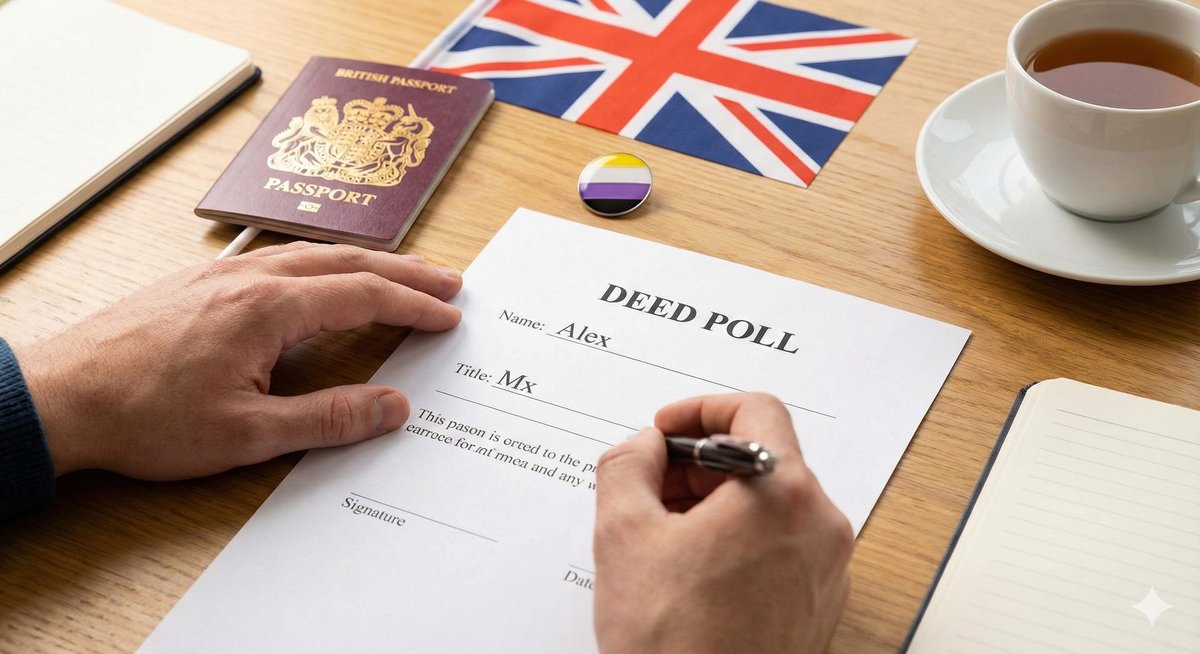
Yes-having a criminal record does not stop you from legally changing your name in the UK. Anyone aged 16 or over is free to change their name by deed poll, whatever their history. But there is one thing every honest answer must make clear: a name change does not erase your convictions, hide your record or wipe the slate clean. Your record stays linked to you, not to your old name-and in certain situations you are legally required to disclose your previous name or notify the authorities of the change.
This guide explains exactly what a name change can and cannot do when you have a criminal history, the legal duties that apply, and how to do it properly and lawfully.
The general rule: a record does not block a name change
There is no law in England, Wales, Scotland or Northern Ireland that prevents someone with a criminal record from changing their name. A deed poll is simply a legal document by which you give up your old name and adopt a new one. You do not need permission from the police, the courts, the Home Office or anyone else, and you do not have to explain your reasons.
For the overwhelming majority of people with a record-spent convictions, old cautions, motoring matters, anything that is fully behind them-changing your name works in exactly the same way as it does for everyone else. You sign an adult deed poll, then use it to update your passport, driving licence, bank, employer and the rest of your records.
The important exceptions are people who are currently subject to active supervision or monitoring-for example those on probation, on licence, or on a register such as the Sex Offenders Register. Those situations carry strict notification duties, which we cover below.
A name change does NOT wipe your record
This is the single most important point on the whole page, so let us be blunt about it.
Your criminal record is not stored against your name. It is held on the Police National Computer (PNC) and tied to your identity through fingerprints, photographs, DNA and date of birth-biometric data that does not change when your name does. When you change your name, the police and the Disclosure and Barring Service (DBS) update their records to show your new name and your former name. The history follows you.
So changing your name will never:
- Delete or ‘spend’ a conviction (only time, under the Rehabilitation of Offenders Act 1974, does that);
- Hide your past from a criminal records check;
- Remove you from any register or monitoring arrangement;
- Stop a former name appearing on an enhanced DBS certificate.
If your goal is to make a genuine fresh start with a new name-for personal, family or safety reasons-that is completely legitimate. If your goal is to conceal your record from people legally entitled to see it, that will not work and may itself be a criminal offence.
You must still disclose your record where the law requires it
A new name does not switch off your existing legal duties to disclose. The two situations that catch most people are:
DBS checks (criminal records checks)
If you apply for a job, volunteer role or licence that requires a DBS check, the application form asks for all names you have ever been known by, including previous surnames and forenames. You must give them honestly. The DBS cross-references your current and former identities, so an undisclosed name change does not hide anything-it simply makes you look as though you tried to. Standard and enhanced checks will reveal convictions and cautions that are not yet eligible for filtering, under whichever name you held them.
Insurance, finance and official forms
Many application forms-insurance, certain financial products, professional registration-ask you to declare unspent convictions or to list former names. Changing your name does not change what you must declare. Failing to disclose where you are legally or contractually required to can void a policy, end a contract or amount to fraud.
The simple rule: if a form asks for your former names or your record, the honest, lawful answer is to give it. The name change itself is legal; hiding it from people entitled to know is the problem.
When you must actively notify the authorities
Most people changing their name have no one to tell beyond updating their own records. But some people are under a positive duty to report a name change-and failing to do so is a criminal offence in its own right.
The Sex Offenders Register (notification requirements)
If you are subject to the notification requirements of the Sexual Offences Act 2003 (commonly the “Sex Offenders Register”), you must notify the police of any change of name-including a deed poll-within three days of the change. This is a legal requirement, not a courtesy. Failing to notify is a separate criminal offence that can result in a fine or imprisonment. You can still change your name; you simply must report it.
If you are on probation, a licence or a court order
People serving a community sentence, on post-release licence, or subject to certain court orders have conditions that usually require them to keep their probation officer or supervising authority informed of personal changes, including their name. A name change is generally still possible, but it must go through the correct channels first. Because the rules here are detailed, we cover them in full in our dedicated guide on changing your name while on probation.
If you have pending criminal proceedings or are on bail
If you are awaiting trial, on bail, or in the middle of live criminal proceedings, you should notify the court, your solicitor and the police of any name change so that court records and bail conditions stay accurate. Changing your name to frustrate proceedings or evade identification could be treated as perverting the course of justice.
The “fraudulent intent” line you must not cross
The law that allows free name changes also draws a firm boundary: you cannot change your name for a fraudulent or unlawful purpose. That includes changing your name to escape debts, to deceive an employer, to obtain credit dishonestly, or to evade the police or the courts.
Changing your name to dodge creditors is a particularly common misconception-and a risky one. Debts are tied to your identity and credit file, not your name, so the strategy does not work and carries real legal danger. We explain exactly why in our guide to changing your name to avoid debt and the legal risks involved.
How to change your name legally and correctly
For everyone whose record does not place them under active monitoring, the process is straightforward and inexpensive:
- Get a deed poll. A professionally printed unenrolled deed poll from UK Name Change starts at just £14.49, with same-day dispatch if you order before 3pm and free Royal Mail Tracked delivery. An unenrolled deed poll is legally valid and accepted by HM Passport Office, the DVLA, HMRC, banks, the NHS, employers and schools-in fact around 98% of UK name changes are unenrolled. A solicitor would charge £150-£300+ for the very same document.
- Sign it with two independent witnesses. Your witnesses must each be an adult aged 18 or over who is not a relative, partner or anyone living at your address. Keep the original wet-ink signed document safe-passport, DVLA and banks need the original, never a photocopy.
- Update your records. The DVLA driving licence update is free, as are updates to your bank, HMRC, the NHS, your employer and utilities. A new UK adult passport costs £102 online or £115.50 by post.
- Disclose where required. List your former name on any DBS check or form that asks, and meet any notification duty that applies to you.
Enrolment at the Royal Courts of Justice (£53.05) is entirely optional. It publishes your old and new name publicly in the London Gazette and takes 2-3 weeks-and adds no legal validity. Most people, including those with a record, have no reason to enrol.
Frequently Asked Questions
If I change my name will my criminal record follow me?
Yes. Your criminal record is tied to your identity, not your name — police and DBS systems link all previous names, and DBS certificates list them. Changing your name legally is allowed with a record, but it never erases or hides one, and registered offenders must notify the police of a new name (usually within 3 days). Concealing a name change where disclosure is required is a criminal offence.
Does changing my name remove my criminal record?
No. Your record is held against your biometric identity-fingerprints, DNA and date of birth-not your name. A name change updates the record to show your new name alongside your former one. Only the passage of time can make a conviction ‘spent’ under the Rehabilitation of Offenders Act 1974.
Do I have to tell employers about my former name?
If a job requires a DBS check, yes-the form asks for every name you have been known by, and you must answer honestly. For roles with no DBS check and no requirement to disclose unspent convictions, you generally do not need to mention a former name, but you must never give false information where it is requested.
Can I be refused a deed poll because of my record?
No. A deed poll is a document you make for yourself, not something the state approves or refuses. As long as you are 16 or over and are not changing your name for a fraudulent or unlawful purpose, you are free to do it regardless of your history.
Will a name change show up on a DBS check?
Standard and enhanced DBS certificates can show previous names, and they always reveal any convictions or cautions that are not eligible for filtering-under whichever name you held them at the time. A name change does not hide your past from a DBS check.
I’m on the Sex Offenders Register-can I still change my name?
Yes, but you must notify the police of the change within three days, as required by the notification requirements of the Sexual Offences Act 2003. Failing to do so is a criminal offence. The deed poll itself remains lawful.
Is changing my name to avoid debt or police interest legal?
No. Changing your name for a fraudulent or unlawful purpose-including evading debts, creditors or the authorities-is not permitted and can be a criminal offence. It also does not work, because debts and records are tied to your identity, not your name. See our guides on probation rules and on the risks of changing your name to avoid debt.
Ready to change your name the right way?
If your name change is honest and lawful, a criminal record is no barrier at all. Get a legally valid, professionally printed deed poll from UK Name Change-from just £14.49, dispatched the same day if you order before 3pm, with free tracked delivery and trusted by over 160,000 customers. Start your adult deed poll now and make your fresh start the proper way.