For most parents, changing a child's name is a matter of family unity or tradition. But for some, it is a matter of safety. If you are fleeing domestic abuse, harassment, or a dangerous ex-partner, changing your child's surname can feel like a necessary shield to protect their location and identity.
However, the legal system in the UK is complex. If you make the wrong administrative choice, you could accidentally publish your new home address to the very person you are trying to avoid.
This is a sensitive and critical guide on how to handle a name change when safety is the priority.
WARNING: The "Enrolled" Deed Poll Trap
If there is only one thing you take away from this guide, let it be this: Do NOT use an "Enrolled" Deed Poll.
There are two types of Deed Polls in the UK:
- Unenrolled (Standard): These are private legal documents. They are not registered anywhere centrally.
- Enrolled: These are registered with the Royal Courts of Justice.
The Danger:
By law, if you Enrol a Deed Poll, the details must be published in The London Gazette. This is a searchable public newspaper. The entry will list:
- Your child's old name.
- Your child's new name.
- Your full new home address.
This creates a permanent, searchable link between your old identity and your new location. If you are hiding from an abuser, an Enrolled Deed Poll destroys your anonymity. Always use a standard, private Unenrolled Deed Poll (which is what we provide).
Bypassing Consent: The Legal Reality
Even if an ex-partner is abusive, dangerous, or subject to a restraining order, they do not automatically lose Parental Responsibility.
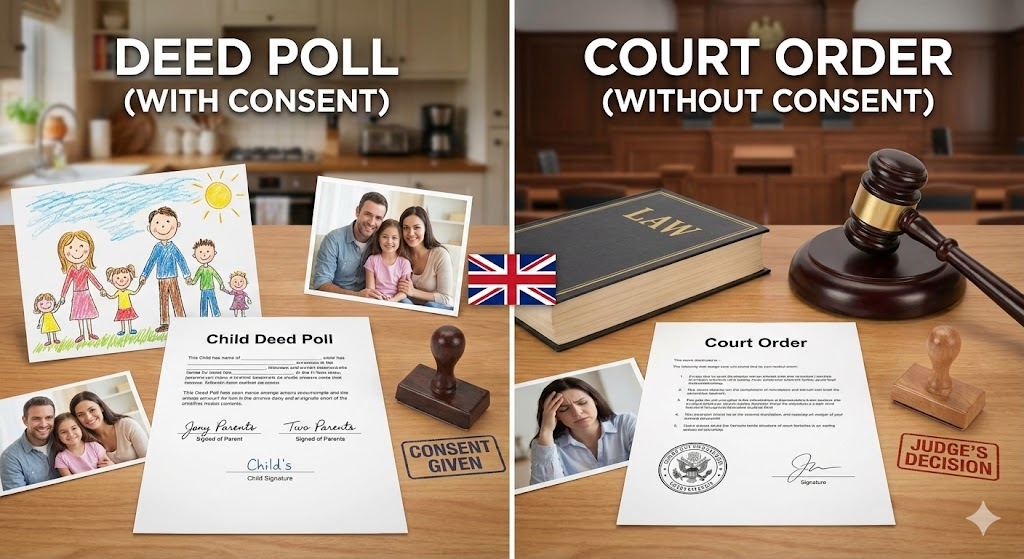
Legally, you still need their written consent to change the child's name via Deed Poll.
The Dilemma: Asking them for consent might reveal your location or provoke an attack.
What You Cannot Do
You cannot simply forge their signature or ignore their rights because they are "dangerous." If you change the name without legal authority, the ex-partner can apply to the court to have it reversed, dragging you back into their orbit.
What You MUST Do: The Court Route
You must apply to the Family Court for a Specific Issue Order to change the name without the other parent's consent.
Protecting Your Address (Form C8):
When you apply to the court, you must file Form C8 ("Confidential contact details"). This ensures that your address is kept private from the other parent and their solicitors during the proceedings.
How the Court Decides
A judge will prioritise the safety of the child above the "rights" of the parent.
- If the risk is severe: If there is a proven risk of abduction or serious harm, the court may grant the name change to hide the child's identity.
- If the risk is managed: Courts often prefer to keep the child's original name to maintain their sense of identity, even if they restrict the father's access. Changing a surname to "hide" a child is considered a drastic step, usually reserved for witness protection-style scenarios.
The "Known As" Option (A Safer Interim Step)
While you wait for court orders, you can ask your child's school and GP to use a new name informally.
This is called a "Known As" name.
- How it works: The child is called by the new surname in class and on the register to protect their privacy from other parents/community members.
- The Limit: Official documents (reports, exam certificates) may still need to show the legal birth name until the court order is granted.
Summary for Safety
| Action | Safety Rating |
|---|---|
| Enrolled Deed Poll | DANGEROUS (Publishes address) |
| Unenrolled Deed Poll | SAFE (Private document) |
| Applying to Court (with C8) | SAFE (Keeps address off files) |
If you are in immediate danger, please contact the police or a domestic abuse charity like Refuge or Women's Aid before worrying about paperwork.
When you are safe and ready to handle the legal name change privately, contact our team for a confidential Unenrolled Deed Poll service.