Leaving an abusive relationship is an act of immense courage. For many survivors, the final step in breaking free—and ensuring their future safety—is changing their identity. A new name can be a shield, making it significantly harder for a perpetrator to trace you.
However, the legal name change process in the UK has a trap that many people fall into unknowingly. If you choose the wrong type of name change, you could accidentally publish your new identity and address on the internet for anyone to see.
At UK Name Change, your safety is our priority. We have guided many survivors through this process discreetly and securely. This guide explains how to change your name without leaving a digital footprint.
CRITICAL WARNING: Avoid "Enrolled" Deed Polls
If you are hiding from an abuser, you must NOT "enroll" your Deed Poll.
There is a common misconception that you must register your name change with the Royal Courts of Justice to make it "official." This is dangerous for survivors because:
- Enrolling a Deed Poll is a public process.
- It requires your name change to be published in The London Gazette.
- This publication lists your Old Name, your New Name, and your Home Address.
- This information is permanently searchable on Google.
Doing this creates a direct link between your past and present, accessible to anyone with a smartphone.
The Safe Route: "Unenrolled" Deed Polls
To stay safe, you should use a Standard (Unenrolled) Deed Poll. This is the service provided by UK Name Change.
An unenrolled Deed Poll is a private legal document. It is just as valid as an enrolled one—it is accepted by HM Passport Office, the DVLA, banks, and HMRC—but it is never published. The only people who will know about your name change are the specific organisations you choose to show the document to.
Protecting Your Address: The Electoral Roll
Even with a private Deed Poll, you can be traced via the Electoral Roll (voting register). Credit reference agencies buy this data, and it often ends up on "people finder" websites.
If you are at risk, you should register for Anonymous Registration with your local council.
- This allows you to vote without your name and address appearing on the electoral register.
- You will need to provide evidence (e.g., a court order or an attestation from a senior police officer or social worker).
- Once anonymous, you can safely update your credit history without exposing your location.
Data Hygiene: Breaking the Digital Link
Changing your legal name is step one. Step two is ensuring your digital footprint doesn't give you away.
- Social Media: Do not simply rename your old Facebook or Instagram accounts. Create entirely new accounts with new email addresses. Old accounts often have cached data or mutual friend links that can be exploited.
- Password Security: When you update your banks with your new name, change all your passwords and security questions. Abusers often know the answers to "Mother's Maiden Name" or "First Pet."
- Post Redirection: Be cautious with Royal Mail redirection services if you are moving house, as this can sometimes leave a trail.
How We Ensure Your Privacy
We understand that discretion is not a luxury; it is a necessity. Our service is built to be secure:
- Secure Processing: Your data is encrypted and handled with strict confidentiality.
- Discreet Delivery: Our envelopes are plain, ensuring that your business remains private even when the post arrives.
- No Public Registers: We do not publish your data anywhere.
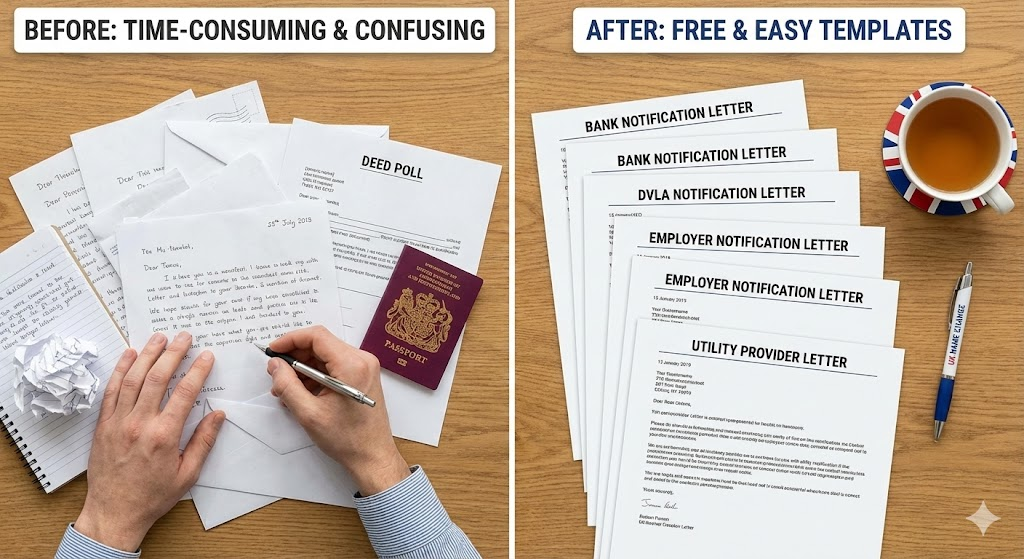
Our Complete Package (£39.99) allows you to get your paperwork in order quickly and correctly, minimising the time you spend in "limbo" between identities. We provide the templates you need to update banks efficiently, helping you secure your financial independence in your new name.
You deserve a life free from fear and a name that belongs only to you. We are here to help you claim it safely.
Note: If you are in immediate danger, please contact the police on 999. For support, contact the National Domestic Abuse Helpline on 0808 2000 247.
HTML