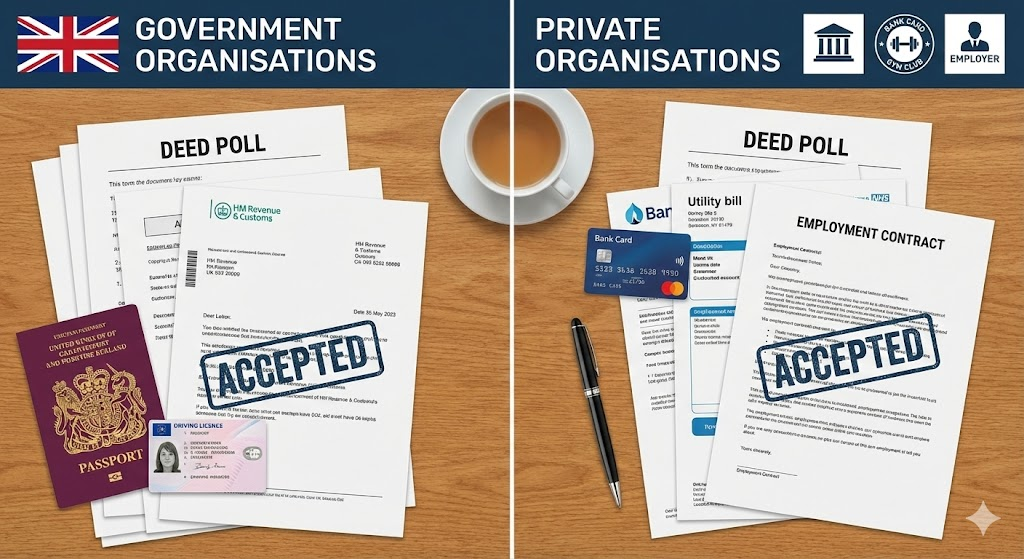
Once you have your signed and witnessed deed poll in hand, the next step is the "notification phase." For many residents in London and across the UK, this can feel like a tale of two worlds. On one hand, you have government departments like the Passport Office, and on the other, private organisations like banks, gyms, and utility providers.
A common concern is whether these different entities have different "rules" for accepting a deed poll. At UK Name Change, we’ve helped over 70,000 people navigate these updates. In this guide, we’ll explain the nuances of acceptance between public and private sectors and how you can ensure a smooth transition with both.
1. Government Organisations: The Standard Setters
UK government bodies are the most formal "gatekeepers" of your identity. Because they issue your primary identification (passports and driving licences), they have the strictest requirements for deed poll acceptance.
HM Passport Office (HMPO)
The Passport Office is the "Gold Standard." If they accept your deed poll, almost everyone else will follow suit. Their primary requirements are that the deed poll is unenrolled or enrolled, contains the three mandatory legal declarations, and is signed with a "wet ink" signature. Interestingly, in 2026, they often require "evidence of name use" (like a bank statement or utility bill) alongside your deed poll to prove you have actually adopted the new name in your daily life.
The DVLA
The DVLA is generally considered the most "user-friendly" government body for name changes. They typically accept an unenrolled deed poll without requiring additional proof of use, provided the document is an original. Updating your licence here first is a smart strategy, as it gives you government-issued photo ID to show private companies later.
HMRC and DWP
These departments handle your tax, National Insurance, and benefits. They are legally required to keep accurate records, so they will accept a valid deed poll to ensure your contributions and payments are correctly assigned to your new identity.
2. Private Organisations: The "Terms of Service" World
Private companies, such as banks, insurance providers, and employers, operate differently. While they are bound by UK GDPR to keep your data accurate, they also have their own internal security policies.
Banks and Building Societies
Banks are the most "government-like" of the private organisations. Due to Anti-Money Laundering (AML) laws, they must be certain of who you are. While they cannot legally refuse a valid deed poll, they may insist on seeing the original document in person at a branch rather than a scan. Some misinformed staff may claim they only accept "enrolled" deed polls, but this is a common myth that can be challenged by citing Financial Ombudsman guidelines.
Employers
Your employer needs your legal name for payroll and pension purposes. Under the Data Protection Act 2018, they have a duty to update your records when presented with legal evidence of a name change. Most HR departments in London are well-versed in this, but smaller businesses may need a polite reminder of their obligations to maintain accurate employee data.
Utility Companies and Subscriptions
Energy suppliers, mobile networks, and gyms are usually the easiest to update. Many now allow you to upload a scan of your deed poll via an online portal. Because the risk of "identity fraud" is lower for a gym membership than a passport, their verification processes are often significantly faster.
Key Differences at a Glance
| Feature | Government Bodies | Private Organisations |
|---|---|---|
| Primary Goal | National Security / Record Accuracy | Fraud Prevention / Data Compliance |
| Method of Submission | Almost always by Post | In-person, Online, or Email |
| Secondary Evidence | Required by Passport Office | Rarely required |
| Legal Duty | Statutory Duty | GDPR / Contractual Duty |
How to Ensure Acceptance Everywhere
To avoid friction with both sectors, follow these three golden rules:
- Use a Professional Provider: A "DIY" deed poll is the most common reason for rejection. Documents from UK Name Change use solicitor-approved wording that is recognised and trusted by both the Home Office and major high-street banks.
- Order Multiple Originals: Private companies often want to see an "original" rather than a photocopy. If you only have one, you have to wait for the Passport Office to return it before you can go to the bank. Having 5-10 originals allows you to update everyone simultaneously.
- Present a Professional Image: Printing your deed poll on high-quality archive paper (which we offer with our premium packages) gives the document immediate authority. When a bank clerk or HR manager sees a professionally produced deed, they are far less likely to question its validity.
Conclusion
While government and private organisations have different "flavours" of bureaucracy, they are all ultimately looking for the same thing: clear, legal evidence of your name change. By starting with a high-quality deed poll from UK Name Change, you remove the biggest barrier to acceptance.
Our Complete Package Dashboard is specifically designed to help you bridge the gap between these two worlds, providing tailored instructions and templates for both government agencies and private firms.
Ready to ensure your new name is accepted across the board? Start your application today and get the documentation you need for a seamless transition. If you’ve encountered an organisation that is refusing to recognise your deed poll, contact our London-based support team for expert advice on how to enforce your rights.