If you are changing a child’s name to keep them safe from an abusive or dangerous parent, the safest route is a private (unenrolled) deed poll combined, where another parent has parental responsibility and will not consent, with a Specific Issue Order from the family court - and you protect your whereabouts by asking the court to withhold your address using Form C8. Crucially, you should never enrol the deed poll, because enrolment publishes the change publicly in the London Gazette. This guide walks you through it calmly and carefully.
First, please look after yourself. If you or your child are in immediate danger, call 999. For confidential support you can contact the free 24-hour National Domestic Abuse Helpline on 0808 2000 247 (run by Refuge), or Women’s Aid and Men’s Advice Line for ongoing help. Changing a name is one piece of a wider safety plan - a specialist domestic abuse adviser or family solicitor can help you fit the legal steps around your situation.
Why the “unenrolled” deed poll matters so much for safety
There are two kinds of deed poll in the UK, and the difference is critical when safety is at stake.
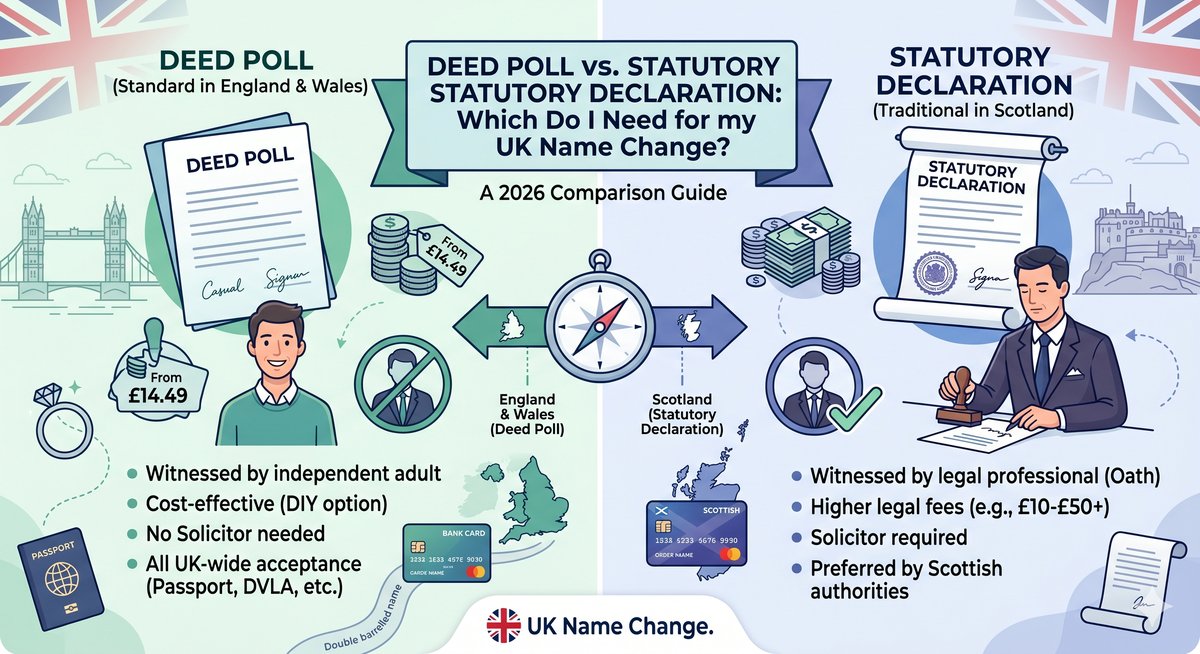
An unenrolled deed poll is a private legal document. It is signed and witnessed, and it is accepted by HM Passport Office, the DVLA, HMRC, the NHS, banks, employers and schools. Around 98% of UK name changes use this route. Nothing about it is published anywhere - it stays between you and the organisations you choose to show it to.
An enrolled deed poll is the opposite. Enrolment at the Royal Courts of Justice costs £53.05, takes 2-3 weeks, and - this is the part that matters - it publishes your name change publicly in the London Gazette, the UK’s official public record. The old name and new name become searchable online forever. Enrolment adds no extra legal validity whatsoever; it simply makes the change public. For a family fleeing harm, that public footprint is exactly what you are trying to avoid.
The takeaway is simple: for any safety-driven name change, use an unenrolled deed poll only. Never enrol it.
Parental responsibility: the rule you cannot skip
It is tempting to think that an abusive parent forfeits their say. Legally, they usually do not. Anyone with parental responsibility (PR) keeps it unless a court removes it - and a parent named on the birth certificate (for births registered in England and Wales from December 2003 onwards) normally has PR even if they have behaved appallingly.
To change a child’s surname, you generally need the written consent of everyone with parental responsibility. You cannot forge a signature, and you cannot simply proceed because contact has broken down. If you change the name without proper authority, the other parent can ask the court to reverse it, which is distressing for the child and undermines your position. The safer path is to get the court’s permission first.
Where the other parent is absent, untraceable, or simply refuses, the rules and evidence differ - our companion guide on changing a child’s surname without the other parent’s consent covers that scenario in detail. This article focuses specifically on the safety and protection angle.
The Specific Issue Order: court permission to change the name
When a parent with PR will not consent, you apply to the family court for a Specific Issue Order under section 8 of the Children Act 1989. This is the order that authorises a single specific decision - here, changing the child’s surname - without the other parent’s agreement.
You apply on Form C100. In most cases you must first attend a MIAM (Mediation Information and Assessment Meeting), but there is an exemption where domestic abuse is involved, so you can usually go straight to court. The court fee is £263, and you may qualify for fee remission (Help with Fees) if you are on a low income or certain benefits.
The deciding principle is always the same: the child’s welfare is the court’s paramount consideration. Judges work through the “welfare checklist” - the child’s needs, any risk of harm, their wishes and feelings (depending on age), and the effect of any change. In genuine safety cases, courts can and do permit a surname change to help protect a child’s identity and location. In lower-risk cases, a judge may instead keep the existing name but restrict the other parent’s contact or information rights. Either way, going through the court gives you a lawful, durable result that an angry ex cannot quietly unwind.
If you are weighing the deed poll route against the court route more broadly, our guide comparing the deed poll versus a court order for a child’s name change explains exactly when each is needed.
Keeping your address confidential: Form C8
Court paperwork is normally shared with the other parent - which is alarming if they must not know where you live. The protection here is Form C8 (Confidential Contact Details). You list your address, telephone and other contact details on the C8 instead of on the main forms, and the court keeps them off the documents served on the other party.
Practical points that matter:
- Complete a C8 at the same time as your C100 - do not put your address anywhere on the forms the other parent will see.
- Ask the court office to confirm your details are flagged as confidential.
- If you have moved to a refuge or safe address, tell your solicitor or the court clerk so nothing is disclosed inadvertently.
- Consider a non-molestation order or occupation order alongside the name application if you need direct protection from harassment or violence.
The “known as” option while you wait
Court timescales can stretch over months. In the meantime, schools and GP surgeries will generally agree to record a child as “known as” a new name - using it on the class register and in day-to-day settings - even though official records still show the birth name until you have a deed poll plus, where required, the other parent’s consent or a court order. This is an informal courtesy, not a legal name change, but it can reduce a child’s exposure quickly and quietly while the formal process runs.
Putting it together: the safe sequence
- Get safe and get advice (helplines, a domestic abuse adviser, ideally a family solicitor).
- If a parent with PR will not consent, apply for a Specific Issue Order on Form C100, citing the domestic abuse MIAM exemption.
- File Form C8 to keep your address confidential, and consider protective orders.
- Once consent or a court order is in place, order an unenrolled child deed poll - never enrol it.
- Use the original wet-ink deed poll to update the passport, NHS records and school.
A professionally printed, correctly worded child deed poll from UK Name Change costs from £14.49, with same-day dispatch before 3pm and free Royal Mail Tracked delivery - a fraction of the £150-£300+ a solicitor charges for the same document. If you also need to change your own name as part of leaving, an adult deed poll is private in exactly the same way; our guide on changing your name after domestic abuse while protecting your privacy covers the adult side.
Frequently Asked Questions
Can I change my child’s surname without the abusive parent’s consent?
Not unilaterally if they have parental responsibility. You either need their written consent or a Specific Issue Order from the family court authorising the change. Changing it without authority risks the other parent applying to reverse it.
Will changing the name hide us from the other parent?
A name change alone is not a hiding mechanism, but it helps reduce a child’s searchable footprint - provided you use an unenrolled deed poll and never enrol it. Your location is protected separately through Form C8 and, where needed, protective orders.
Does an enrolled deed poll publish my home address?
Enrolment publishes the old and new name in the London Gazette with contact details for the notice. That public record is precisely what safety cases must avoid, which is why you should always choose the private, unenrolled deed poll.
How long does a Specific Issue Order take?
It varies by court and complexity, but contested children matters commonly take several months. You can use a “known as” name at school and the GP in the meantime, while official records await the order.
Do I have to attend mediation first?
Usually you must attend a MIAM before applying, but there is an exemption where domestic abuse is involved, allowing you to apply to court directly. Keep any evidence of abuse to support the exemption.
Is an unenrolled deed poll really accepted by passports and schools?
Yes. An unenrolled deed poll is legally valid and accepted by HM Passport Office, the DVLA, HMRC, the NHS, banks, employers and schools. Around 98% of UK name changes use this route. Provide the original wet-ink document, not a photocopy.
Ready to protect your child’s name - privately
When the consent or court order is in place, take the final step safely. Order a private, professionally printed child deed poll from £14.49, dispatched same day before 3pm with free tracked delivery, trusted by 160,000+ customers. It is unenrolled by default - nothing is published, and your family’s privacy stays intact.