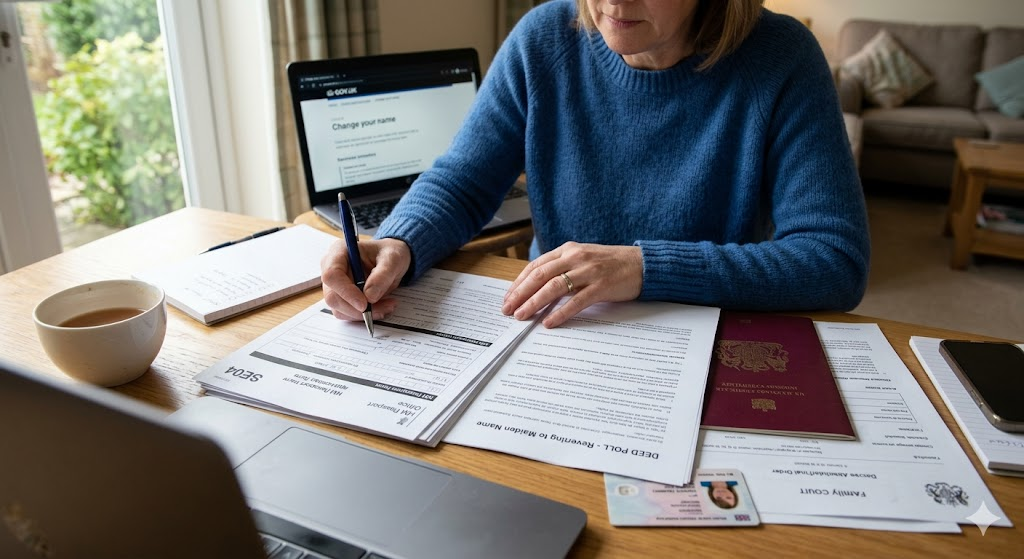
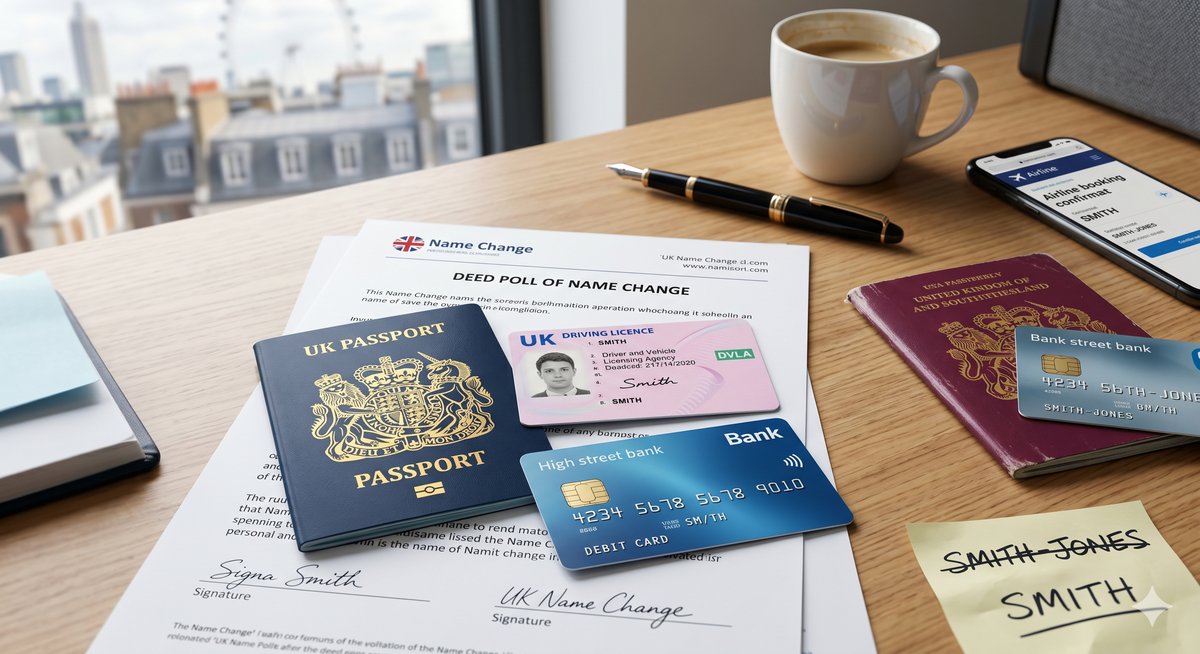
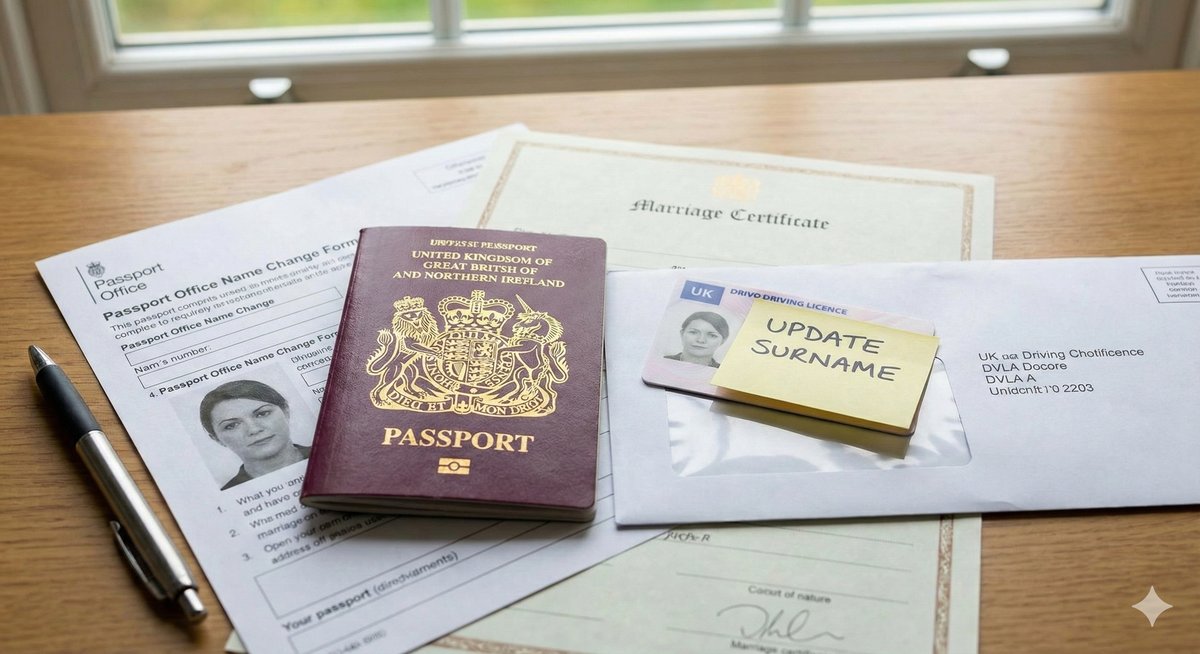
The core difference is simple: a hyphenated surname joins two existing surnames with a hyphen (Smith + Jones → Smith-Jones), while a merged or “meshed” surname blends parts of both into a single brand-new word (Smith + Mason → Smason). Both are completely legal in the UK, but they are created differently: a hyphenated name can sometimes ride on a marriage certificate, whereas a merged name is an invented surname that exists nowhere on official record - so it must be created by deed poll. This guide explains exactly how each works, how to make one, and the real-world trade-offs of each.
Hyphenated vs merged surnames: the precise difference
People often lump these two together as “modern” surnames, but they are mechanically different things.
- Hyphenated (double-barrelled with a hyphen): Both original surnames survive intact, glued together with a hyphen. Charlotte Smith and David Jones become Smith-Jones. Both names remain readable and traceable.
- Merged (meshed/blended): Letters or syllables from each surname are fused to create a single, previously non-existent word. Smith and Mason might become Smason; Pugh and Griffiths might become Puffiths. The result is one new surname, not a pair.
The distinction matters because it changes how you create the name, how easy it is for officials to verify, and how it behaves for the next generation. This page focuses specifically on the hyphenated-versus-merged choice. If you want the broader case for and against double-barrelling generally, see our guide to the pros, cons and legality of double-barrelled surnames. If you are thinking of inventing a fresh shared family name from scratch, read creating a new surname after marriage.
Are both legal in the UK?
Yes - in UK law you can call yourself by any name you choose, provided it is not for fraud or to deceive. There is no official list of “approved” surnames. A hyphenated name and an invented merged name are equally lawful. The practical question is never legality; it is proof. To get a passport, driving licence or bank account in your new name, you need a document that organisations recognise, and that is where the two routes diverge.
Proving a hyphenated name
If you are marrying or in a civil partnership, some couples adopt a hyphenated surname and many institutions will accept the marriage certificate as evidence - particularly when one partner is simply taking the other’s name. However, the moment you combine both partners’ surnames (so two people become Smith-Jones), acceptance gets patchy. A marriage certificate shows two separate surnames; it does not say “these two are now one hyphenated name.” That is why many couples choosing a hyphen still use a deed poll to remove any doubt.
Proving a merged name
A merged surname appears on no official record - not your birth certificate, not your marriage certificate, nowhere. There is simply no other way to evidence it. For a meshed name, a deed poll is not optional; it is the only mechanism that creates the legal change and gives you a document to show HM Passport Office, the DVLA, your bank and HMRC.
How to create each surname
Creating a hyphenated surname
You decide the order (Smith-Jones or Jones-Smith - there are no rules), then change your name by deed poll for guaranteed, friction-free acceptance everywhere. A deed poll states clearly that you have abandoned your former name and adopted the new hyphenated one, signed and witnessed, so no institution has to interpret your marriage certificate.
Creating a merged surname
First, design the word. Try combining the start of one surname with the end of the other, and test several options aloud before committing. Then formalise it with a deed poll. Because the name is invented, the deed poll is the founding document of your new surname - everything else (passport, licence, bank) is updated from it.
For both routes the process is identical and inexpensive. A professionally printed, unenrolled deed poll from UK Name Change starts at £14.49, with same-day dispatch on orders placed before 3pm and free Royal Mail Tracked delivery. An unenrolled deed poll is legally valid and accepted by HM Passport Office, the DVLA, HMRC, banks, the NHS, employers and schools - around 98% of UK name changes are done this way. A solicitor would charge £150-£300+ for the very same document, which is unnecessary.
Hyphenated surnames: pros and cons
Advantages
- Both family identities survive. Nothing is lost; both surnames remain visible and traceable for genealogy.
- Instantly understood. Hyphenated names are common in the UK, so spelling and acceptance are rarely questioned.
- Professional continuity. Colleagues and clients can still find the “old” surname within the new one.
Disadvantages
- Length. Two long surnames can overflow forms, boarding passes and email signatures.
- The next generation. If a Smith-Jones marries a Brown-Patel, what do their children become? Hyphen stacking has a natural ceiling.
- It is not truly “new.” Some couples want a single shared identity, which a hyphen does not deliver.
Merged (meshed) surnames: pros and cons
Advantages
- A single, equal, shared name. Neither partner’s name “wins”; you both adopt the same new word.
- Short and distinctive. A blend is usually shorter than a hyphenated pair and entirely your own.
- Clean for children. Your children inherit one straightforward surname with no hyphen-stacking problem later.
Disadvantages
- It breaks the genealogical trail. An invented name cuts the documentary link to both family lines.
- Constant explaining. Because it is unfamiliar, expect repeated spelling and pronunciation queries.
- Deed poll is mandatory. There is no marriage-certificate shortcut; the name does not exist until you create it.
Which should you choose?
Choose a hyphen if preserving both family histories matters more than having a brand-new identity, or if you value instant recognition on forms and at borders. Choose a merge if you want one short, equal, shared name and you are comfortable being the only people in the world with it. A useful test: write the candidate name out, sign it, and say it aloud on a phone call. If it still feels right after that, it is right for you. Either way, the deed poll route is identical, so the decision is purely personal - not legal or administrative.
Combining surnames after your wedding? Our guide to how to change your surname after marriage explains when your marriage certificate is enough and when you need a deed poll.
Frequently Asked Questions
Is a merged surname actually legal in the UK?
Yes. You may adopt any surname you like, including an invented one, as long as it is not for fraudulent purposes. Because a merged name appears on no existing record, you create and prove it with a deed poll.
Do I need a deed poll for a hyphenated surname?
Not always - some institutions accept a marriage certificate for simple cases. But when you combine both partners’ surnames, acceptance is inconsistent, so a deed poll is the reliable way to guarantee every organisation updates your records without query.
Can both partners change to the same merged surname?
Yes. Each adult completes their own deed poll adopting the identical new surname. Anyone aged 16 or over can sign their own deed poll.
Will a passport office accept a merged or hyphenated name?
Yes. HM Passport Office accepts an unenrolled deed poll for both. Remember they require the original wet-ink signed deed poll, not a photocopy. The current adult passport fee is £102 online or £115.50 by post.
Can our children take the merged surname too?
Yes. A child’s name can be changed by deed poll with the consent of everyone holding parental responsibility. Many couples give children the merged name from birth so there is no hyphen-stacking issue in future.
Is meshing the same as creating a new family surname?
Meshing is one method of creating a new surname - specifically by blending two existing names. You can also invent a completely unrelated new surname; see our guide on creating a new surname after marriage for the full range of options.
Make your new surname official
Whether you settle on a crisp hyphen or a one-of-a-kind merge, a deed poll turns your choice into a document every UK organisation will recognise. Start your adult deed poll from £14.49 with same-day dispatch before 3pm and free tracked delivery - trusted by over 160,000 customers.