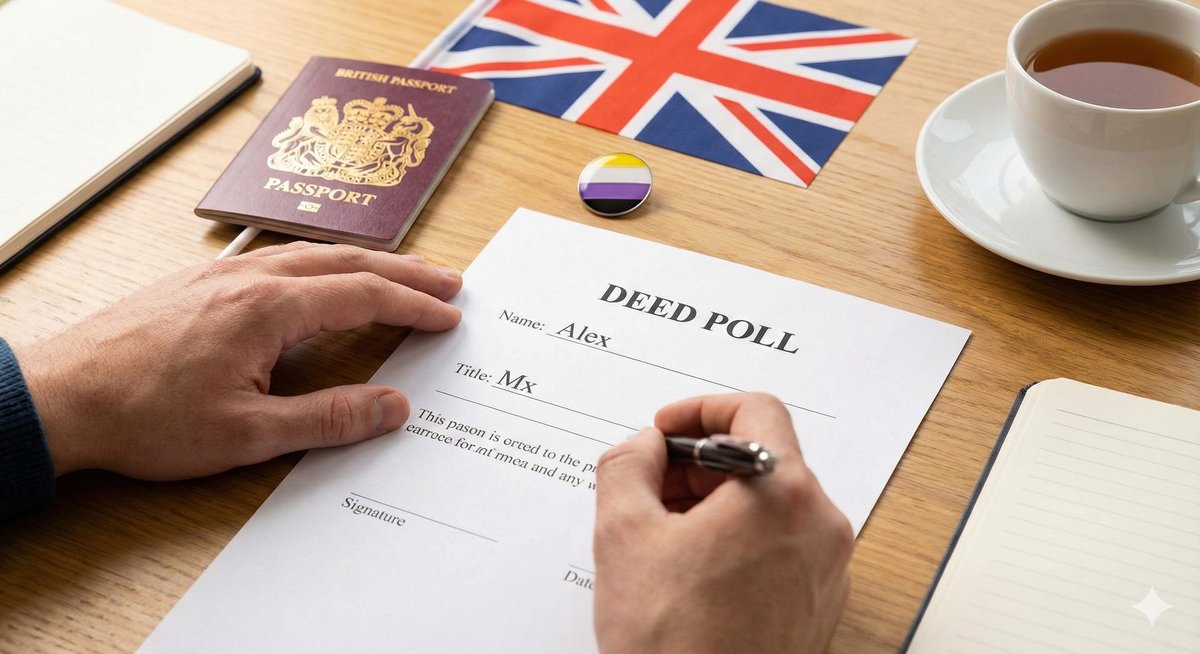
No - you do not always legally have to use a deed poll to change your name in the UK. A deed poll is the standard piece of evidence that proves a name change, but it is not the only one. If you are taking a spouse’s surname on marriage, or reverting to a former name after divorce, your marriage certificate or decree absolute (now called the final order) does the same job. For almost every other change - a new first name, a brand-new surname, a different spelling, or double-barrelling - a deed poll is what banks, HM Passport Office and the DVLA will ask to see.
The confusion comes from the fact that, under UK common law, you can technically adopt any name you like simply by using it. The catch is that “just using it” rarely satisfies the organisations that hold your records. This guide sets out precisely when the law lets you skip the deed poll and when, in practice, you really do need one.
The short version: evidence, not permission
There is no single law in the UK that says you must have a deed poll to change your name. Changing your name is a right, not a privilege you apply for. What every bank, government department and employer actually needs is proof that the change has happened. A deed poll is simply the most widely accepted form of that proof.
So the real question is never “am I allowed to change my name without a deed poll?” - you always are. The useful question is: “which document will the people who hold my records accept as evidence?” For two specific situations, the answer is a certificate you already have. For everything else, the answer is a deed poll.
When you do NOT need a deed poll
There are a small number of life events where the law already produces an official document that proves your name change. In these cases, paying for a deed poll would be unnecessary.
1. Taking a spouse’s surname on marriage or civil partnership
When you marry or enter a civil partnership, your marriage or civil partnership certificate is accepted everywhere as proof that you can take your partner’s surname. You do not need a deed poll to switch from your name to theirs - the certificate is enough for your passport, driving licence, bank and HMRC.
One limit worth knowing: a marriage certificate only covers taking your partner’s existing surname, or double-barrelling the two surnames together in some cases. If you want to invent a completely new shared surname (sometimes called “meshing”), or change a first name at the same time, the certificate no longer covers it - and you are back to needing a deed poll.
2. Reverting to a former name after divorce
If you took your spouse’s surname when you married and you simply want to go back to your maiden or previous name after divorce, you generally do not need a deed poll. Your decree absolute (final order) together with your original marriage certificate, or sometimes your birth certificate, is usually accepted as proof that you are returning to a name you legally held before.
You are reverting to a name, not creating a new one - that is the key distinction. If you want to move to any name you have not held before, a deed poll is required.
3. Changing a title
A title - Mr, Mrs, Ms, Mx or Dr - is not legally part of your name. You can ask your bank, GP or employer to update your title at any time, free of charge, with no deed poll and no paperwork. Switching from Mrs to Ms, or to the gender-neutral Mx, needs nothing more than a request.
For the full breakdown of every situation where no deed poll is required, see our official exemptions list.
When you DEFINITELY need a deed poll
Outside of marriage and divorce, there is no automatic certificate proving your new name. A deed poll fills that gap. You will need one to:
- Change your first or middle name - a marriage certificate never covers forenames.
- Adopt a brand-new surname that you have not legally held before.
- Create a new shared surname on marriage (meshing two surnames into one new word).
- Change the spelling of your name, even slightly.
- Double-barrel two surnames outside of a marriage.
- Change your name to reflect your gender identity as a transgender or non-binary person.
- Change a child’s name (with the consent of everyone holding parental responsibility).
In all of these cases, the deed poll is the document HM Passport Office, the DVLA, HMRC, your bank, the NHS and your employer will expect. An adult deed poll is legally valid the moment it is signed and witnessed - you do not need a solicitor or a court to make it count.
Enrolled vs unenrolled: do you need the “official” version?
A common worry is that the cheap deed poll is somehow not the “real” one. It is. There are two types of deed poll, and the difference has nothing to do with legal validity.
An unenrolled deed poll is the standard document used for roughly 98% of UK name changes. It is legally valid and accepted by HM Passport Office, the DVLA, HMRC, banks, the NHS, employers and schools. An enrolled deed poll is the same document, additionally registered at the Royal Courts of Justice for £53.05; this publishes your new name publicly in the London Gazette and takes 2-3 weeks. Enrolment adds no extra legal validity - it is simply a public record, which most people neither need nor want.
So when you do need a deed poll, the unenrolled version is almost certainly the right one. A professionally printed deed poll from UK Name Change starts at £14.49, with same-day dispatch on orders placed before 3pm and free Royal Mail Tracked delivery - against the £150-£300+ a solicitor would charge for the identical document.
The “name by usage” trap
Because common law lets you adopt a name just by using it, some people assume they can skip the paperwork entirely. In theory, yes. In practice, this fails fast. Your bank will not rename your account on your say-so. HM Passport Office will not issue a passport in a name you cannot evidence. The DVLA needs documentary proof. Without a deed poll, you end up with a name nobody official will recognise - which defeats the point of changing it.
If you are weighing up an informal change against a documented one, our guide to informal vs legal name change in the UK explains exactly where the usage route breaks down.
What about a statutory declaration?
A statutory declaration is occasionally suggested as an alternative to a deed poll. For a straightforward name change it is rarely the right tool - a deed poll is cheaper, more widely recognised and purpose-built for the job. There are a few narrow situations where a statutory declaration is preferred, which we cover in deed poll vs statutory declaration: which one do I need.
When You Don't Need a Deed Poll: The Official Exemptions List
You don’t need a deed poll in four main situations: taking your spouse’s surname on marriage or civil partnership (your certificate is the proof), reverting to your maiden or former name after divorce (the marriage certificate plus decree absolute does the job), changing only your title - Mr, Mrs, Ms, Mx or Dr - and using a name informally without changing it legally. In every other case - choosing a brand-new first name or surname, dropping or adding a middle name, or any change unconnected to marriage - a deed poll is the document that makes it official.
A deed poll is simply the legal evidence that you have abandoned your old name and adopted a new one. Where the law or an existing certificate already provides that evidence, you don’t need to pay for a separate document. Below is the official exemptions list, followed by a quick guide to when you genuinely do need a deed poll.
Informal vs. Legal Name Changes: Pros & Cons (2026 Guide)
In the UK, an informal name change lets people call you by a new name socially, but only a legal name change - evidenced by a deed poll - lets you update your passport, bank account, driving licence and official records. Both rely on the same common-law right to use any name you like, but they buy you very different things in practice. The crucial difference is proof: an informal name has none, while a deed poll is a signed legal document that institutions accept as evidence your name has changed.
An informal name change - often called being “known as” a name - simply means you start using a different name in everyday life. There’s no paperwork, no cost and no central register of names in England and Wales. You ask friends, colleagues and family to call you something new, and they do. That’s it.
Converting a Nickname to a Legal Name: How & Why
If everyone already calls you by a nickname-‘Jamie’ instead of ‘James’, ‘Beth’ instead of ‘Elizabeth’, or simply a name you’ve answered to for years-you can make that nickname your official legal name by signing a deed poll, then using it to update your passport, driving licence, bank and every other record. There’s no court hearing, no solicitor and no waiting list: a professionally printed unenrolled deed poll from UK Name Change costs from £14.49 and is accepted right across the UK.
Plenty of people live a kind of double life on paper. Friends, colleagues and family use one name; your passport, payslip and bank card use another. For a while that’s harmless, but eventually the mismatch bites-a flight booked under your everyday name won’t match your passport, a new employer asks for ID that doesn’t look like ‘you’, or a credit check throws a wobble because your accounts don’t agree on who you are.
Frequently Asked Questions
Can I make my nickname my legal name even if it’s not on my birth certificate?
Yes. Your legal name does not have to appear on your birth certificate, and your birth certificate is not changed by a deed poll-it’s a historical record. The deed poll becomes the legal evidence of your current name, and that’s what organisations rely on going forward.
Do I need to prove people already call me by this nickname?
No. You don’t need to show evidence of past use, witnesses to your nickname, or any reason at all. You simply declare your new name on the deed poll and sign it with two independent witnesses. The fact that everyone already uses it is a nice bonus, not a legal requirement.
How long does the whole process take?
The deed poll itself is fast-order before 3pm and we dispatch the same day with free tracked delivery. Once you’ve signed it, the timeline depends on each organisation: banks and the DVLA are usually quick, while a standard passport takes a few weeks (or days, if you pay for Fast Track or Premium).
Can I keep my surname and only change my first name to my nickname?
Absolutely. A deed poll can change your first name, your surname, or both. If you only want to formalise the nickname version of your first name and keep your existing surname, simply state that on the document.
Is an informal name change legal in the UK?
Yes. Under common law you can call yourself any name you like, provided it’s not for fraudulent purposes. The limitation isn’t legality - it’s that an informal name has no documentary proof, so you can’t use it to update official records like your passport or bank account.
Can I use a “known as” name on my passport?
No. HM Passport Office will only issue a passport in a new name if you provide evidence of the change, such as a deed poll or a marriage certificate. There is no informal way to change the name printed in your passport.
Does a deed poll make my name “more legal” than an informal one?
No - both rely on the same legal right to use any name. A deed poll doesn’t upgrade your right; it simply provides the signed, witnessed proof that institutions need before they’ll update your records.
Do I need a deed poll to change my title to Mr, Mrs, Ms or Mx?
No. A title is not legally part of your name, so you can change it informally without any document. Most organisations will update your title on request.
Do I need a deed poll to take my husband’s or wife’s surname?
No. Your marriage or civil partnership certificate is all the evidence you need. HM Passport Office, the DVLA, your bank, HMRC and the NHS will update your records using that certificate, with no deed poll required.
Can I go back to my maiden name after divorce without a deed poll?
Yes. To revert to your maiden name you can use your original marriage certificate together with your decree absolute (or final order). A deed poll is only needed if you want a completely new surname rather than your birth name.
Do I need a deed poll to change my title to Mx, Ms or Dr?
No. A title is not legally part of your name, so you can change it simply by asking each organisation to update their records. No document is required for a title-only change.
Is it legal to just be ‘known as’ a different name?
Yes, provided you’re not doing it to defraud or deceive. You can use any name informally. However, official records such as passports, driving licences and bank accounts will require documentary proof, and a ‘known as’ name doesn’t provide it - which is when a deed poll is needed.
Is a deed poll a legal requirement to change your name in the UK?
No. There is no law forcing you to use a deed poll. Changing your name is a common-law right. A deed poll is simply the most widely accepted way to prove the change to banks, the passport office and other organisations. For marriage and divorce reversions, a certificate proves it instead.
Can I change my name with just a marriage certificate?
Yes, if you are taking your spouse’s existing surname. A marriage or civil partnership certificate is accepted as proof for your passport, driving licence, bank and HMRC. It does not cover changing a first name, inventing a new surname or altering spellings - those need a deed poll.
Do I need a deed poll to go back to my maiden name after divorce?
Usually not. Your decree absolute (final order) plus your marriage certificate, or your birth certificate, is normally enough to revert to a former name. You only need a deed poll if you want to move to a name you have never legally held.
Does an unenrolled deed poll count as legal?
Yes. An unenrolled deed poll is legally valid the moment it is signed by you and two independent adult witnesses. It is accepted by HM Passport Office, the DVLA, HMRC, banks, the NHS and employers, and is used for around 98% of UK name changes. Enrolment at the Royal Courts of Justice is optional and adds no legal weight.
Do I need a solicitor to get a deed poll?
No. A deed poll does not need a solicitor or a court to be valid. A solicitor would typically charge £150-£300+ for the same document you can get professionally printed for £14.49.
Who can witness my deed poll?
Your witnesses must each be an independent adult aged 18 or over - not a relative, partner or anyone living at your address. HM Passport Office, the DVLA and banks require the original wet-ink signed deed poll, not a photocopy.
Ready to change your name the right way?
If your change falls outside marriage or divorce, a deed poll is the document that works everywhere - and you do not need to pay solicitor prices for it. Order a professionally printed, legally valid adult deed poll from just £14.49, with same-day dispatch before 3pm and free tracked delivery. Trusted by over 160,000 customers, it is accepted by the passport office, the DVLA, HMRC and your bank.