For the overwhelming majority of people, changing your name by deed poll is low-risk, fully reversible in practice and straightforward - but a sensible name change risk assessment means weighing four things before you commit: your paper trail, your professional and credit records, how family and contacts will react, and any personal safety considerations. Work through each one honestly and you can change your name with your eyes wide open, knowing exactly what to expect and how to manage it. This guide is decision-support, not a warning: most readers will finish it reassured.
Why a risk assessment is worth ten minutes
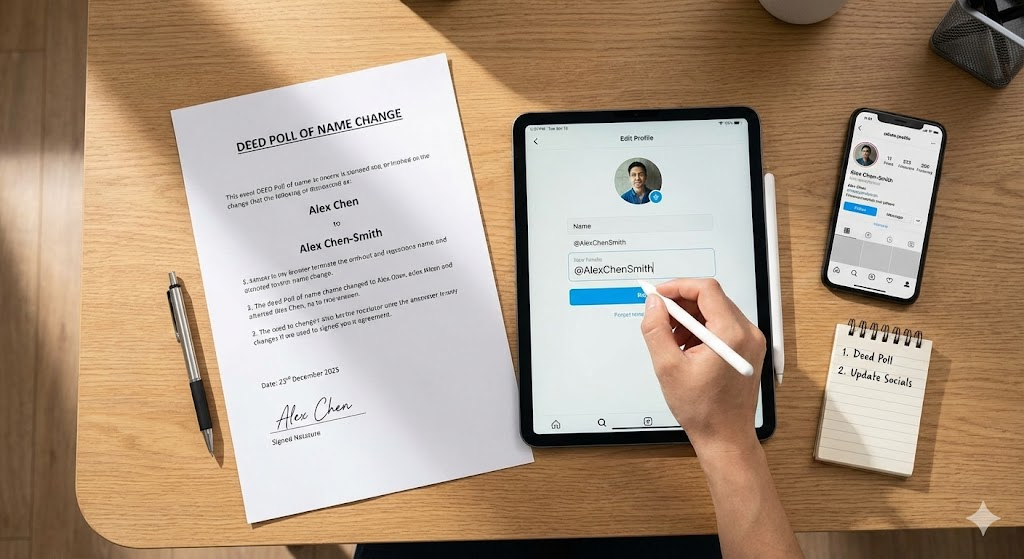
A deed poll itself is simple. An unenrolled deed poll from UK Name Change costs from £14.49, is dispatched the same day if you order before 3pm, and is legally valid the moment you sign it in front of an independent witness. Around 98% of UK name changes are unenrolled, and HM Passport Office, the DVLA, HMRC, banks, the NHS, employers and schools all accept this document. There is no court approval to wait for and no public record unless you choose to enrol.
The complexity, where there is any, lives in the aftermath - the dozens of records that carry your old name and the people who know you by it. None of that is a reason not to proceed. It is simply the part worth planning. The four factors below are the ones that genuinely change how smooth your transition will be.
Factor 1: Your paper trail
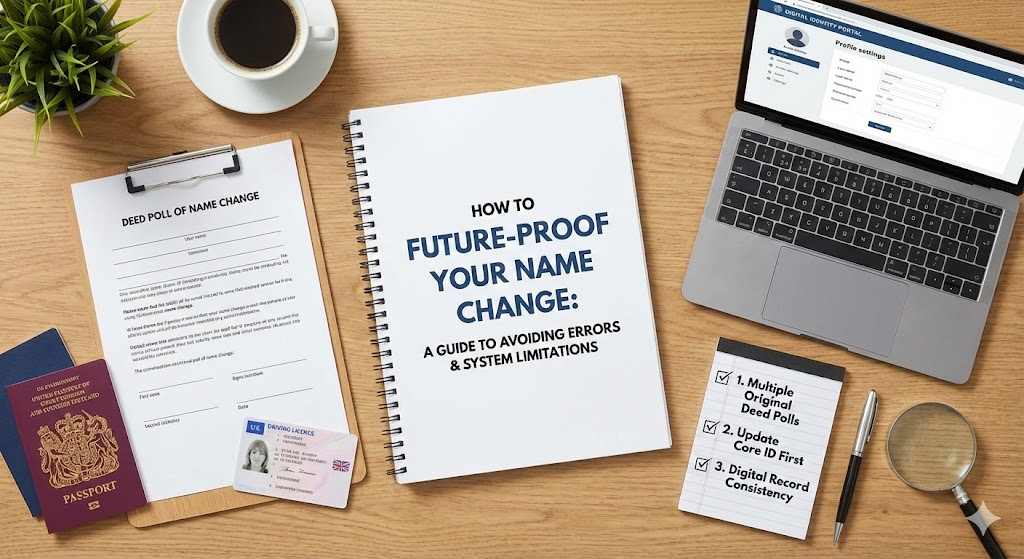
The single most important habit when you change your name is keeping an unbroken evidence chain that links the old you to the new you. Your deed poll is the bridge, so guard the original. HM Passport Office, the DVLA and banks all require the original wet-ink signed deed poll, not a photocopy, so never send your only copy to anyone you cannot get it back from.
Make a simple checklist of every organisation that holds your name - passport, driving licence, bank and building society accounts, HMRC, your GP and the NHS, your employer or pension provider, the electoral roll, utilities, insurers, subscriptions and loyalty schemes. Then update them in a deliberate order. Most updates are free: the DVLA charges nothing to update your driving licence, and banks, HMRC, the NHS, employers and utilities update your name at no cost. The main paid step is a passport (£102 online or £115.50 by post, with Fast Track at £192 and Premium at £239.50 if you are in a hurry).
The risk to manage here is a gap - a record left in your old name long after the others have changed, which can trip up identity checks years later. The mitigation is boring but effective: keep your deed poll safe, photograph it, log the date you updated each organisation, and don't leave dormant accounts unchanged.
Factor 2: Professional and credit records
This is the factor most people underestimate. Your name appears across professional and financial systems that talk to each other, and a sudden change can briefly look like a mismatch.
Your credit file
Lenders and credit reference agencies link your history to your name and address. When you change your name, notify your bank, card providers and the credit reference agencies promptly and supply your deed poll so your existing history transfers to the new name rather than splitting into a thin, brand-new file. If you are mid-application for a mortgage, loan or tenancy, finish that process first - changing your name halfway through can flag anti-fraud checks and delay or void an offer. There is no harm in waiting a few weeks for the right moment.
Qualifications, licences and background checks
Degrees, professional registrations (think nursing, teaching, financial services), DBS checks and references are all tied to a name. After a change you may need to show your deed poll to your professional body, your university or a prospective employer so the dots join up. Declare former names where a form asks for them - on a DBS check, for example - rather than hoping the omission goes unnoticed. Done properly, this is administrative, not a barrier. The mitigation is to update regulated bodies early and keep your deed poll handy for any future check that reaches back into your history.
Factor 3: Family, contacts and the social side
The practical records are only half the picture. A name carries meaning, and the people around you have their own relationship with yours.
Reactions vary. Some changes - taking a partner's surname, double-barrelling after marriage, anglicising a name, or moving to a chosen name - are warmly received. Others may surprise relatives, especially where a family or cultural name is involved. None of this affects your legal right to change your name: anyone aged 16 or over can change their own name and sign their own deed poll. But it is worth thinking through how and when you tell people, and being ready for questions. A short, calm explanation usually defuses most concern.
One small but useful point: a title (Mr, Mrs, Ms, Mx or Dr) is not legally part of your name, so you don't need a deed poll merely to change a title. If your only goal is to drop or change a title, you can often do it by simply telling organisations.
Factor 4: Personal safety considerations
For most people this factor is not relevant - but for some it is the most important of all, and it deserves careful thought. If you are changing your name partly to distance yourself from an abusive ex-partner, a stalker, or anyone you have genuine reason to fear, the way you change it matters.
The key decision is enrolment. Enrolling your deed poll at the Royal Courts of Justice (£53.05, taking 2-3 weeks) publishes your old and new names publicly in The London Gazette. Enrolment adds no legal validity whatsoever - an unenrolled deed poll is just as valid - so for anyone with safety concerns, enrolment is usually exactly the wrong choice because it creates a searchable public link between your identities. An unenrolled deed poll keeps your change private.
If safety is a driver for your change, plan the wider picture too: who you tell, how you handle the electoral roll (you can register anonymously in certain circumstances), and how you sequence updates so your new name does not leak back to the person you are moving away from. We cover this in depth in our guide to protecting your identity after a name change, which is essential reading if this factor applies to you.
When to pause - and when to just proceed
Pause and plan the timing if you are mid-mortgage, mid-visa, mid-application or holding travel booked in your current name. A handful of genuinely unusual situations - dual nationality, certain visas, criminal-justice obligations - carry specific rules; we set these out in our guide to the rare legal complications of changing your name so you can check whether any apply to you. For everyone else - the vast majority - there is nothing to wait for. A deed poll is cheaper and faster than the £150-£300+ a solicitor would charge for the identical document, and you stay in control of every step.
Frequently Asked Questions
Is changing my name by deed poll risky?
For most people, no. The document itself is low-risk, legally valid the moment you sign it, and accepted across UK officialdom. The only real work is updating your records carefully and managing the personal side - both entirely manageable with a little planning.
Will changing my name damage my credit score?
Not if you do it properly. Tell your bank, card providers and the credit reference agencies and supply your deed poll so your existing history transfers to your new name. Avoid changing your name in the middle of a mortgage or loan application, as that can trigger fraud checks - finish the application first.
Do I need to tell the authorities I have changed my name?
You update each organisation that holds your details - passport, DVLA, HMRC, your bank, the NHS and so on - rather than registering centrally. Specific obligations apply in narrow cases (for example certain criminal-justice situations); see our guide to rare legal complications to check whether any affect you.
Should I enrol my deed poll?
Usually not. Enrolment costs £53.05, takes 2-3 weeks and publishes your name change in The London Gazette, yet adds no legal validity. If you have any privacy or safety concerns, an unenrolled deed poll is the better choice because it keeps your change private.
Can family stop me from changing my name?
No. Anyone aged 16 or over can change their own name without anyone else's permission. Family approval is a social consideration, not a legal one. (Under-16s do need the consent of everyone with parental responsibility.)
Ready to change your name with confidence?
If you have worked through the four factors and you are happy to proceed, there is no reason to wait. Get a professionally printed, legally valid adult deed poll from UK Name Change for just £14.49, with same-day dispatch before 3pm and free Royal Mail Tracked delivery. Join the 160,000+ people we have helped change their names simply, privately and properly.