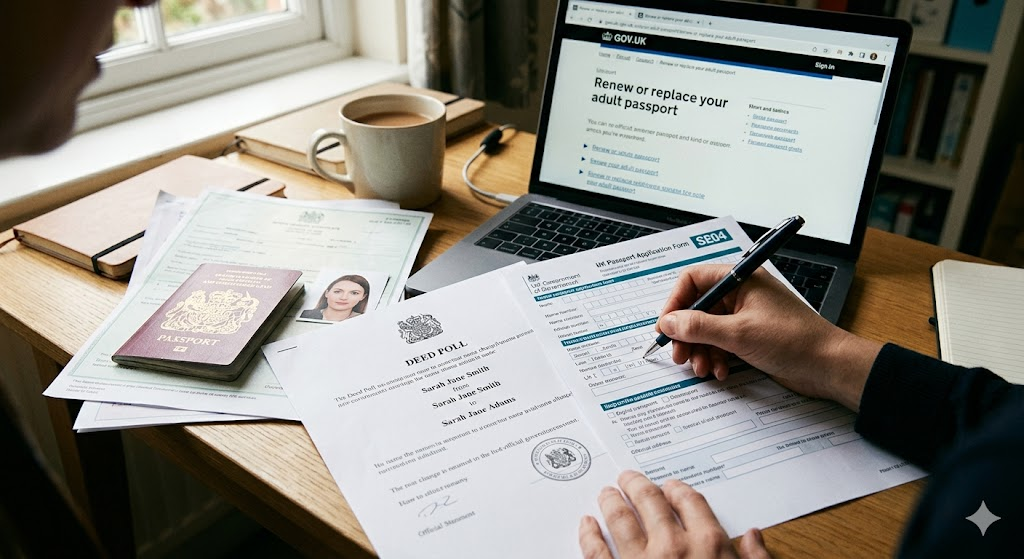
To update your passport, NHS and HMRC records when transitioning, you change your name with a deed poll first, then update your gender marker with each body separately - using a doctor’s letter for your passport, your GP for your NHS records, and HMRC’s specialist team for tax and National Insurance. You do not need a Gender Recognition Certificate (GRC) to change your name, your title, your gender marker on your passport, or your NHS records. An unenrolled deed poll from £14.49 is all the legal name-change evidence these organisations require.
This guide is records-focused and written for trans and non-binary people. It covers exactly what each body needs, how your NHS number and confidentiality are handled, and the order that saves you the most hassle. For the bigger picture, see our companion guides on changing your name and gender marker in the UK and the full process to legally change your name when transitioning.
Step one: get your deed poll (the document everything else relies on)
Almost every record update starts with one piece of paper: a legal deed poll. Anyone aged 16 or over can change their own name and sign their own deed poll. A deed poll changes your name; it does not, by itself, change your gender marker - that is a separate step with each organisation, covered below.
You do not need a solicitor (who would charge £150-£300+ for the same document), and you almost certainly do not need to pay to “enrol” it. Around 98% of UK name changes use an unenrolled deed poll, which is legally valid and accepted by HM Passport Office, the NHS, HMRC, DVLA, banks and employers alike. Enrolment at the Royal Courts of Justice (£53.05) is optional, takes 2-3 weeks, adds no legal validity, and publishes your former and new name publicly in the London Gazette - something many trans people understandably prefer to avoid.
A few practical points before you order:
- Use the original, wet-ink document. HM Passport Office, HMRC and banks need the original signed deed poll, not a photocopy. Order more than one original if you have many records to update at once.
- Choose your witnesses carefully. Your witnesses must each be an independent adult aged 18 or over - not a relative, partner or anyone living at your address.
- Your title is not your name. A title (Mr, Mrs, Ms, Mx, Dr) is not legally part of your name, so no deed poll is needed to change it - just ask each organisation to update it.
You can order a professionally printed deed poll from UK Name Change from £14.49, with same-day dispatch if you order before 3pm and free Royal Mail Tracked delivery.
Updating your passport (HM Passport Office)
Changing your name only
To change the name on your passport, send your completed application with your original deed poll. HM Passport Office will issue a new passport in your chosen name. The standard adult passport fee is £102 online or £115.50 by post; if you need it quickly, the 1-week Fast Track service is £192 and the 1-day Premium service is £239.50.
Changing your gender marker
HM Passport Office can issue a passport showing the gender (and corresponding title) you live in - and you do not need a Gender Recognition Certificate to do this. Alongside your deed poll, you will need a letter from your doctor or medical consultant confirming that your change of gender is likely to be permanent. With that, your passport can be reissued in your affirmed name and gender, usually at the same time as the name change.
Currently UK passports are issued with either an “M” or “F” marker; there is no “X” option, which is a known limitation for many non-binary travellers.
Updating your NHS records (and your NHS number)
Name and title
Updating your name and title with the NHS is free and straightforward. Take your deed poll to your GP surgery and ask them to update your name, title and how you are addressed across your record. This flows through to letters, prescriptions and appointment systems.
Gender marker and your NHS number
Changing your gender marker on your NHS record is a bigger process, handled through your GP and Primary Care Support England (PCSE). When your gender marker is changed, the NHS issues you a brand-new NHS number. A fresh medical record is created under your new details and your previous record is sealed, then its relevant clinical history is transferred across. This is done to protect your confidentiality - but it has practical consequences worth understanding before you proceed.
The most important is screening. NHS screening invitations are sent based on the gender marker held on your record, not on your anatomy:
- Trans men and non-binary people registered as male will not automatically be invited for cervical screening, even if they have a cervix. You can ask your GP to arrange screening manually.
- Trans women registered as female may not be automatically invited for prostate or abdominal aortic aneurysm checks where relevant; again, your GP can flag this.
None of this should put you off - it simply means having an open conversation with your GP so that the right screening is booked in by hand. Because a new NHS number can briefly affect linked services (such as prescriptions or hospital referrals in progress), many people time the gender-marker change for a quieter period in their care.
Updating HMRC (tax, National Insurance and your records)
Your name
Updating your name with HMRC is free. You can tell HMRC online, by phone or by post, providing your deed poll where asked. This keeps your PAYE, Self Assessment and National Insurance records correct and your payslips in your real name.
Gender on your HMRC record
HMRC links your gender to the sex recorded at birth unless you hold a Gender Recognition Certificate. Without a GRC, HMRC will keep its underlying record aligned to your birth-registered sex for National Insurance and pension purposes, while still using your correct name and title in all correspondence.
HMRC has a dedicated, confidential team for trans and non-binary taxpayers, based at Benton Park View in Newcastle upon Tyne. Contacting this specialist team lets you update your details discreetly and flag that you do not wish your former name or gender history disclosed in routine correspondence. Your information is handled under HMRC’s confidentiality rules, and a marker can be set so that frontline staff handle your account sensitively.
Records update order: a quick checklist
- Order your deed poll (ideally two originals) - from £14.49.
- Passport: update name and, if you wish, gender marker (deed poll + doctor’s letter). £102 online.
- NHS: update name and title at your GP (free); discuss the gender-marker change and screening.
- HMRC: update your name (free) and contact the specialist Newcastle team about your gender record.
- Then everything else: DVLA (free), bank, employer and utilities (all free) - keep your original deed poll handy as several need to sight it.
Frequently Asked Questions
Do I need a Gender Recognition Certificate to change my passport or NHS records?
No. You can change your name and gender marker on your passport (with a doctor’s letter) and update your NHS record without a GRC. A GRC mainly affects legal sex for marriage, pensions and your HMRC record - it is not required for the everyday updates covered here.
Will changing my NHS gender marker affect my medical care?
It can affect automated screening invitations, because these are triggered by the gender marker on your record rather than your anatomy. Speak to your GP so any cervical, breast, prostate or other screening you need is booked manually. Your clinical history is transferred to your new record.
Is an unenrolled deed poll accepted by the passport office, NHS and HMRC?
Yes. An unenrolled deed poll is legally valid and accepted by HM Passport Office, the NHS, HMRC, DVLA, banks and employers. Around 98% of UK name changes are unenrolled. You only need to send the original wet-ink document, not a photocopy.
Do I need a deed poll just to change my title to Mx?
No. A title such as Mr, Mrs, Ms, Mx or Dr is not legally part of your name, so no deed poll is required to change it. Simply ask each organisation to update your title on its records.
Can I keep my former name and gender history confidential?
Yes. The NHS seals your previous record when your gender marker changes, and HMRC’s specialist team in Newcastle can mark your account so your former name and gender history are not disclosed in routine correspondence. Using an unenrolled deed poll also keeps your change off the public London Gazette.
Can I update everything at 16, or do I need to be 18?
Anyone aged 16 or over can change their own name and sign their own deed poll, then use it to update these records. Under-16s need the consent of everyone with parental responsibility.
Update your records in your real name today
Every record above starts with one valid document. Order a professionally printed, legally valid adult deed poll from UK Name Change for just £14.49 - trusted by over 160,000 customers, with same-day dispatch before 3pm and free tracked delivery. Then walk through the wider process in our guides to changing your name and gender marker and how to legally change your name when transitioning.